Shift Signals Growing Investor Demand for Safe-Haven Assets Amid Market Uncertainty
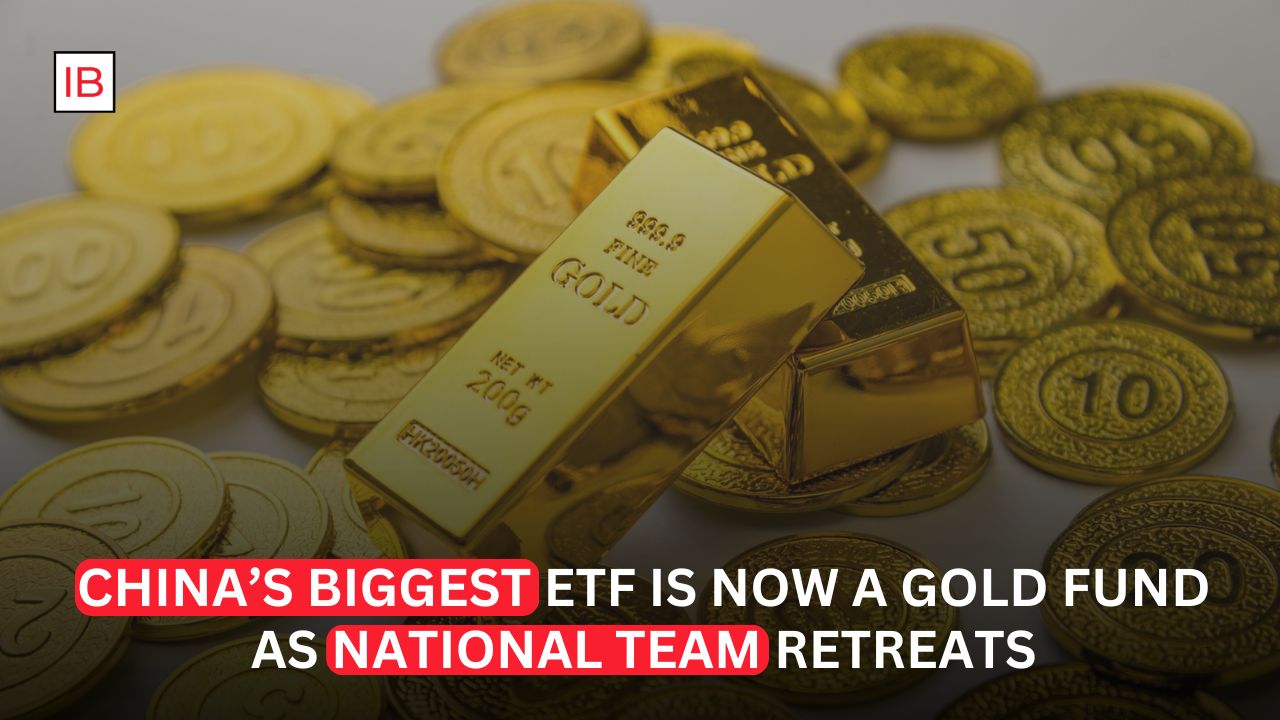
China’s investment landscape has reached a symbolic turning point after the country’s largest exchange-traded fund (ETF) became a gold ETF, replacing the once-dominant CSI 300 equity ETF that had been heavily supported by state-backed investors.
The development reflects changing investor sentiment as demand shifts toward defensive assets while China’s so-called “national team” gradually reduces its direct support for the domestic stock market.
Gold ETF Takes the Top Spot
The Huaan Yifu Gold ETF has become China’s largest ETF by market capitalization, reaching approximately 90 billion yuan and overtaking the Huatai-PineBridge CSI 300 ETF, which now holds about 83 billion yuan in assets.
The milestone marks a significant change from previous years, when broad equity funds dominated the Chinese ETF market thanks to substantial government-backed buying.
National Team Steps Back
China’s “national team”—a group of state-backed institutions led by Central Huijin Investment, a subsidiary of China’s sovereign wealth fund—played a major role in supporting domestic equities beginning in 2024.
At its peak, the Huatai-PineBridge CSI 300 ETF grew to roughly 440 billion yuan after receiving massive state-backed inflows aimed at stabilizing China’s stock market.
This year, however, those institutions have gradually reduced their holdings, signaling that authorities are becoming more comfortable allowing market forces to play a larger role.
Investors Move Toward Defensive Assets
The reshuffling of China’s largest ETFs highlights growing demand for safer investment options.
Beyond gold, investors have also poured money into:
- Short-term bond ETFs
- Money market ETFs
- Cash-management products
- Other lower-risk investment vehicles
The trend reflects continued caution despite gains in parts of China’s equity market.
Stock Rally Has Been Narrow
Although Chinese equities have posted gains this year, the recovery has been uneven.
Technology and AI-related semiconductor companies have driven much of the market’s advance, while many traditional sectors continue to struggle amid:
- Slower economic growth
- Weak consumer demand
- Property market challenges
- Ongoing uncertainty over corporate earnings
As a result, many investors have preferred gold and fixed-income products over broader equity exposure.
Gold Remains a Popular Hedge
The popularity of gold ETFs reflects continued demand for assets viewed as protection against uncertainty.
Although gold prices have pulled back from earlier highs this year, a modest rebound over recent trading sessions helped lift the Huaan Yifu Gold ETF above the CSI 300 ETF.
Analysts say investors continue to view gold as an attractive hedge against geopolitical tensions, inflation risks, and financial market volatility.
Changing Investment Landscape
The shift also illustrates how China’s ETF market has evolved.
Instead of broad stock index funds dominating investor flows, defensive products now occupy many of the largest positions in the ETF rankings, reflecting a more cautious approach among both institutional and retail investors.
Market participants say future leadership will likely depend on improvements in China’s economic outlook and corporate earnings.
Looking Ahead
The rise of China’s largest gold ETF represents more than a change in rankings—it signals a broader shift in investor behavior as government support for equities gradually recedes.
While China’s stock market continues to benefit from advances in selected technology sectors, investors are increasingly favoring gold and other defensive assets until there is greater confidence in the country’s economic recovery. Whether equities reclaim their dominant position will depend on stronger growth, improved corporate performance, and sustained market confidence in the months ahead.