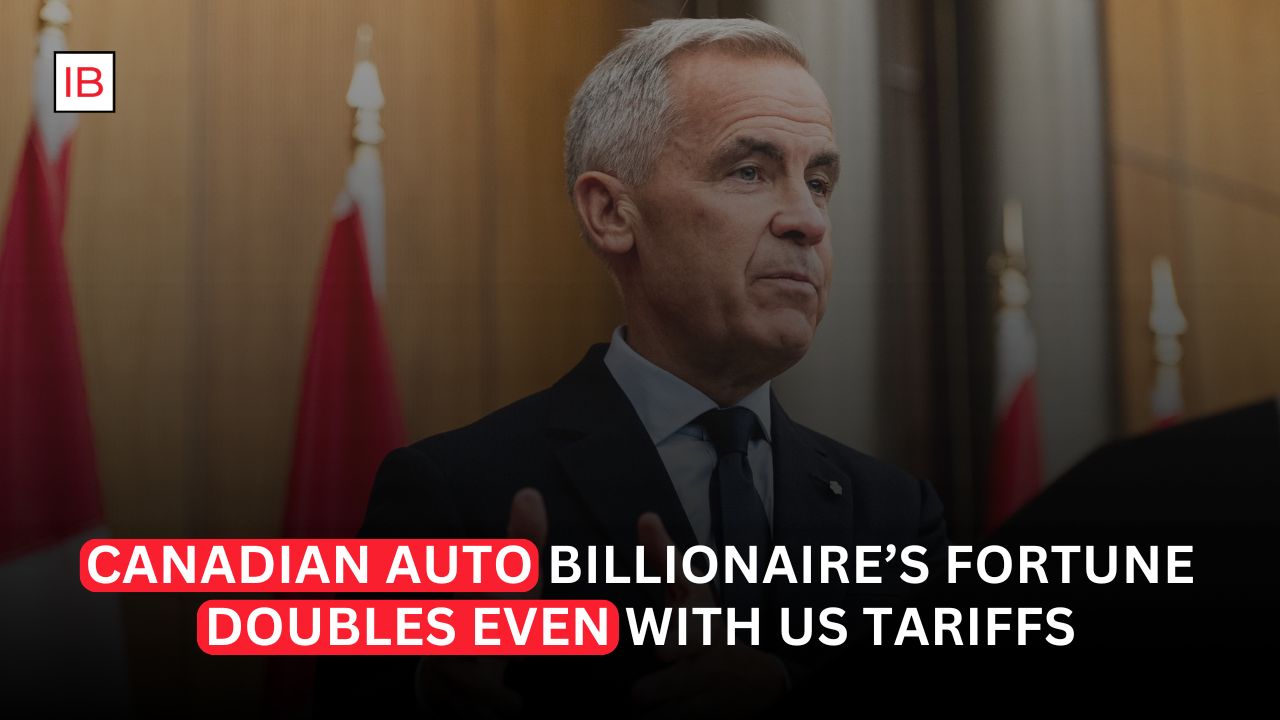
Linda Hasenfratz’s fortune has roughly doubled since the initial shock from US tariffs on Canada’s auto industry, highlighting an important reality of the trade war: tariffs can hurt an industry without necessarily destroying the wealth of its most successful owners.
When President Donald Trump first targeted Canadian autos with tariffs, Hasenfratz briefly lost her billionaire status. Since then, however, shares of Linamar Corp., the auto-parts manufacturer she leads, have recovered strongly, pushing her wealth back above the billion-dollar mark and roughly doubling her fortune from its low point.
The story is therefore less about one billionaire getting richer and more about how companies are adapting to a dramatically changed North American auto industry.
Tariffs Were Supposed to Be a Major Threat
The US tariffs created an obvious risk for Canadian automotive suppliers.
Canada’s auto industry is deeply integrated with the US manufacturing system. Parts can cross the border multiple times before a finished vehicle reaches consumers.
That means tariffs can increase costs throughout the supply chain.
For a company like Linamar, the threat was particularly significant because its operations are tied closely to global automakers and North American vehicle production.
The original market reaction reflected those concerns.
But the expected damage has not translated into a permanent collapse in the company’s value.
Linamar Has More Than One Source of Revenue
One reason Hasenfratz’s fortune recovered is that Linamar isn’t simply a Canadian auto-parts supplier.
The company operates across multiple industrial businesses, including automotive manufacturing and agricultural equipment.
That diversification matters.
When one part of the economy suffers, another can provide support.
The agricultural-equipment business gives Linamar exposure to a different cycle from passenger vehicles, while its international operations provide another layer of diversification.
That makes the company less vulnerable than a manufacturer whose entire business depends on one country and one customer group.
The Auto Industry Is Adapting
Tariffs don’t necessarily eliminate trade.
They change the economics of trade.
Automakers and suppliers respond by adjusting sourcing, production locations, pricing and supply chains.
Some costs are absorbed by manufacturers.
Some are passed to consumers.
Some are shifted to suppliers.
And some companies attempt to restructure their operations to reduce tariff exposure.
That process can be painful, but it also means the initial assumption that tariffs will simply destroy corporate profitability can be too simplistic.
The North American auto industry is large enough and interconnected enough that companies have strong incentives to find ways around the disruption.
Investors Look Beyond the Tariff Headline
The recovery in Linamar’s valuation also shows how financial markets assess companies differently from political headlines.
A tariff can be negative for an industry while a particular company can still perform well.
Investors ask different questions:
- How much revenue is actually exposed?
- Can the company raise prices?
- Can production be shifted?
- How diversified is the business?
- How strong is the balance sheet?
- What happens to competitors?
- Is the market already pricing in the worst-case scenario?
If investors conclude that the initial tariff shock was overstated, a stock can recover even while the underlying industry remains under pressure.
Canada’s Auto Sector Still Faces Real Risks
The headline about Hasenfratz’s wealth should not be interpreted as evidence that tariffs don’t matter.
They do.
Canada’s auto industry remains highly exposed to US trade policy, and the current dispute is becoming even more uncertain.
The Trump administration is preparing a new 50% tariff on many Canadian goods, scheduled to take effect Aug. 19, although several categories—including energy, potash, fish and critical minerals—are excluded.
The auto sector is already subject to separate tariff measures, making the overall trade environment particularly complicated.
That uncertainty can discourage investment even when companies remain profitable.
The Bigger Threat Is Uncertainty
For businesses, tariffs aren’t only about the percentage charged at the border.
The bigger problem can be uncertainty.
A company considering a new factory may hesitate if it doesn’t know what its products will face when they cross the US-Canada border five or ten years from now.
That affects capital expenditure.
It affects hiring.
It affects supply-chain decisions.
And it can encourage companies to build redundant production capacity in multiple countries.
Those costs ultimately have to be paid by somebody.
Hasenfratz’s Wealth Is Also a Lesson in Concentrated Ownership
There is another important part of the story.
Hasenfratz’s fortune is closely tied to her ownership stake in Linamar.
That means changes in the company’s share price can have an enormous effect on her personal net worth.
When the stock falls sharply, her wealth can drop by hundreds of millions of dollars on paper.
When the shares recover, the reverse happens.
That doesn’t mean she received that money in cash.
Much of the change represents the market value of her equity holdings.
So saying her fortune “doubled” is primarily a statement about the value investors place on the company—not necessarily about how much money she has withdrawn from the business.
Why the Story Matters for Investors
The episode illustrates why investors shouldn’t evaluate tariff exposure by looking only at headline export numbers.
A company can have substantial exposure to a tariffed industry while still having characteristics that protect shareholders.
Diversification can reduce dependence on one market.
Pricing power can help offset higher costs.
Vertical integration can provide more control over production.
International operations can reduce geographic concentration.
Strong management can help companies adapt faster than competitors.
Those factors can matter more over time than the initial tariff shock.
North American Manufacturing Is Being Repriced
The deeper story is that US-Canada trade is being reorganized.
For decades, automakers treated North America as a highly integrated manufacturing zone.
Parts, components and finished vehicles moved across borders with relatively little friction.
Tariffs challenge that model.
Companies now have to consider not just production efficiency but geopolitical risk.
That could make some North American manufacturing more expensive—but potentially more resilient.
It may also push companies to source more components domestically or diversify production into Mexico and other markets.
The Political Message Is More Complicated
The tariff strategy was designed partly to encourage more manufacturing inside the United States.
But the Canadian auto industry is not an isolated foreign competitor.
US automakers depend heavily on Canadian suppliers and integrated production networks.
That means tariffs can impose costs on both sides of the border.
The result is a complicated political trade-off:
Protect domestic production, but risk making the entire regional supply chain more expensive.
That tension will remain central to the North American auto industry.
The Bottom Line
Linda Hasenfratz’s recovery from the tariff-driven drop in wealth demonstrates that tariffs can create serious industry-level disruption without permanently destroying the value of a well-diversified company.
Linamar has benefited from its broader industrial footprint, while investors appear to have reassessed the company’s ability to navigate the changing trade environment.
But the risks have not disappeared.
With US-Canada trade negotiations still unsettled and additional tariffs looming, Canadian manufacturers continue to face a difficult operating environment.
The bigger lesson is that the winners and losers from the trade war will not be determined simply by nationality.
They will be determined by who has the flexibility, diversification and financial strength to adapt when the rules of North American trade keep changing.