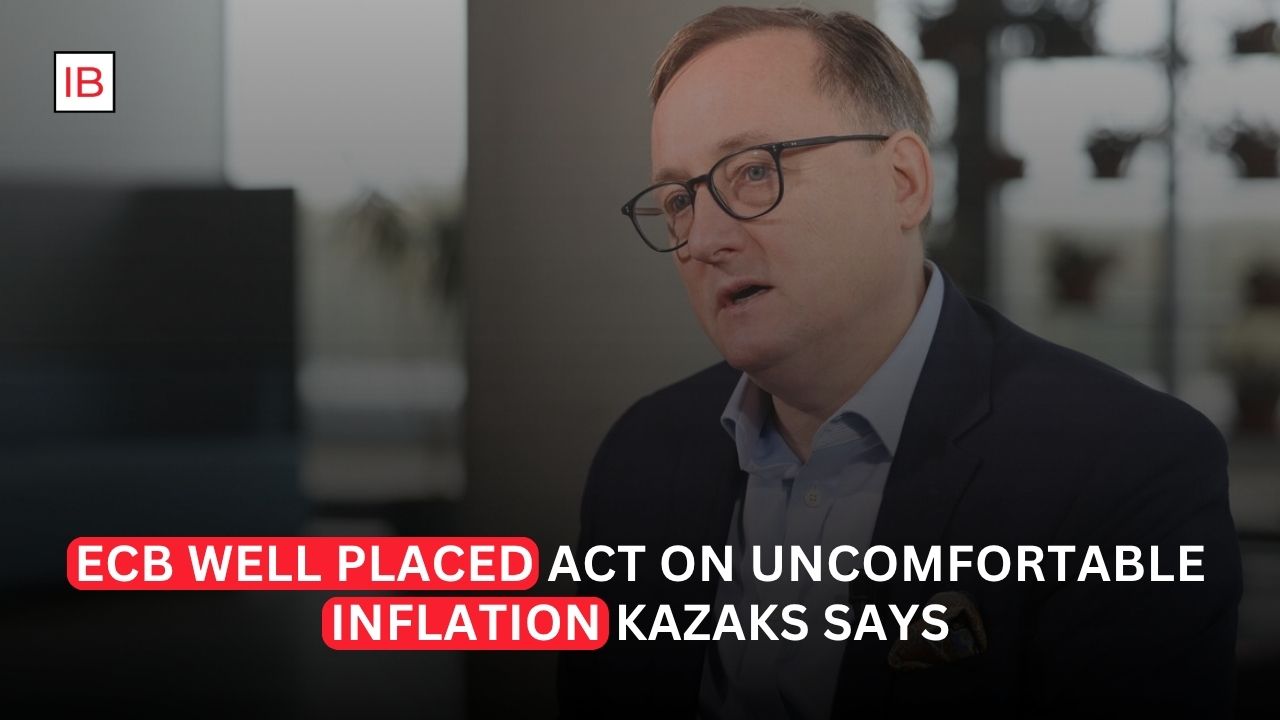
The European Central Bank is in a position to respond if inflation pressures become more persistent, according to ECB Governing Council member Martins Kazaks, highlighting the difficult policy balance facing the central bank as energy costs and geopolitical uncertainty continue to complicate the euro-area outlook.
Kazaks, who is also governor of Latvia’s central bank, has repeatedly argued that policymakers should remain cautious rather than assume that recent inflation pressures will disappear automatically. His latest comments reinforce the idea that the ECB wants to preserve flexibility as it assesses whether higher prices are temporary or beginning to spread more broadly through the economy.
The ECB’s latest projections already point to an uncomfortable year for inflation. The central bank expects euro-area headline inflation to average around 3% in 2026 before declining toward 2.3% in 2027 and 2% in 2028.
That trajectory puts policymakers in a difficult position: inflation is above target, but the economy also faces significant risks from expensive energy and weaker growth.
Inflation Has Become a More Difficult Problem
The ECB’s primary objective is to maintain price stability, with a medium-term inflation target of 2%.
The current environment is challenging because the latest inflation pressures are not coming exclusively from excessive consumer demand.
Energy prices have become an important source of upward pressure following geopolitical disruption and uncertainty around energy supplies.
That creates a problem for central bankers.
Higher energy prices can:
- Increase household energy bills
- Raise transportation costs
- Increase manufacturing expenses
- Push up food prices
- Reduce consumer purchasing power
- Increase business operating costs
At the same time, expensive energy can weaken economic activity.
Consumers have less money available for discretionary spending, while companies may delay investment because operating costs are rising.
That means the ECB risks facing inflation and weak growth simultaneously.
Kazaks Wants the ECB to Remain Flexible
Kazaks has previously emphasized that policymakers should not become complacent about inflation.
In January, he said the ECB had to remain alert because inflation and growth risks were moving in both directions.
That approach is particularly relevant now.
If inflation begins spreading from energy into services, wages and other categories, the ECB may need to respond more aggressively.
But if higher energy prices primarily create a temporary increase in headline inflation while weakening economic activity, raising interest rates could make the situation worse.
The central bank therefore needs to distinguish between temporary price shocks and persistent inflation.
The ECB Has Already Taken Action
The ECB is not starting from a completely neutral position.
It has already responded to the inflationary environment by raising borrowing costs this year.
That decision was controversial because parts of the euro-area economy were already under pressure from higher energy costs.
Critics argued that monetary tightening could weaken demand without solving the underlying supply-side problem.
But policymakers have another concern.
If businesses and workers begin expecting inflation to remain high, temporary energy shocks can become embedded in broader price-setting behavior.
That is the so-called second-round effect.
The Danger of Second-Round Inflation
Second-round effects are one of the biggest concerns for the ECB.
Imagine energy prices rise sharply.
Businesses initially face higher costs.
They then raise prices to protect profit margins.
Workers respond by demanding higher wages because their purchasing power has fallen.
Companies subsequently increase prices again to compensate for higher labor costs.
The process can create a cycle.
The potential chain is:
Higher energy prices
→ higher business costs
→ higher consumer prices
→ stronger wage demands
→ higher service prices
→ persistent inflation.
The ECB wants to prevent that cycle from becoming entrenched.
Kazaks has previously said the central bank had not yet seen major second-round inflation effects from the energy shock, but he also warned that risks remained.
Services Inflation Is Especially Important
Energy prices can move sharply and then reverse.
Services inflation is different.
Prices for restaurants, hotels, healthcare, transportation and other services tend to be more closely connected to wages and domestic demand.
If services inflation remains elevated, policymakers may become more concerned that inflation is becoming structurally persistent.
That is why the ECB pays close attention to measures that exclude volatile energy and food prices.
The central bank’s June projections put inflation excluding energy and food at an average of 2.5% in both 2026 and 2027, before easing to 2.2% in 2028.
Those numbers suggest the underlying inflation problem is expected to be more persistent than the headline rate alone might indicate.
The ECB Faces a Growth Problem Too
The biggest complication is that interest-rate increases cannot produce more oil, gas or other commodities.
If inflation is being driven by supply disruptions, higher rates have limited power to directly fix the original problem.
Instead, rate increases work mainly by weakening demand.
That creates a painful trade-off.
If the ECB raises rates to suppress inflation, it could also reduce:
- Business investment
- Housing activity
- Consumer spending
- Credit demand
- Employment
- Economic growth
The central bank therefore has to determine how much inflation can be tolerated temporarily without allowing expectations to become unanchored.
Energy Prices Are the Key Variable
The future path of European inflation will depend heavily on energy markets.
The Middle East conflict and disruption around major energy routes have already created concerns about higher oil and gas prices.
Earlier in the year, Reuters reported that higher oil prices could quickly feed into European inflation because fuel costs are passed through to consumers relatively rapidly.
The effect becomes more serious if elevated energy prices remain in place for an extended period.
A temporary spike may eventually disappear from annual inflation comparisons.
A prolonged shock can spread through the wider economy.
That distinction will be crucial for the ECB.
Why Kazaks’ Comments Matter for Markets
Central-bank communication has a major influence on financial markets.
Investors constantly try to predict the next ECB decision.
If policymakers sound more concerned about inflation, markets can price in higher interest rates.
That can push European bond yields higher and potentially strengthen the euro.
If policymakers focus more heavily on weak growth, investors may expect rates to remain unchanged or eventually decline.
That can have the opposite effect.
Kazaks’ comments therefore matter not only because of what he says about inflation, but because they provide clues about how the ECB might react if the data deteriorates.
Markets May Be Underestimating Inflation Risks
One potential concern for investors is complacency.
If markets assume inflation will automatically return to 2%, they could be vulnerable to a surprise.
The ECB’s own projections already show inflation averaging 3% in 2026.
That is significantly above the central bank’s target.
The challenge is that inflation is expected to fall afterward.
If that forecast proves correct, policymakers may be able to avoid aggressive tightening.
But if inflation remains elevated into 2027, the ECB could face pressure to do more.
The Euro Could Become an Important Adjustment Mechanism
Currency movements can also affect inflation.
A stronger euro makes imported goods and commodities cheaper in euro terms.
That can help offset some external price pressures.
A weaker euro does the opposite.
For an economy that imports large quantities of energy and raw materials, the exchange rate can therefore influence inflation significantly.
This means the ECB will also be watching currency markets as it assesses the broader inflation outlook.
The Fed Adds Another Complication
The ECB does not operate in isolation.
US monetary policy can affect European financial conditions and currency markets.
If US interest rates remain high while the ECB cuts rates, the interest-rate gap could encourage capital to move toward dollar assets.
That could weaken the euro.
A weaker euro would make imported commodities more expensive and could add to inflationary pressure.
The ECB therefore has to consider international financial conditions even though its mandate is focused on the euro area.
What Could Force the ECB to Act?
Several developments could push policymakers toward further tightening.
Persistent energy inflation
If oil and gas prices remain elevated for months, inflation could stay above target.
Wage acceleration
Rapid wage growth could increase services inflation.
Rising inflation expectations
If households and businesses begin expecting permanently higher prices, the problem becomes harder to control.
Weakening euro
A weaker currency could increase import costs.
Strong domestic demand
If consumers and businesses continue spending aggressively despite higher prices, inflation could become more persistent.
What Could Keep the ECB on Hold?
The opposite scenario is also possible.
The ECB could remain patient if:
- Energy prices stabilize
- Services inflation continues falling
- Wage growth moderates
- Consumer demand weakens
- Economic growth deteriorates
- Inflation expectations remain anchored
In that situation, additional rate increases could cause unnecessary economic damage.
This explains why policymakers are emphasizing flexibility rather than committing to a predetermined path.
The ECB’s Biggest Challenge Is Timing
The difficult part is not simply deciding whether rates should rise.
It is deciding when to act.
Central-bank policy works with a lag.
If the ECB waits until inflation is obviously entrenched, it may have to raise rates sharply.
If it reacts too early to a temporary energy shock, it could unnecessarily weaken the economy.
That makes the next several inflation reports extremely important.
Policymakers will be looking beyond headline numbers to determine whether inflation is spreading into wages and services.
Investors Should Watch These Indicators
Several economic indicators will help determine the next stage of ECB policy.
Inflation
The headline rate remains important, but underlying inflation may matter more.
Services prices
Persistent services inflation would be a warning sign.
Wage growth
Higher wages could create additional domestic price pressure.
Energy markets
Oil and gas prices remain a major external risk.
Inflation expectations
Stable expectations would give the ECB more room to wait.
Economic growth
Weak growth could limit the willingness to raise rates.
Bond yields
European bond markets will reflect changing expectations about monetary policy.
Conclusion
The ECB’s current position is uncomfortable because inflation remains above target while economic growth faces significant pressure from higher energy costs and geopolitical uncertainty.
Martins Kazaks’ message is essentially that the central bank has the tools and flexibility to respond if inflation becomes more persistent.
That does not necessarily mean another rate increase is imminent.
The more important point is that ECB policymakers do not want markets, businesses or households to assume that elevated inflation will simply be ignored.
The central bank’s latest projections already show inflation averaging around 3% in 2026 before moving toward 2% over the following years.
Whether that forecast becomes reality will depend heavily on energy prices, wages, services inflation and inflation expectations.
The ECB’s biggest risk is reacting too slowly if a temporary energy shock becomes embedded in the broader economy.
Its other risk is reacting too aggressively to a supply-driven inflation spike and unnecessarily damaging growth.
That leaves policymakers with little room for complacency.
For investors, the message is clear: the ECB may be prepared to act if inflation becomes more uncomfortable, but the direction of policy will depend on whether price pressures prove temporary or persistent.