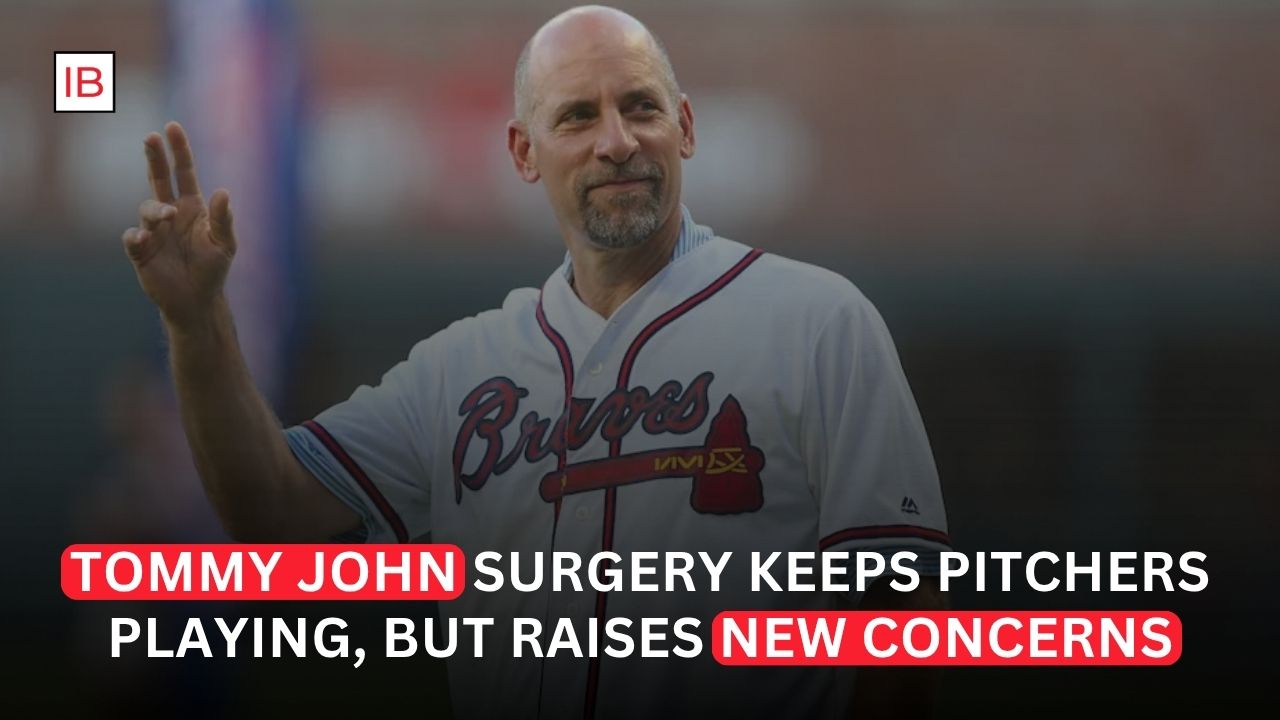
A Revolutionary Operation Changed Baseball Forever
Few medical procedures have had a greater impact on professional sports than Tommy John surgery.
The operation transformed what was once considered a career-ending elbow injury into something many baseball players can recover from. For decades, pitchers who suffered serious damage to the ulnar collateral ligament, or UCL, often had little hope of returning to their previous level.
That changed in 1974 when Los Angeles Dodgers pitcher Tommy John underwent an experimental operation performed by orthopedic surgeon Dr. Frank Jobe.
The procedure reconstructed the damaged ligament in John’s pitching elbow. At the time, the chances of success were considered extremely uncertain. Yet John returned to Major League Baseball in 1976 and went on to win 164 games after the surgery, compared with 124 before it. He ultimately finished his career with 288 victories over 26 seasons.
The success of that operation created one of the greatest advances in sports medicine.
But more than five decades later, baseball faces a difficult question: Has the surgery that saved countless careers also made the sport more willing to accept the conditions that destroy pitchers’ arms?
Tommy John’s Legacy Became Bigger Than His Career
Tommy John died in August 2026 at the age of 83, bringing renewed attention to the procedure that permanently attached his name to baseball history.
John was already an accomplished Major League pitcher before his injury. However, the surgery performed by Dr. Jobe turned him into something much larger: a symbol of the possibility that an athlete could recover from what had previously been a devastating injury.
The operation replaced his damaged UCL with a tendon graft. John endured a long rehabilitation process before returning to competition.
His recovery changed the way doctors, teams and athletes viewed serious elbow injuries.
Since then, thousands of professional and amateur players have undergone UCL reconstruction. More than 2,600 Major League players have reportedly received the procedure, while many more surgeries have been performed on athletes outside MLB.
Players such as Shohei Ohtani, Justin Verlander and Bryce Harper have undergone procedures associated with UCL injuries and returned to elite competition.
The operation has unquestionably extended careers.
However, its widespread success has created an uncomfortable paradox.
The better baseball becomes at repairing damaged arms, the more frequently the sport appears willing to push those arms toward the point of damage.
Pitchers Are Throwing Harder Than Ever
Modern baseball rewards velocity.
A pitcher throwing 100 miles per hour can become one of the most valuable players in the sport. Teams use advanced technology to measure velocity, spin rate, movement and other characteristics that can make a pitch more difficult to hit.
The result has been an intense competition to develop faster and more powerful pitchers.
But increased velocity places greater stress on the elbow.
MLB’s own research into pitcher injuries identified the pursuit of velocity and increasingly advanced pitch characteristics as major concerns. Higher throwing speeds increase torque and stress on the elbow, while modern development systems often encourage players to maximize performance measurements.
The problem is becoming increasingly visible.
A recent report noted that approximately one in three MLB pitchers has undergone Tommy John surgery, illustrating how common the procedure has become in professional baseball.
The surgery has helped pitchers return.
It has not solved the injury problem.
Tommy John Surgery Is Not a Performance Upgrade
One of the most dangerous misconceptions surrounding the operation is the belief that Tommy John surgery can somehow make a pitcher stronger.
Some athletes, parents and coaches have even come to believe that the procedure can increase velocity or improve performance.
Medical experts reject that idea.
The American Sports Medicine Institute has specifically warned that Tommy John surgery should not be viewed as a way to make pitchers throw harder or become better players. Any improvement after recovery can result from rehabilitation, strength training, mechanical adjustments and time away from competition rather than the surgery itself.
The operation is still major surgery.
Recovery can take more than a year, and athletes may never return to their previous level.
Some require additional procedures.
The risks remain significant, particularly as pitchers increasingly undergo repeat surgeries.
Cincinnati Reds ace Hunter Greene, for example, underwent his second Tommy John surgery in August 2026. His expected recovery period is between 12 and 18 months, putting not only the remainder of his 2026 season but potentially all of 2027 at risk.
That illustrates the limits of modern sports medicine.
Doctors can repair damaged ligaments, but they cannot guarantee that an athlete’s arm will remain healthy forever.
The Injury Problem Starts Long Before the Major Leagues
Perhaps the biggest concern is that elbow problems are no longer limited to professional athletes.
Young baseball players are specializing earlier and spending more time pitching throughout the year.
Instead of playing multiple sports and allowing their bodies to rest, some young athletes join travel teams, attend pitching academies and compete across multiple leagues.
They may pitch for several teams during the same season.
Research and medical organizations have repeatedly identified overuse, year-round pitching and inadequate rest as major risk factors for elbow injuries.
Pitch counts are particularly important.
One study involving former Little League World Series participants found that players who exceeded recommended pitch counts and later became professional pitchers faced a substantially higher likelihood of requiring UCL reconstruction than those who followed the recommendations.
The exact causes of every injury are complex.
But the broader message is clear: arms are not designed to operate at maximum intensity indefinitely.
Baseball’s Development System May Be Part of the Problem
Modern pitching development has become highly sophisticated.
Players can visit specialized facilities where cameras and sensors analyze every movement of their throwing motion.
The technology can help athletes improve.
But it can also create pressure to constantly chase better numbers.
A young pitcher who throws 92 miles per hour may want to reach 95.
A pitcher with good spin may try to generate even more movement.
Every improvement can create an advantage in a sport where small differences matter.
But the human body has limits.
MLB’s injury report noted that the sport’s obsession with velocity and “stuff” has emerged as a significant concern alongside traditional problems such as overuse.
The irony is that technology capable of measuring the stress on pitchers may also be contributing to an environment where athletes feel pressured to push harder.
The industry has become extremely good at identifying elite pitching characteristics.
It may not yet be equally effective at protecting the arms required to produce them.
Teams Have Learned to Replace Injured Pitchers
There is also an economic side to the problem.
Baseball teams now operate with deep pools of pitchers.
If one player suffers an elbow injury, organizations often have another prospect developing in the minor leagues.
This can make individual injuries feel less catastrophic from an organizational perspective.
Tommy John surgery also provides a pathway back.
A player may miss a season or more, but teams know there is at least a realistic chance that he can return.
That can unintentionally change the calculation.
If a torn UCL no longer automatically ends a career, there may be less pressure to fundamentally change the system that contributed to the injury.
The procedure becomes a safety net.
But a safety net is not the same as prevention.
A Generation of Pitchers Is Paying the Price
The modern game is producing extraordinary performances.
Pitchers throw harder than previous generations and possess more movement, more specialized pitches and more advanced training.
Fans benefit from watching elite athletes push the boundaries of performance.
Yet the physical cost is becoming impossible to ignore.
The 2026 season alone has continued to demonstrate how frequently pitchers deal with serious elbow injuries.
Players returning from surgery are now a regular part of Major League rotations, while others begin long rehabilitation processes after undergoing their first or even second reconstruction.
The question is no longer whether Tommy John surgery works.
It clearly does.
The question is why baseball needs it so often.
The Surgery Changed the Definition of a Career-Ending Injury
Before Tommy John’s operation, a serious UCL injury could effectively end a pitcher’s career.
Afterward, athletes had hope.
That represents an enormous achievement.
Tommy John’s own career remains the best example.
He returned from an operation that had never previously been attempted on a Major League pitcher and continued competing for more than a decade.
His recovery helped convince athletes that damaged elbows could be repaired.
The procedure has since helped preserve the careers of some of baseball’s biggest stars.
Without it, the history of the sport would look very different.
But success can create its own problems.
Because the operation became so effective, baseball may have gradually normalized the injury that requires it.
A torn elbow ligament is no longer viewed with the same sense of finality.
Players, teams and fans have become accustomed to hearing that a pitcher will undergo Tommy John surgery and return in 12 to 18 months.
That expectation can make the underlying injury appear less serious than it truly is.
Prevention Must Become More Important
The future of baseball should not depend on eliminating Tommy John surgery.
The procedure remains one of the most important developments in sports medicine.
Instead, the sport needs to focus more heavily on reducing the number of players who require it.
That could involve:
- Better workload management
- Stricter pitch limits for young athletes
- More rest between appearances
- Reduced year-round pitching
- Encouraging young players to play multiple positions
- Improved strength and conditioning programs
- More attention to early signs of elbow pain
- Greater caution around the constant pursuit of velocity
No single solution will eliminate arm injuries.
Baseball involves an unnatural and physically demanding throwing motion, particularly for pitchers performing at maximum intensity.
But reducing unnecessary stress could help protect more athletes.
The research on youth workloads provides an especially important warning: prevention needs to begin long before a player reaches the professional level.
Looking Ahead
Tommy John surgery remains one of the greatest success stories in sports medicine.
It saved Tommy John’s own career and created a pathway for thousands of athletes who followed him.
His remarkable return after the 1974 operation helped change baseball forever, and his legacy remains visible every time an injured pitcher begins the long process of rehabilitation.
But the growth of the procedure also raises an important question for the sport.
Has baseball become too comfortable with repairing broken arms instead of preventing them from breaking in the first place?
Pitchers are throwing harder than ever, development systems increasingly reward maximum velocity and young athletes are specializing earlier.
At the same time, Tommy John surgery has become so common that it can sometimes feel like a routine part of a pitching career.
It is not.
It is major surgery, followed by months of rehabilitation and no guarantee of a successful return.
The procedure should be remembered as a medical breakthrough, not as a normal stage of player development.
Tommy John’s courage in undergoing the experimental surgery opened the door for generations of athletes.
The challenge for baseball now is to honor that legacy by ensuring fewer young pitchers need to walk through it.
Tommy John surgery saved baseball careers. The next revolution in the sport may be finding a way to save pitchers’ arms before surgery becomes necessary.