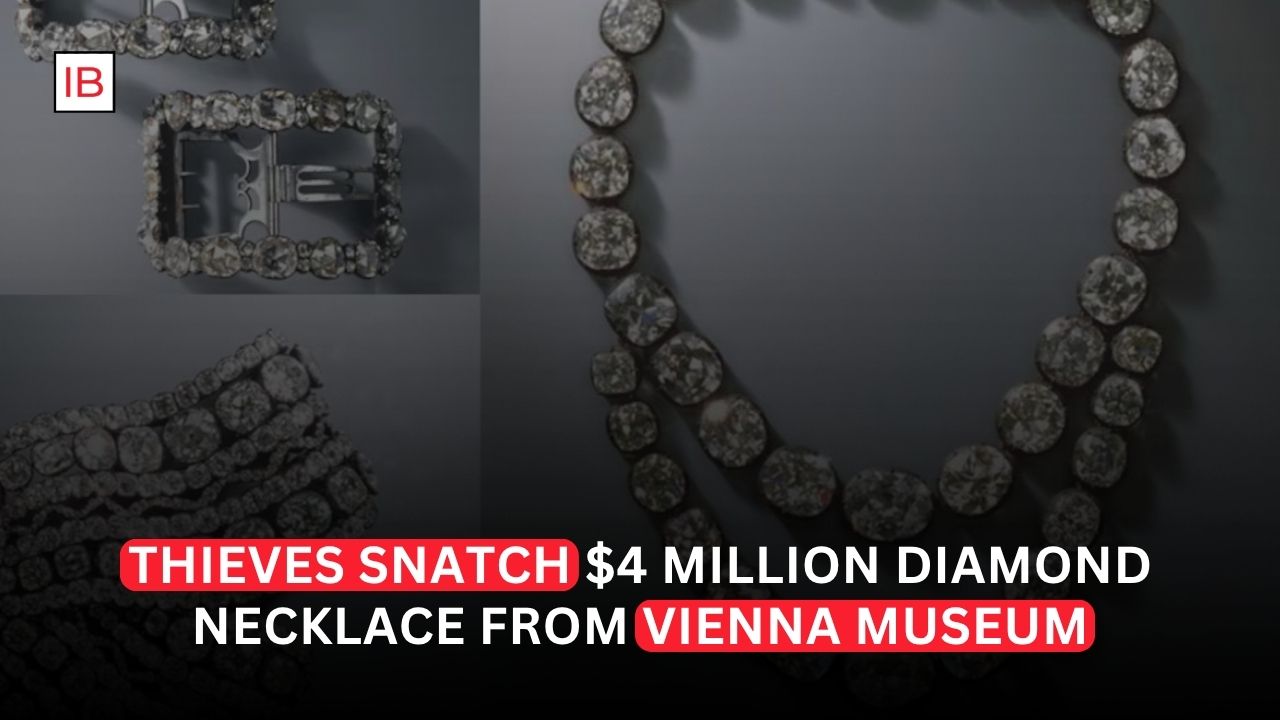
Two thieves have stolen a multimillion-dollar diamond necklace from a museum in Vienna after smashing a glass display case during opening hours, turning a major jewelry exhibition into the scene of a dramatic art theft.
The incident occurred on August 27 at the Museum of Applied Arts, known as the MAK, in central Vienna. According to Austrian police, two unidentified men entered the museum around 2 p.m. before breaking a display case and fleeing with the necklace. Investigators have launched a search for the suspects.
Valuable Necklace Stolen
The stolen piece is a platinum necklace decorated with 673 diamonds weighing around 200 carats. It was created for the Egyptian royal family and was worn by Queen Nazli in 1939 during the wedding of her daughter Fawzia to Iranian Crown Prince Mohammad Reza Pahlavi, who later became the Shah of Iran.
The necklace has a remarkable auction history. It was sold by Sotheby’s in New York in 2015 for about $4.3 million, equivalent to roughly €3.7 million at the time. The jewelry had reportedly disappeared from public view for decades before resurfacing at the auction.
Thieves Struck During Visiting Hours
Police said the suspects appeared to enter the museum as ordinary visitors.
Once inside, they smashed the glass display case, removed the necklace and escaped. The use of a hammer or similar tool has been reported by Austrian media covering the investigation.
The speed of the theft suggests the perpetrators may have deliberately targeted the necklace rather than acting randomly. Police have not publicly confirmed whether the thieves had prior knowledge of the exhibition or the item’s value.
Police Launch Manhunt
Vienna’s State Criminal Police Office has taken control of the investigation.
Authorities immediately began searching the surrounding area, including deploying a police tracking dog. Investigators are also examining surveillance footage from nearby businesses and public-transport locations in an effort to establish how the suspects escaped.
Police have released photographs of the suspected thieves and are asking the public for information.
The two men are described as approximately 170 to 175 centimeters tall, with slim builds, dark hair and dark beards. They were reportedly wearing black outer clothing and dark sneakers with white soles.
Museum Exhibition Temporarily Closed
The theft occurred during the MAK’s “Glanzstücke” exhibition, which features around 500 objects.
More than 300 pieces come from the collection of luxury jeweler Van Cleef & Arpels, while more than 200 objects come from the museum’s own collection. The stolen necklace was among the exhibition’s most valuable and historically significant pieces.
The museum itself remained open following the incident, although the affected exhibition was temporarily closed.
Museum officials said the situation was brought under control with the assistance of security personnel and police. No one was injured during the theft.
A Piece With Royal History
The necklace’s value is not based solely on its diamonds.
Its connection to the Egyptian royal family and the Iranian monarchy gives it substantial historical importance.
Queen Nazli was the wife of King Fuad I of Egypt and the mother of King Farouk. Her daughter Fawzia later became Queen of Iran after marrying Mohammad Reza Pahlavi.
The necklace therefore represents a link between two former royal families and an important period in Middle Eastern history.
Why Jewelry Is a Target
High-value jewelry presents a particular challenge for museums and law-enforcement agencies.
Precious stones can potentially be removed from their original settings and sold separately, making recovery more difficult.
That is one reason European authorities have warned about an increase in thefts involving gold, jewelry and other high-value cultural objects. Europol recently said museum heists are becoming more violent and increasingly involve opportunistic criminal networks recruited through social media.
Europe Faces More Museum Heists
The Vienna theft comes amid growing concern about museum security across Europe.
Recent years have seen several high-profile robberies involving valuable jewelry and cultural artifacts. The Louvre in Paris was targeted in a major jewelry heist in 2025, while another robbery at the Drents Museum in the Netherlands involved explosives.
These incidents have increased pressure on museums to strengthen security around their most valuable collections.
The Investigation Continues
For Austrian investigators, the immediate priority is finding the two suspects and recovering the necklace.
Because the stolen piece is highly distinctive, investigators may have an advantage if the thieves attempt to sell it openly.
However, dismantling the necklace or moving its diamonds individually could make recovery significantly harder.
Police have asked anyone with information about the suspects or the stolen necklace to contact the Vienna State Criminal Police Office.
Conclusion
The theft of a $4.3 million diamond necklace from Vienna’s Museum of Applied Arts has highlighted the continuing security challenges faced by museums displaying valuable jewelry and cultural objects.
Two unidentified men allegedly entered the museum during normal visiting hours, smashed a glass display case and escaped with a necklace containing 673 diamonds weighing around 200 carats.
The necklace is particularly significant because it was created for Egypt’s royal family and was worn by Queen Nazli at her daughter’s 1939 wedding. Its later appearance at a Sotheby’s auction in 2015 resulted in a sale price of approximately $4.3 million.
Vienna police have released descriptions and photographs of the suspects and are examining surveillance footage while continuing a citywide search.
The case also comes at a time when European authorities are warning about increasingly aggressive museum thefts. Europol has identified valuable jewelry, precious metals and cultural artifacts as attractive targets for criminals because they can generate large returns and, in some cases, be difficult to trace after being dismantled.
For the MAK, the incident is a serious loss not only because of the necklace’s monetary value but also because of its historical significance.
Whether investigators can recover the piece intact will depend on how quickly the suspects are identified and whether the necklace can be traced before it is altered or broken apart.