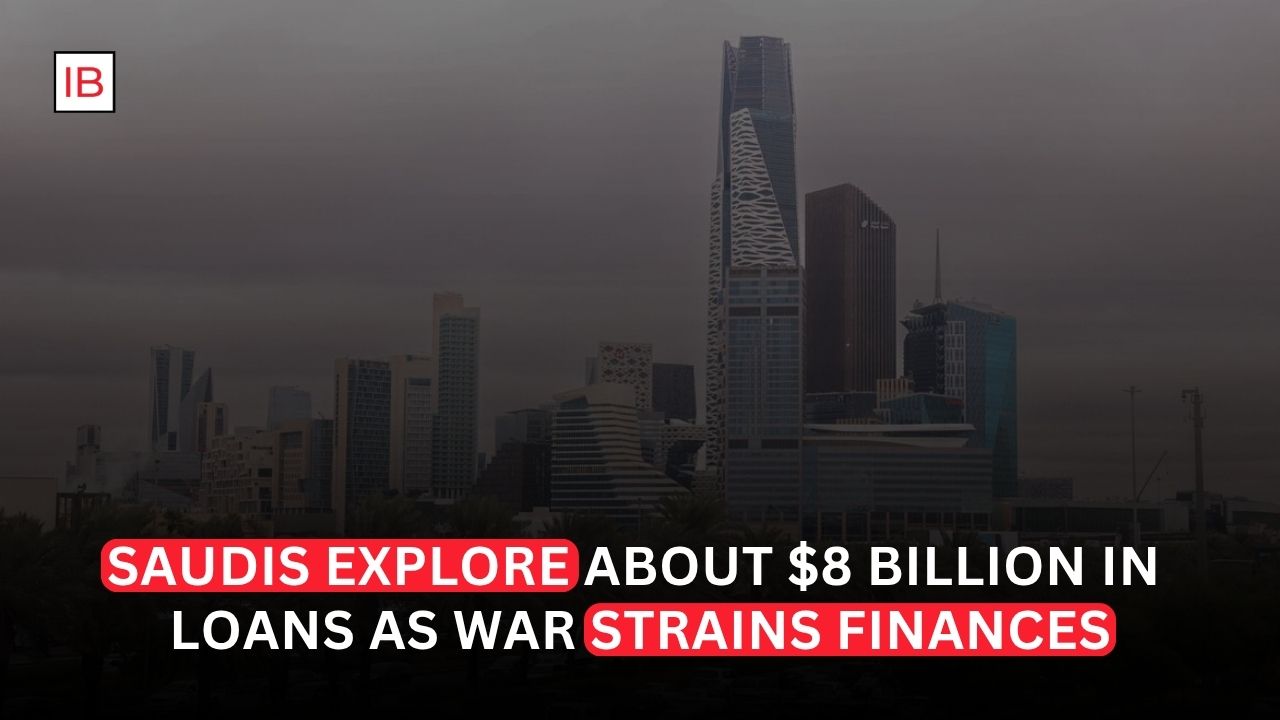
Saudi Arabia is sounding out banks about raising at least $8 billion in loans as the conflict involving Iran places additional pressure on the kingdom’s finances. The move underscores how the regional war is beginning to affect even the Gulf’s wealthiest economies, forcing governments to reassess spending, borrowing and investment plans.
The potential borrowing would give Riyadh additional financial flexibility at a time when the conflict has disrupted energy markets, shipping routes and regional economic activity. It also highlights the tension between Saudi Arabia’s ambitious investment agenda and the growing costs associated with maintaining economic stability during a prolonged regional crisis.
Saudi Arabia Turns to Debt Markets
Saudi Arabia has traditionally relied heavily on oil revenue to finance government spending and maintain large investment programs.
But the kingdom has increasingly used debt markets as part of a broader strategy to diversify its sources of financing.
Exploring new loans does not necessarily mean Saudi Arabia is facing an immediate liquidity crisis. The country has substantial financial assets, including holdings controlled by its sovereign wealth fund.
Instead, borrowing can provide a way to preserve cash and avoid disrupting strategic projects while economic conditions remain uncertain.
War Raises Financial Pressure
The conflict with Iran has created new economic risks across the Gulf.
The Strait of Hormuz remains a critical chokepoint for global energy shipments, and disruptions there have affected oil flows, shipping costs and regional business activity.
The latest escalation has already weighed on Gulf financial markets. Saudi stocks were broadly flat on Aug. 31 as investors assessed the continuing military tensions between the US and Iran.
For Saudi Arabia, the consequences extend beyond the stock market.
The government must account for higher security spending, potential disruptions to trade and the economic effects of regional instability.
Oil Revenue Is Not the Whole Story
At first glance, higher oil prices might appear beneficial for Saudi Arabia.
The kingdom is one of the world’s largest oil producers, meaning a sustained rise in crude prices can increase government revenue.
But the relationship is more complicated during a war.
Higher oil prices can also raise the cost of transportation, imports and domestic production.
More importantly, disruptions to oil shipments can reduce the amount of crude that reaches international customers.
The kingdom therefore has to balance the benefit of higher prices against the risks created by instability in regional energy infrastructure.
Hormuz Is a Major Concern
The Strait of Hormuz is particularly important.
A large share of global oil and liquefied natural gas shipments traditionally passes through the waterway.
The current conflict has sharply reduced traffic and forced Gulf producers to search for alternative routes.
Saudi Arabia has infrastructure that can move some crude toward Red Sea ports, allowing exports to bypass Hormuz.
Other Gulf states are also accelerating investments in pipelines and alternative ports as the conflict exposes the risks of relying on a single maritime chokepoint.
These projects could strengthen the region’s long-term resilience, but they require substantial capital.
Borrowing Can Protect Investment
Saudi Arabia is in the middle of an enormous economic transformation under its Vision 2030 strategy.
The government is investing heavily in tourism, infrastructure, technology, logistics, entertainment and new industries designed to reduce dependence on crude oil.
Projects such as large urban developments and tourism destinations require years of spending.
A sudden reduction in investment could undermine the diversification strategy.
Borrowing allows the government to maintain spending even if short-term fiscal conditions deteriorate.
That makes debt a useful tool—but only if borrowing costs and debt levels remain manageable.
The Sovereign Wealth Fund Is Central
Saudi Arabia’s Public Investment Fund is one of the world’s largest sovereign wealth funds.
It controls hundreds of billions of dollars in assets and has become the financial engine behind many of the kingdom’s diversification projects.
The fund has invested in technology, sports, entertainment, infrastructure and global companies.
However, many of its projects are capital-intensive and may not generate immediate returns.
The government therefore faces a balancing act between preserving the PIF’s investment capacity and using national financial resources to respond to the war.
Interest Rates Matter
Borrowing has become more expensive globally compared with the ultra-low-rate period of the 2010s.
Higher US Treasury yields have pushed up borrowing costs across international debt markets.
That matters particularly for Gulf economies because their currencies are closely linked to the US dollar.
Saudi Arabia’s monetary policy therefore tends to move alongside US monetary conditions.
If global borrowing costs remain elevated, issuing billions of dollars in new debt could become more expensive.
The kingdom has the financial strength to borrow, but the cost of that borrowing still matters.
Gulf Economies Face Broader Risks
Saudi Arabia is not the only Gulf economy dealing with financial pressure.
The conflict has disrupted tourism, trade, energy production and transportation across the region.
Qatar, for example, has suffered major losses from the disruption of LNG exports, while other Gulf countries have faced pressure on markets and logistics.
The result is a regional economic shock that affects countries differently.
Energy exporters may benefit from higher commodity prices while simultaneously suffering from reduced shipping capacity.
Non-oil sectors can be hurt by weaker tourism and investment.
Saudi Arabia Has a Large Financial Cushion
Saudi Arabia enters the crisis from a stronger position than many emerging markets.
The kingdom has substantial foreign assets, oil reserves and access to international capital markets.
That means an $8 billion financing package would be relatively modest compared with the overall size of the Saudi economy and its financial resources.
The more important issue is what the borrowing signals.
If the war continues for an extended period, Saudi Arabia may need to borrow repeatedly while continuing to finance domestic investment and defense requirements.
Defense Spending Could Rise
Regional security concerns have increased sharply.
Saudi Arabia has invested heavily in military capabilities for years, and the latest conflict could create pressure for additional spending on air defense, missile systems and other security infrastructure.
Those expenditures do not directly contribute to economic diversification.
Yet they may become unavoidable if the security environment deteriorates.
This creates another trade-off for the government: money directed toward defense cannot simultaneously be spent on infrastructure, tourism or technology projects.
The Kingdom Wants Economic Stability
Saudi policymakers have spent years trying to make Saudi Arabia less dependent on oil price cycles.
Vision 2030 is designed to create a more diversified economy in which tourism, manufacturing, logistics, technology and services contribute significantly to national income.
The current war tests that strategy.
If regional instability lasts for years, investment projects could face delays and private investors could become more cautious.
The government may then need to provide additional financial support.
Alternative Energy Routes Become More Valuable
One long-term consequence of the war could be accelerated investment in alternative export routes.
Saudi Arabia already has pipelines capable of moving crude toward the Red Sea.
Expanding such infrastructure could reduce dependence on Hormuz and give Riyadh greater flexibility during future crises.
Other Gulf countries are considering similar strategies, including new ports, storage facilities and pipeline networks.
These investments could ultimately strengthen the region’s energy security.
But they also add to capital requirements at a time when governments are already facing higher expenses.
Oil Prices Could Provide Some Relief
Higher crude prices remain an important financial cushion.
If oil prices stay elevated for an extended period, Saudi Arabia could receive additional export revenue that helps offset some of the costs of the war.
But relying on higher oil prices carries risks.
A prolonged period of expensive oil can weaken global economic growth and reduce demand.
It can also accelerate investment in alternative energy and encourage consumers to reduce fossil-fuel consumption.
Saudi Arabia therefore has an incentive to benefit from strong prices without allowing the global economy to deteriorate severely.
Investors Will Watch the Debt
International investors are likely to pay attention to Saudi borrowing plans.
The kingdom has spent years building credibility in international debt markets.
A new multibillion-dollar loan could demonstrate continued access to financing despite geopolitical turbulence.
But repeated borrowing without corresponding revenue growth could eventually raise questions about fiscal discipline.
The key issue will therefore be whether the borrowing is temporary and strategic or becomes a persistent requirement.
Vision 2030 Faces a Stress Test
The current crisis represents a test for the government’s ambitious economic plans.
Saudi Arabia has announced huge projects intended to transform the country’s economy and attract international investment.
Those plans were developed under assumptions of relative regional stability and strong access to capital.
War changes those assumptions.
Projects may need to be reprioritized, delayed or financed differently.
Some initiatives could also become more important if they strengthen economic resilience.
Saudi Arabia Is Not Alone
The financial pressures facing Riyadh are part of a broader transformation across the Gulf.
Governments are increasingly investing in infrastructure that allows them to operate independently of vulnerable trade routes.
Ports, pipelines, storage facilities and alternative transport networks are becoming strategic assets.
The conflict has therefore accelerated an economic trend that was already underway.
Gulf states are no longer treating infrastructure purely as a commercial issue.
They are increasingly viewing it as part of national security.
Conclusion
Saudi Arabia’s exploration of roughly $8 billion in loans is an important signal of how deeply the regional war is affecting Gulf finances.
The kingdom remains in a comparatively strong financial position, with substantial oil resources, sovereign wealth and access to international capital markets.
The potential borrowing should therefore not be interpreted as evidence that Saudi Arabia is running out of money.
Instead, it reflects a strategic effort to maintain financial flexibility while uncertainty surrounding the conflict continues.
The challenge is that Saudi Arabia is simultaneously pursuing one of the world’s most ambitious economic transformation programs.
Vision 2030 requires enormous investment in infrastructure, tourism, technology, logistics and new industries.
At the same time, the war is creating additional demands for defense, energy security and alternative trade routes.
Higher oil prices could provide some relief by increasing export revenue.
But the benefits are not guaranteed.
Disruptions around the Strait of Hormuz can interfere with shipments, while higher energy prices can increase costs throughout the economy.
Saudi Arabia’s decision to explore additional financing therefore reflects a broader balancing act.
The government wants to protect investment without exhausting its financial reserves, while maintaining confidence among international investors.
The country’s large financial cushion gives it room to maneuver.
But if the conflict becomes prolonged, borrowing requirements could increase and some Vision 2030 projects may have to be reprioritized.
The war is also encouraging Saudi Arabia and its Gulf neighbors to invest more aggressively in alternative pipelines, ports and trade routes.
Those investments could reduce future exposure to Hormuz, although they require significant capital today.
For now, Saudi Arabia remains far better positioned than many countries facing similar geopolitical shocks.
The real question is not whether Riyadh can raise $8 billion.
It almost certainly can.
The question is how much additional borrowing and spending will be required if the conflict continues—and whether Saudi Arabia can preserve its ambitious economic transformation while paying the rising cost of regional security.