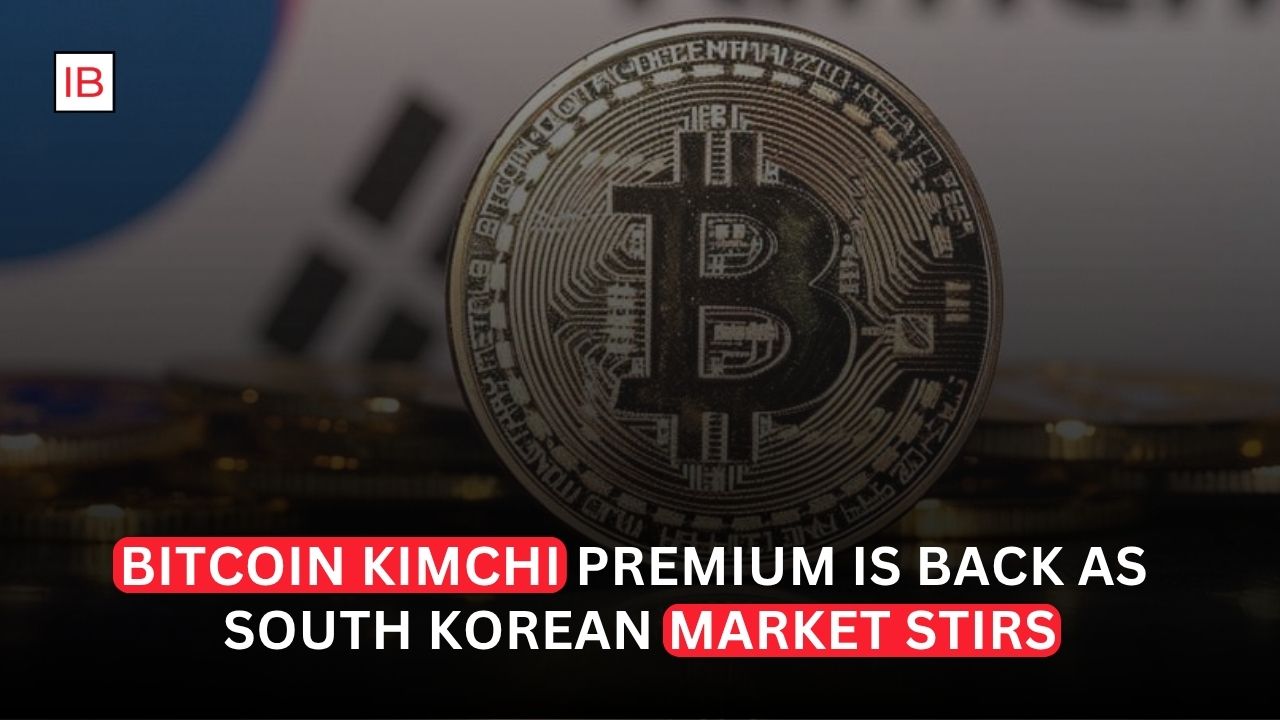
Bitcoin is once again trading at a premium on South Korean exchanges, signaling that local demand for cryptocurrencies may be returning as investors in one of the world’s most active retail trading markets reassess risk assets.
The so-called “kimchi premium” describes a situation in which Bitcoin trades at a higher price in South Korea than on major overseas exchanges. The gap is closely watched because it can provide a rough indication of how aggressively South Korean investors are buying crypto.
The development comes after a period in which the premium had largely disappeared and, at times, turned negative. In August, Bitcoin was trading below international prices on South Korean exchanges, with domestic prices averaging about 0.48% lower than overseas prices during the first nine days of the month.
The return of a positive premium therefore suggests that market conditions are changing.
What the Kimchi Premium Means
The kimchi premium is not simply another Bitcoin price indicator.
It reflects a difference between prices on South Korean exchanges and those in international markets.
When Korean investors are willing to pay more for Bitcoin, local prices can move above global benchmarks. That difference can become especially pronounced when retail investors become highly enthusiastic about cryptocurrencies.
Historically, the premium has appeared during periods of intense speculative demand.
But it is important not to overinterpret it.
A positive premium does not automatically mean that Bitcoin is entering another speculative bubble.
It can simply indicate that demand in South Korea is temporarily stronger than elsewhere.
The Premium Had Recently Disappeared
The latest development is significant partly because the Korean market had recently moved in the opposite direction.
South Korean Bitcoin prices spent an unusually long period below international prices.
According to CryptoQuant data cited by South Korean media, 123 of the first 221 days of 2026 had recorded a reverse kimchi premium. From June 20 through July 24, the reverse premium continued for 35 consecutive days, the longest such streak on record.
That period suggested that Korean traders were not displaying the aggressive appetite that had characterized previous crypto rallies.
The shift back toward a premium therefore represents a notable change in market behavior.
Korean Investors Have Been Moving Between Markets
South Korea is unusual because retail investors participate heavily in both stocks and cryptocurrencies.
That creates the possibility of capital rotating between different speculative markets.
Earlier this year, South Korean stocks experienced a huge rally, particularly in technology and artificial-intelligence companies.
Crypto activity weakened during that period as some retail investors appeared to favor equities instead.
That relationship became particularly visible when South Korean stocks later suffered a sharp reversal.
CoinDesk reported in March that the Kospi fell about 20% in two trading sessions following a massive retail-driven rally, while crypto trading activity began increasing again.
The pattern suggests that some Korean investors may not be abandoning risk altogether when one market becomes less attractive.
They may simply move to another.
The Stock Market Could Be Driving the Shift
South Korea’s stock market remains an important factor in understanding the renewed crypto activity.
The country’s technology-heavy equity market has been strongly influenced by the global AI boom.
Semiconductor companies such as Samsung Electronics and SK Hynix have benefited from demand for advanced chips used in AI systems.
That helped drive significant gains in Korean stocks.
But rapid gains can also create conditions for profit-taking.
If investors begin reducing positions in equities after a large rally, cryptocurrencies can become an alternative destination for speculative capital.
This does not mean Korean stocks and Bitcoin will always move in opposite directions.
The relationship is much more complicated.
But both markets compete for the attention of a highly active retail-investor base.
Bitcoin’s Global Rally Helps
The renewed Korean premium is also occurring against a broader recovery in Bitcoin.
Bitcoin recently climbed above $80,000 for the first time since May, reaching about $81,238 before pulling back.
The rally has been supported by several factors, including renewed institutional demand, expectations surrounding US monetary policy and growing interest in Bitcoin as a hedge against currency and debt risks.
Spot Bitcoin exchange-traded funds also recorded strong inflows during the recent rally.
That means Korean traders are not operating in isolation.
Global momentum can encourage domestic investors to participate more aggressively.
Institutional Demand Is Also Returning
The recent Bitcoin recovery has not been driven entirely by retail traders.
Spot Bitcoin ETFs recorded approximately $1.92 billion in inflows during the week cited by Investors Business Daily, the strongest weekly inflow period of 2026 at that point.
That institutional participation is important because it can make a Bitcoin rally more durable than one based solely on speculative retail buying.
If global institutional demand remains strong, Korean investors may feel more comfortable increasing their exposure.
The kimchi premium could then become part of a broader global rally rather than a purely local phenomenon.
The Dollar Is Another Variable
Bitcoin’s recent recovery has also been linked to concerns about the US dollar and government debt.
US Treasury plans to increase long-term debt buybacks have contributed to expectations for lower long-term yields and potentially weaker dollar conditions.
A weaker dollar can support Bitcoin because the cryptocurrency is often treated as a dollar alternative or a hedge against currency debasement.
That narrative has gained attention among investors concerned about rising government debt.
South Korean investors are exposed to these global monetary forces just as international investors are.
The Korean Won Matters
The exchange rate between the Korean won and the US dollar also matters when comparing Bitcoin prices across markets.
If the won weakens significantly, the local-currency price of Bitcoin can rise even if the dollar-denominated Bitcoin price changes less dramatically.
That can complicate interpretation of the kimchi premium.
A widening premium may reflect stronger local demand, currency movements or differences in market liquidity.
Therefore, traders need to distinguish between a genuine surge in Korean buying and a mechanical price effect.
Arbitrage Is Not Easy
In theory, the kimchi premium should create an easy arbitrage opportunity.
A trader could buy Bitcoin overseas at the lower price and sell it on a Korean exchange at the higher price.
In practice, that trade is much harder.
South Korea’s financial regulations, anti-money-laundering requirements and restrictions on moving capital across borders can prevent traders from quickly exploiting the difference.
That is one reason the premium can persist.
If international traders could freely move unlimited amounts of capital between markets without friction, large price differences would tend to disappear quickly.
A Small Premium Is Not a Mania
The size of the premium matters.
A modest premium should not be confused with the extreme conditions seen during previous crypto bubbles.
The kimchi premium reached dramatically higher levels during earlier speculative episodes. Research has documented premiums exceeding 20% during periods of intense market demand.
Therefore, simply observing that Korean Bitcoin prices are once again above international prices does not establish that another speculative frenzy is underway.
The more useful signal is whether the premium continues widening alongside rapidly rising trading volumes and aggressive retail positioning.
Korean Retail Traders Remain Important
South Korea has long been one of the world’s most active cryptocurrency markets.
Domestic exchanges attract significant retail participation, making investor sentiment particularly important.
Korean traders have also demonstrated a willingness to pursue high-growth technology themes.
That behavior has recently been visible in the country’s stock market, where AI and semiconductor companies attracted substantial buying.
If the stock market becomes less attractive, some of that speculative appetite could migrate back toward digital assets.
Crypto Exchanges Could Benefit
A return of speculative activity would be positive for South Korean cryptocurrency exchanges.
Higher trading volumes generate more transaction revenue and increase user activity.
The country’s largest exchanges have historically benefited from periods when retail investors aggressively trade Bitcoin and other digital assets.
But exchanges also face regulatory scrutiny.
South Korean authorities have strengthened oversight of cryptocurrency platforms in recent years, making compliance an increasingly important cost for the industry.
Regulation Limits the Market
South Korea’s crypto market is not an unrestricted casino.
Exchanges must comply with identity-verification, banking and anti-money-laundering requirements.
Those rules can reduce some of the excesses associated with speculative trading.
They can also make cross-border arbitrage more difficult.
The same regulatory barriers that prevent traders from quickly eliminating the kimchi premium can therefore help explain why price discrepancies persist.
Bitcoin’s Recovery Still Has Risks
The broader Bitcoin rally is not guaranteed to continue.
Bitcoin’s move above $80,000 brought the cryptocurrency close to a major technical resistance zone.
Analysts cited by The Wall Street Journal identified roughly $80,000 to $82,000 as an area where profit-taking could emerge.
If Bitcoin fails to break decisively above that range, the recent momentum could weaken.
A decline in global Bitcoin prices would probably reduce Korean demand as well.
That means the renewed premium should be interpreted as a market signal, not a guarantee of further gains.
Retail Leverage Is Another Risk
Cryptocurrency markets are particularly sensitive to leverage.
When prices rise quickly, traders often increase leveraged positions in anticipation of further gains.
That can amplify a rally.
But if prices reverse, forced liquidations can accelerate the decline.
The recent global Bitcoin rally already triggered nearly $3 billion in crypto liquidations, most of them involving short positions.
A similar dynamic could eventually affect Korean traders if local enthusiasm becomes excessive.
The Premium Could Become a Sentiment Indicator
For investors watching South Korea, the most useful question is not whether the premium exists today.
It is whether it continues rising.
A persistent and widening premium accompanied by higher trading volumes would provide stronger evidence that Korean retail investors are becoming increasingly bullish.
A small premium that quickly disappears would be less meaningful.
The distinction matters because temporary price differences are common in fragmented global markets.
Sustained differences tell a more useful story about investor behavior.
South Korea’s Broader Market Is Stirring
The return of the premium comes as South Korea’s broader financial markets are showing renewed activity.
Recent data showed Korean stocks gaining as strong semiconductor demand helped support exports. The country’s chip industry remains closely tied to the global AI investment cycle.
At the same time, the Korean won has weakened against the dollar and government bond yields have risen.
That combination creates a complicated investment environment.
Investors are simultaneously responding to strong export demand, currency pressures, interest-rate expectations and changing risk appetite.
Bitcoin is being pulled into that broader market debate.
The Bigger Story Is Capital Rotation
The most important implication may therefore be capital rotation rather than Bitcoin itself.
South Korean investors have demonstrated that they can move quickly between asset classes.
When technology stocks offered extraordinary returns, they bought equities.
When that trade became less attractive, crypto activity began to recover.
The renewed kimchi premium may be an early indication that speculative capital is once again flowing toward digital assets.
Conclusion
Bitcoin’s return to a positive kimchi premium marks a notable shift in South Korea’s cryptocurrency market.
For much of 2026, Korean Bitcoin prices frequently traded below international levels, with a reverse premium recorded on 123 of the first 221 days of the year through early August. The reverse premium even persisted for 35 consecutive days between June 20 and July 24.
The renewed premium suggests that local demand is beginning to strengthen.
But the evidence does not yet justify calling it a new Korean crypto mania.
The premium itself is relatively straightforward: Bitcoin trades at a higher price on South Korean exchanges than on overseas platforms. Historically, it has been associated with periods of strong local demand and speculative enthusiasm.
What makes the current episode interesting is the timing.
South Korean investors have recently been heavily involved in a powerful equity rally centered on technology, semiconductors and artificial intelligence.
As that market becomes more volatile, some speculative capital may be moving back toward cryptocurrencies.
The relationship was visible earlier this year when a sharp collapse in Korean stocks coincided with rising crypto activity.
Global Bitcoin conditions are also supportive.
The cryptocurrency recently moved above $80,000, while institutional demand for spot Bitcoin ETFs strengthened substantially.
That gives Korean investors a global bullish narrative to follow.
However, several risks remain.
Bitcoin is approaching a technically important resistance area, while leverage and rapid price increases can create the conditions for sharp reversals.
Currency movements also complicate the interpretation of the kimchi premium.
And South Korea’s regulatory framework makes international arbitrage difficult, allowing price differences to persist longer than they might in a completely open market.
The key indicator from here will be persistence.
If the premium widens alongside increasing Korean trading volumes, it would suggest that domestic retail demand is genuinely accelerating.
If it quickly fades, the move may have been little more than a temporary pricing imbalance.
Either way, the return of the kimchi premium provides a useful window into the behavior of one of the world’s most active crypto-investor populations.
South Korea’s investors are once again showing signs of turning toward Bitcoin.
Whether that develops into another major speculative cycle will depend on what happens next in both the cryptocurrency market and the country’s increasingly important technology-driven stock market.