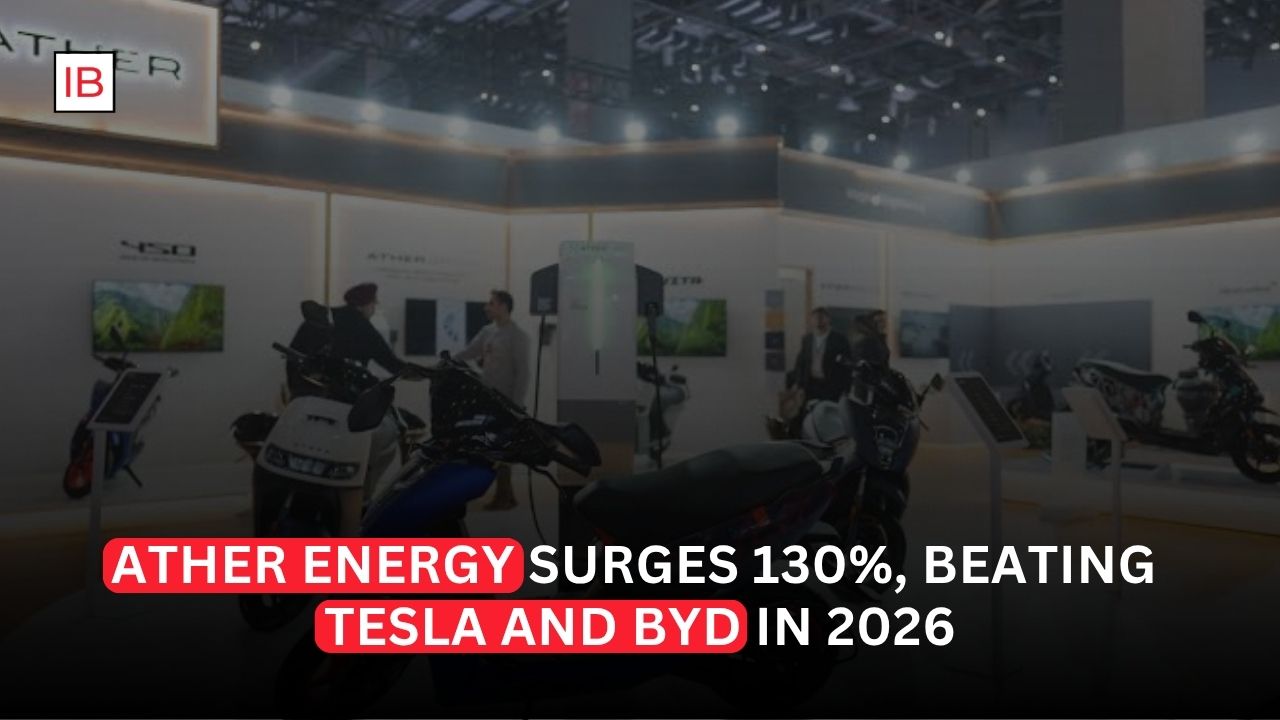
Ather Energy has emerged as one of the world’s strongest-performing publicly traded electric-vehicle companies in 2026, with its shares gaining roughly 130% this year as investors increasingly bet on India’s rapidly expanding electric two-wheeler market.
The rally has put the Indian scooter maker ahead of much larger global EV names such as Tesla and BYD in terms of stock-market performance. But the comparison needs context. Ather operates in a very different market from Tesla and BYD, and its smaller size means that investor enthusiasm can produce much larger percentage moves.
Still, the performance highlights a broader shift in the electric-vehicle industry: investors are increasingly looking beyond electric cars toward two-wheelers, particularly in emerging markets where scooters and motorcycles are a much larger part of everyday transportation.
Ather’s Stock Has More Than Doubled
Ather’s shares have more than doubled in 2026, gaining around 108% by late August and approaching a 130% year-to-date increase by the start of September.
The company’s stock has also recently reached fresh highs, trading around ₹1,700 and giving Ather a market value of more than ₹66,000 crore.
That performance is particularly striking because Ather only became a publicly traded company recently.
Newly listed stocks can experience significant volatility as investors establish a valuation and institutions begin building positions.
Ather’s rapid rise therefore reflects both improving business fundamentals and strong investor expectations.
Why Investors Are Buying Ather
One of the strongest arguments supporting Ather’s rally is the company’s improving financial performance.
Ather’s revenue has been growing rapidly while losses have narrowed.
In the first quarter of fiscal 2027, the company’s net loss fell to about ₹51 crore from ₹178 crore a year earlier. Revenue from operations increased roughly 89% year over year to about ₹1,217 crore.
The company also reported positive EBITDA of about ₹9.45 crore during the quarter, compared with an EBITDA loss of more than ₹105 crore a year earlier.
That improvement matters because investors have historically been skeptical of EV companies that can grow sales but cannot demonstrate a path toward profitability.
Ather is beginning to show that its growth may be accompanied by improving economics.
EV Demand Is Expanding in India
India’s electric two-wheeler market provides Ather with a large potential growth opportunity.
Electric scooters are particularly well suited to Indian cities because they are relatively inexpensive to operate, easier to maneuver through congested roads and generally cheaper to purchase than electric cars.
Ather’s sales have therefore benefited from growing consumer acceptance of electric scooters.
The company sold 262,942 vehicles during fiscal 2026, a 69% increase from the previous year. Quarterly volumes reached a record 83,418 units in the final quarter, up 76% year over year.
Those numbers show that the company’s growth is not based solely on investor speculation.
The Rizta Has Become Important
Ather’s family-oriented Rizta scooter has played an important role in its expansion.
The product helped the company reach customers beyond the performance-focused segment traditionally associated with its brand.
That is strategically important.
Ather needs to move from being a premium electric-scooter specialist toward becoming a mass-market manufacturer if it wants to compete for a much larger share of India’s two-wheeler market.
The Rizta gives it a product positioned toward that broader customer base.
A New Mass-Market Model
Ather has also introduced the Konarc, a new electric scooter aimed at a wider portion of the market.
The entry-level version is priced at ₹99,999, putting it closer to mainstream electric two-wheelers rather than the premium end of the market.
The company says the model will be offered across its S and Z product lines and has a claimed range of between 100 and 200 kilometers depending on the version.
The launch gives Ather another opportunity to expand volumes.
But it also creates a new challenge: maintaining margins while selling into a more price-sensitive market.
Hero MotoCorp Is Increasing Its Stake
A major vote of confidence has come from Hero MotoCorp.
The Indian two-wheeler giant announced that it would spend as much as ₹1,758 crore to acquire additional Ather shares from an existing shareholder.
The transaction would increase Hero’s fully diluted stake from about 29.88% to approximately 32.8%.
Hero is already Ather’s largest shareholder.
Its decision to increase ownership gives Ather additional strategic backing while strengthening the relationship between one of India’s largest traditional motorcycle manufacturers and one of its leading electric competitors.
BlackRock Is Also Buying
Institutional investor interest has provided another signal.
BlackRock Global Funds purchased approximately 2.6 million Ather shares for around ₹445 crore at ₹1,713.02 per share on Sept. 1.
The purchase came as Ather was added to the MSCI India domestic small-cap index.
Institutional buying can increase liquidity and visibility, although it should not automatically be interpreted as proof that the stock is undervalued.
Large investors can buy for many reasons, including index exposure and portfolio allocation.
Ather Is Becoming More Profitable
The most important change may be the improvement in operating performance.
Ather’s adjusted gross margin reached ₹925 crore in fiscal 2026, up 116% year over year. Its full-year EBITDA margin also improved substantially, while the fourth quarter EBITDA margin moved much closer to break-even.
That suggests the company is beginning to benefit from operating leverage.
As production volumes rise, fixed costs can be spread across more vehicles.
If that trend continues, revenue growth could translate into increasingly strong improvements in profitability.
But the Valuation Is the Risk
The biggest problem with the bullish Ather story is valuation.
A stock rising around 130% in less than a year can quickly move ahead of its underlying earnings growth.
Ather remains much smaller than Tesla and BYD, and its current valuation already reflects substantial expectations for future growth.
That means investors are not simply paying for the business Ather has today.
They are paying for a future in which the company becomes a major player in India’s electric two-wheeler market.
If growth disappoints, the stock could fall sharply.
Tesla Is a Different Business
Comparing Ather directly with Tesla can also be misleading.
Tesla is a global electric-car manufacturer with businesses spanning vehicles, energy storage, charging infrastructure and autonomous-driving technology.
Ather is primarily focused on electric two-wheelers and related charging infrastructure.
The companies therefore operate in different markets with very different revenue scales and competitive dynamics.
Ather’s superior stock performance does not mean it has overtaken Tesla as an EV company.
It means its shares have appreciated faster.
BYD Faces a Different Challenge
BYD is also significantly larger than Ather and has a much broader product portfolio.
The Chinese manufacturer produces electric cars, plug-in hybrids, batteries and commercial vehicles.
Its scale gives it advantages in manufacturing and supply chains that Ather cannot easily replicate.
Ather’s opportunity instead comes from specialization.
It is concentrating on a segment where India has enormous consumer demand and where two-wheelers play a much larger role in transportation than in most developed markets.
India’s EV Market Is the Real Story
The larger investment thesis is not simply about Ather.
It is about India’s transition toward electric mobility.
Two-wheelers account for a huge share of personal transportation in the country.
That makes electrification of scooters and motorcycles potentially more important than electric-car adoption in determining India’s overall EV penetration.
A company that establishes a strong position in this market could have a large long-term opportunity.
Competition Is Intense
Ather is not operating in an empty market.
It faces competition from established manufacturers and other electric-vehicle specialists.
Companies such as Ola Electric, TVS Motor and Bajaj Auto are competing aggressively in electric two-wheelers.
Traditional manufacturers have advantages in distribution, manufacturing scale and brand recognition.
Ather therefore needs to continue expanding without sacrificing the product quality and brand identity that helped it establish itself.
Price Competition Could Hurt Margins
The shift toward mass-market scooters creates another risk.
As more companies target price-sensitive customers, manufacturers may be forced to offer discounts or lower-cost models.
That could reduce margins.
Ather’s improving profitability is encouraging, but it has not yet proven that it can maintain strong margins while aggressively expanding its market share.
That is an important test for the next phase of the company’s growth.
Manufacturing Scale Will Matter
Ather’s ability to increase production efficiently will become increasingly important.
Higher volumes can lower per-unit costs.
But rapid expansion also requires capital investment in factories, supply chains and inventory.
If demand grows faster than production capacity, the company could lose sales to competitors.
If capacity grows faster than demand, returns on investment could suffer.
Finding the right balance will be critical.
Charging Infrastructure Is an Advantage
Ather has also invested in its own charging network.
That gives customers greater confidence when purchasing an electric scooter.
Charging availability remains one of the biggest barriers to EV adoption.
A strong network can therefore help differentiate Ather from competitors.
However, maintaining and expanding charging infrastructure requires capital.
The company must ensure that the network supports sales rather than becoming a financial burden.
Software Could Add More Revenue
Ather is also generating revenue beyond vehicle sales.
Software subscriptions, charging, accessories, spare parts and services accounted for around 14% of operating revenue recently, up from 13% in the previous financial year.
That diversification matters.
Vehicle sales are relatively cyclical and competitive.
Recurring services and software can potentially produce higher-margin revenue over the life of the customer relationship.
Investor Expectations Are Now High
The market is beginning to price Ather as a growth company rather than simply an emerging EV manufacturer.
That changes the standard investors will apply.
When a company is struggling, narrowing losses can be enough to impress investors.
Once expectations become high, investors start demanding sustained revenue growth, expanding margins and increasing market share.
Ather now has to deliver against a much higher bar.
The Hero Partnership Helps
Hero MotoCorp’s involvement provides Ather with an important strategic advantage.
Hero has enormous experience in manufacturing, distribution and India’s two-wheeler market.
A deeper relationship could potentially help Ather expand more efficiently.
At the same time, Hero gains greater exposure to the electric segment without having to build the entire business from scratch.
The partnership therefore has strategic value for both companies.
Ather Still Faces Execution Risk
The company must execute on several fronts simultaneously.
It needs to launch new models, increase production, expand distribution, maintain quality, improve profitability and defend market share.
Failure in any one area could weaken the investment case.
A fast-growing stock often creates the illusion that the company’s future is already guaranteed.
It is not.
Stock Momentum Can Reverse Quickly
The 130% rally itself creates risk.
Momentum attracts additional buyers, but momentum can disappear just as quickly when expectations change.
If quarterly sales disappoint, margins weaken or competition intensifies, investors could reassess the valuation.
Ather’s smaller market capitalization also means its stock can be more volatile than much larger companies.
The Next Earnings Reports Matter
Future quarterly results will be more important than the headline stock gain.
Investors will want to see whether revenue continues growing at a strong rate.
They will also examine EBITDA margins, unit volumes, market share and cash generation.
If those metrics continue improving, the valuation may become easier to justify.
If they stagnate, the stock’s rapid appreciation could become difficult to defend.
India’s Two-Wheeler Advantage
The strongest structural argument for Ather is India’s unique transportation market.
Electric two-wheelers require less battery capacity than electric cars.
That can make them significantly cheaper to electrify.
They also have lower running costs and can be particularly useful in congested urban environments.
This gives electric scooters a potentially faster path to mass adoption than electric passenger vehicles.
The Global EV Race Is Changing
Ather’s performance also highlights how the global EV story is becoming more fragmented.
The industry is no longer simply a contest between Tesla and traditional automakers.
China has developed powerful EV manufacturers.
India is building a competitive electric two-wheeler industry.
Other emerging markets are also developing local EV ecosystems.
Investors are increasingly looking for companies positioned to benefit from specific regional transportation needs.
Ather’s Opportunity Is Large
Ather does not need to defeat Tesla or BYD to justify its valuation.
It needs to capture a meaningful share of India’s enormous two-wheeler market.
If electric scooters become mainstream and Ather maintains a strong brand, the company could potentially grow significantly from its current scale.
Its record fiscal 2026 sales show that this opportunity is already translating into substantial volume growth.
But Growth Alone Is Not Enough
The key question is whether Ather can turn scale into sustainable profits.
Many EV companies have demonstrated that consumers will buy electric vehicles.
Fewer have demonstrated that those sales can consistently generate attractive returns.
Ather’s recent improvement in EBITDA and narrowing losses is encouraging, but investors will need to see several more quarters before assuming that the improvement is permanent.
Conclusion
Ather Energy’s roughly 130% stock-market gain in 2026 has made it one of the standout performers in the global EV sector.
The rally reflects a combination of strong sales growth, improving financial performance, expanding electric-scooter demand in India and growing institutional and strategic investor interest.
The company’s fiscal 2026 performance provides real support for the bullish narrative.
Ather sold 262,942 vehicles during the year, up 69%, while quarterly volumes reached a record 83,418 units.
Its latest quarterly results were also materially stronger.
Revenue rose sharply, losses narrowed and EBITDA moved into positive territory.
Hero MotoCorp’s decision to increase its stake to roughly 32.8% adds another layer of strategic support, while BlackRock’s recent purchase demonstrates that institutional investors are paying attention to the company.
But the stock’s spectacular rise is also the biggest reason for caution.
Ather is now valued on expectations of continued rapid growth.
That means the company must prove that its new products can generate significant volumes without destroying margins, while competition from Ola Electric, Bajaj Auto, TVS Motor and other manufacturers remains intense.
The comparison with Tesla and BYD should therefore be interpreted carefully.
Ather has not surpassed those companies in scale, technology or global reach.
It has simply delivered a much stronger percentage return for shareholders in 2026.
Its real opportunity lies elsewhere.
India’s enormous two-wheeler market gives Ather a potentially powerful structural advantage because scooters and motorcycles are far more central to everyday transportation than electric cars are in many other markets.
If Ather can convert that opportunity into sustained market-share gains, improving margins and consistent profitability, its current stock-market momentum could have a fundamental foundation.
If growth slows or competition forces prices lower, however, the same high expectations that drove the rally could become a source of significant downside.
For now, Ather’s surge is a signal that investors are taking India’s electric two-wheeler market seriously.
The next stage will determine whether the company deserves the valuation that its extraordinary 2026 stock performance has created.