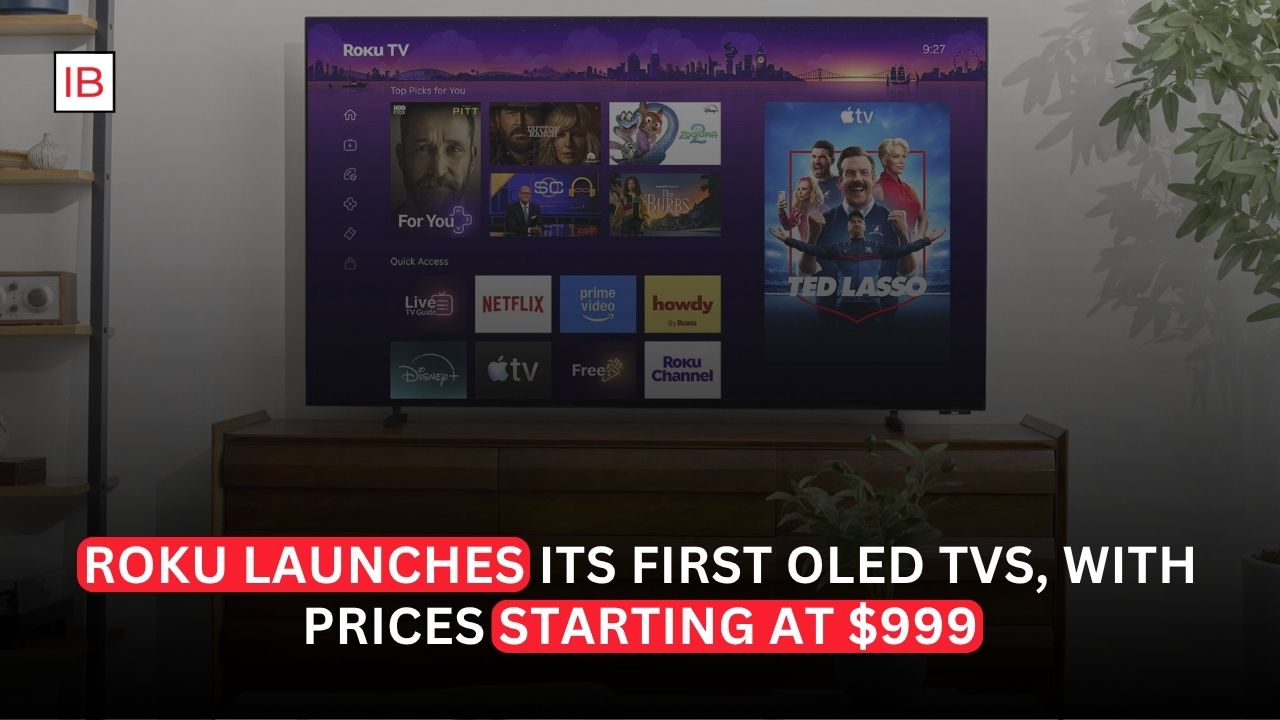
Roku is moving into the premium television market with its first OLED TVs, launching a new lineup designed to combine the company’s familiar streaming platform with higher-end picture technology at prices starting at $999.
The move represents an important expansion for Roku, which has historically built its television business around affordable and midrange sets. OLED technology has traditionally been associated with more expensive televisions from established manufacturers such as LG, Samsung and Sony. Roku is now attempting to make the technology more accessible while competing directly in a market where picture quality and gaming performance have become increasingly important.
The new lineup consists of the Roku Pro Series OLED and the higher-end Pro Series LX OLED. Both use OLED panels and run Roku’s operating system, giving buyers the company’s established interface and streaming ecosystem alongside the display technology.
Roku Enters the OLED Market
Roku has been selling its own branded televisions since 2023, but its previous premium models relied on QLED and Mini-LED technology rather than OLED.
The move into OLED gives Roku access to a different segment of the market.
OLED displays can produce extremely deep blacks because individual pixels can be turned off completely. They also offer strong contrast, wide viewing angles and fast response times, making them attractive to both movie enthusiasts and gamers.
Roku’s decision to enter the category also comes as OLED prices are becoming more competitive. The company’s $999 starting price puts its new television directly into the growing midrange OLED segment.
$999 Starting Price
The standard Roku Pro Series OLED is available in 55- and 65-inch sizes.
The 55-inch model starts at $999, while the 65-inch version costs more.
That pricing is significant because consumers can now consider an OLED television without moving into the $1,500-to-$2,000 price range often associated with larger premium models.
Roku is effectively positioning itself as a value-focused alternative in the OLED market.
However, the low starting price does not mean Roku has stripped the televisions down to basic specifications.
120Hz OLED Panel
The standard Pro Series uses a 120Hz OLED panel, providing smoother motion than conventional 60Hz televisions.
The higher refresh rate is particularly useful for sports and gaming.
The television also supports variable refresh rate technology and automatic low-latency mode, features designed to reduce visual tearing and input delay when connected to gaming consoles or compatible PCs.
That gives Roku a stronger argument for attracting younger consumers who use their televisions for more than streaming shows and movies.
Four HDMI 2.1 Ports
Another notable feature is the inclusion of four HDMI 2.1 ports.
That provides substantial connectivity for modern gaming systems, sound equipment and other high-bandwidth devices.
For buyers with multiple consoles or external devices, having four HDMI 2.1 connections can be more convenient than relying on HDMI switches.
The specification also signals that Roku wants the Pro Series to be taken seriously as a gaming television rather than simply an inexpensive streaming screen.
Dolby Vision and HDR
The Pro Series supports Dolby Vision and HDR10 Plus, giving it compatibility with several modern high-dynamic-range formats.
HDR can improve contrast, brightness and color reproduction when watching compatible movies and television programs.
Combined with OLED’s ability to produce very deep blacks, these technologies give Roku a strong foundation for home-theater performance.
The company is therefore entering the market with a television that offers many of the specifications consumers now expect from established premium brands.
Roku OS Remains the Selling Point
Picture quality may attract customers, but Roku’s software remains one of the company’s biggest advantages.
The new OLED televisions use Roku OS, giving users access to Roku’s familiar interface and streaming ecosystem.
That could appeal to consumers who already use Roku devices and prefer its relatively straightforward navigation.
For Roku, keeping the software experience consistent across lower-cost and premium televisions is also strategically important.
The company can use its television platform to maintain a direct relationship with consumers regardless of the hardware price.
A Backlit Remote
The Pro Series also comes with a backlit Roku remote.
That may sound like a small feature, but it addresses a common problem with television remotes: finding and using buttons in a dark room.
The television itself also includes a remote-finder button, allowing users to locate a misplaced remote more easily.
These features reinforce Roku’s focus on simplicity rather than turning the television into an overly complicated piece of home-theater equipment.
Pro Series LX Takes a Bigger Step
Roku is also introducing the Pro Series LX, which is positioned above the standard Pro Series.
The LX models will arrive in October rather than launching alongside the regular Pro Series.
They will be available in 55- and 65-inch versions priced at $1,299 and $1,599 respectively.
The higher price reflects additional display and gaming capabilities.
More Brightness
One of the main advantages of the Pro Series LX is increased brightness.
According to Roku, the LX is about twice as bright as the regular Pro Series.
That matters because OLED televisions have historically faced greater challenges competing with the brightest LCD and Mini-LED televisions, particularly in rooms with significant ambient light.
Higher brightness can make HDR content more impactful and improve visibility during daytime viewing.
144Hz Gaming Support
The LX also increases the refresh rate to 144Hz for variable-refresh-rate gaming.
That is a more specialized feature than the 120Hz capability of the standard Pro Series.
For PC gamers, a 144Hz television can provide smoother motion when compatible hardware is capable of producing sufficiently high frame rates.
Roku is therefore using gaming performance as another way to differentiate its premium models.
Reducing Screen Reflections
The Pro Series LX also includes a polarizer designed to reduce reflections.
This could be particularly useful in brightly lit rooms, where reflections can reduce the perceived contrast of an OLED screen.
The combination of greater brightness and reduced reflections addresses one of the practical weaknesses that can affect OLED televisions in certain environments.
It also gives Roku a clearer reason for consumers to spend more on the LX model.
Amazon Gets the Exclusive
For 2026, Roku’s new OLED televisions will be sold exclusively through Amazon.
The standard Pro Series is available now, while the LX models are scheduled for October.
The exclusive arrangement gives Roku a large online distribution channel while potentially simplifying the launch.
However, it also means consumers who prefer buying televisions through physical electronics retailers may have fewer options.
Roku Is Moving Upmarket
The OLED launch is part of a broader effort by Roku to expand beyond its traditional reputation as a budget-oriented television platform.
The company already offers higher-end QLED and Mini-LED televisions, including its existing Pro Series.
The new OLED models take that strategy further.
Rather than competing solely on low prices, Roku is attempting to establish itself as a legitimate premium television brand while maintaining the software experience that made its platform popular.
Competition Is Intensifying
Roku is entering an increasingly competitive OLED market.
LG and Samsung have long dominated the category, while Sony has also introduced lower-priced OLED models.
Sony’s recently launched Bravia 6, for example, starts at $1,300 for a 48-inch model and reaches $4,000 for an 83-inch version.
That makes Roku’s $999 entry price particularly aggressive.
But price alone will not guarantee success.
Consumers comparing OLED televisions will also examine processing, brightness, motion handling, color accuracy, gaming performance, software and long-term reliability.
The Value Proposition Has to Hold
Roku’s biggest challenge will be convincing consumers that its OLED models provide enough performance to compete with established brands.
A lower price creates attention, but premium television buyers can be demanding.
If Roku compromises too heavily on image processing or brightness to achieve the $999 price, consumers may decide that spending more on an LG, Samsung or Sony television is worthwhile.
The company therefore needs to deliver a noticeable improvement over its existing LCD and Mini-LED models.
OLED Prices Are Changing
Roku’s launch also reflects a broader change in the television market.
OLED technology is becoming less exclusive as manufacturers develop cheaper panels and more affordable television designs.
That is putting pressure on established brands to justify premium prices.
As more manufacturers enter the midrange OLED category, consumers are likely to gain more choices and potentially better value.
Roku’s arrival could accelerate that trend.
Roku Has a Software Advantage
Hardware specifications are only part of the competition.
Roku’s software platform gives the company an established ecosystem that many television manufacturers have spent years trying to build.
Consumers already familiar with Roku may prefer its interface over alternatives from Google, Samsung or other television makers.
That familiarity could help Roku sell premium televisions to existing customers who are ready to upgrade.
The Bigger Strategic Goal
The OLED launch is ultimately about more than one television model.
Roku’s television business helps the company extend its software platform into consumers’ homes.
The more valuable the hardware becomes, the more opportunities Roku has to keep users within its ecosystem and generate advertising and platform revenue.
That makes premium televisions strategically important even if hardware margins are not the company’s primary objective.
Conclusion
Roku’s first OLED televisions mark a significant expansion of the company’s hardware strategy.
The standard Pro Series launches in 55- and 65-inch sizes with prices starting at $999, while the Pro Series LX will arrive in October at $1,299 for 55 inches and $1,599 for 65 inches.
The televisions combine OLED display technology with Roku OS, Dolby Vision, HDR10 Plus, gaming features and four HDMI 2.1 ports.
The standard model offers a 120Hz refresh rate, while the LX adds greater brightness, 144Hz variable-refresh-rate gaming support and a polarizer designed to reduce reflections.
The pricing is the most aggressive part of the strategy.
Roku is entering a market historically dominated by companies with much longer experience in premium displays, but it is doing so at a price that could attract buyers who previously considered OLED too expensive.
That does not mean Roku has an easy path.
The company will have to prove that its picture quality and processing can compete with established OLED manufacturers while maintaining the simple software experience that distinguishes Roku.
Its Amazon exclusivity also gives the launch a narrower retail footprint.
Still, the arrival of Roku in OLED is another sign that the technology is moving further into the mainstream.
As more manufacturers compete at lower prices, OLED televisions are becoming less of a luxury product and more of a mainstream option.
For Roku, the opportunity is larger than selling televisions.
A successful OLED lineup could move the company further upmarket while strengthening the Roku platform and giving it a stronger presence in the premium home-entertainment market.