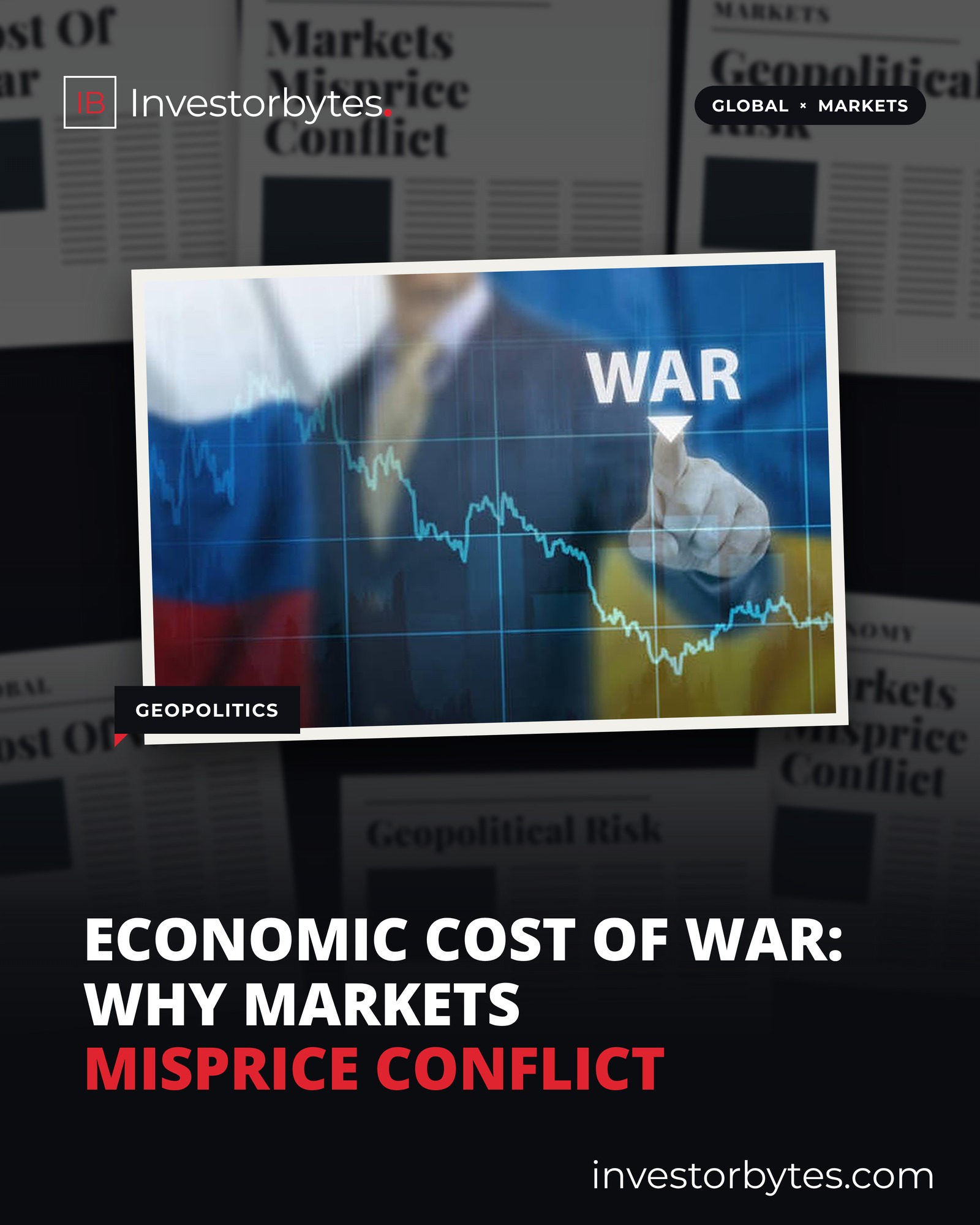
The economic cost of war is rarely paid by those who decide to wage it. That is the central argument advanced by Cambridge University associate professor Antara Haldar, who contends that armed conflict ranks among the most systematically mispriced activities in the modern world. With the US-Israeli war with Iran disrupting tanker traffic through the Strait of Hormuz, her thesis has moved from academic theory into the daily calculations of traders, central bankers and finance ministers far from the front lines.
Haldar’s point is not that war is cheap. It is that the bill is spread so widely, across borders, markets and generations, that the governments starting a conflict face only a fraction of the true price. In a globalised economy, that leakage is no longer an accident. It is built into the system.
Why the economic cost of war spills across borders
The Strait of Hormuz illustrates the problem neatly. A sizeable share of the world’s seaborne oil and liquefied natural gas passes through the narrow waterway between Iran and Oman, and when shipping there is throttled, the shock does not stay in the Gulf. Higher crude and gas prices feed into transport and electricity costs. Pricier energy lifts the cost of fertiliser, which in turn pushes up food prices. Central banks confronted with renewed inflation may keep policy tighter for longer, and growth slows in economies that had no say in the decision to fight.
The International Monetary Fund has already warned that the conflict is denting growth prospects for many countries as energy shocks ripple outward and inflation picks up. European Central Bank President Christine Lagarde has made a similar observation, noting that the costs are diffused through the global system and absorbed largely by energy importers, emerging markets and ordinary households.
Edward Fishman of the Center on Global Energy Policy, author of the book Chokepoints, has argued that the very infrastructure binding the world economy together, from energy shipping lanes to payment networks and supply chains, becomes a channel for contagion once conflict hits it. Haldar describes Hormuz as a structural vulnerability rather than a one-off risk.
Direct spending is only the visible tip
Washington’s direct military outlays on the Iran campaign could run from tens to hundreds of billions of dollars. Large as those sums are, Haldar argues that the indirect costs transmitted through energy, food and financial markets are likely to be far greater.
History supports the warning. Economists Joseph Stiglitz and Linda Bilmes famously estimated that the Iraq war cost the United States trillions of dollars once its wider macroeconomic effects were counted, far above early official projections. Research from both the IMF and the World Bank has found that violent conflict depresses growth even in economies located well away from the fighting. The war in Ukraine offers a more recent example: its negative spillovers for the rest of the world, from grain and energy prices to European industrial competitiveness, have far exceeded the direct costs borne by Russia itself.
Three ways the bill gets shifted
Haldar identifies three mechanisms through which the economic cost of war is pushed onto others.
The first is spatial. Because economies are tightly interconnected, disruption at a single node, particularly an energy chokepoint, cascades outward through trade and prices. A country that imports most of its fuel can find its inflation outlook rewritten by a conflict thousands of kilometres away.
The second is temporal. Governments typically finance wars with borrowing rather than immediate taxation, which shifts the burden onto future taxpayers who have no vote today. The fiscal legacy of past conflicts can linger in public debt for decades, constraining spending choices long after the fighting ends.
The third is distributive. Those who take the decision to go to war are seldom those who pay for it. Oxford economist Paul Collier has argued that conflicts persist precisely because they can be privately rewarding for small groups even when they are collectively irrational. Narrow interests may gain while importers, consumers and households lose.
What mispricing means for investors
The economic logic is familiar from other fields. When an activity is underpriced, it tends to be oversupplied, much as subsidised goods tend to be overconsumed. Pollution is the textbook example of a negative externality, and Haldar places risk and war in the same category. The result, in her framing, is that war looks expensive in theory but turns out to be affordable in practice for those who start it, because much of the bill lands elsewhere.
For markets, that has practical implications. If conflict is structurally underpriced by decision-makers, investors should not assume that its expense will deter it. Geopolitical risk premiums in oil, shipping insurance and emerging-market debt may need to be treated as a recurring feature rather than a temporary spike. Portfolios heavily exposed to energy importers, or to economies with limited fiscal room, are the most vulnerable to the second-round effects she describes. Readers can explore the full argument in Haldar’s original essay for World Finance.
Can the costs of conflict be internalised?
Haldar’s prescription borrows from environmental economics. Just as carbon pricing attempts to make polluters pay for the damage they cause, the costs of war would need to be internalised so that those who initiate a conflict bear all or most of its true cost. The idea that war imposes burdens on others has a long pedigree in political economy, running from Adam Smith and David Ricardo through John Maynard Keynes and Karl Polanyi.
Turning the principle into practice is the hard part. Haldar argues it would require an effective global institution capable of aligning the private and social costs of conflict more closely than markets can on their own. No such body currently exists, and existing multilateral organisations have struggled to enforce far less ambitious rules. Sanctions, reparations and frozen sovereign assets offer partial precedents, but they are applied selectively and usually after the damage is done.
Conclusion
The economic cost of war, Haldar’s analysis suggests, is not just high but misallocated. As long as those who choose conflict can export much of its price to energy importers, emerging markets, households and future taxpayers, the incentives will remain distorted. For policymakers, the challenge is institutional. For investors, the lesson is simpler: in a world where war appears affordable to those who wage it, geopolitical shocks are likely to keep arriving, and their costs will keep travelling far beyond the battlefield.