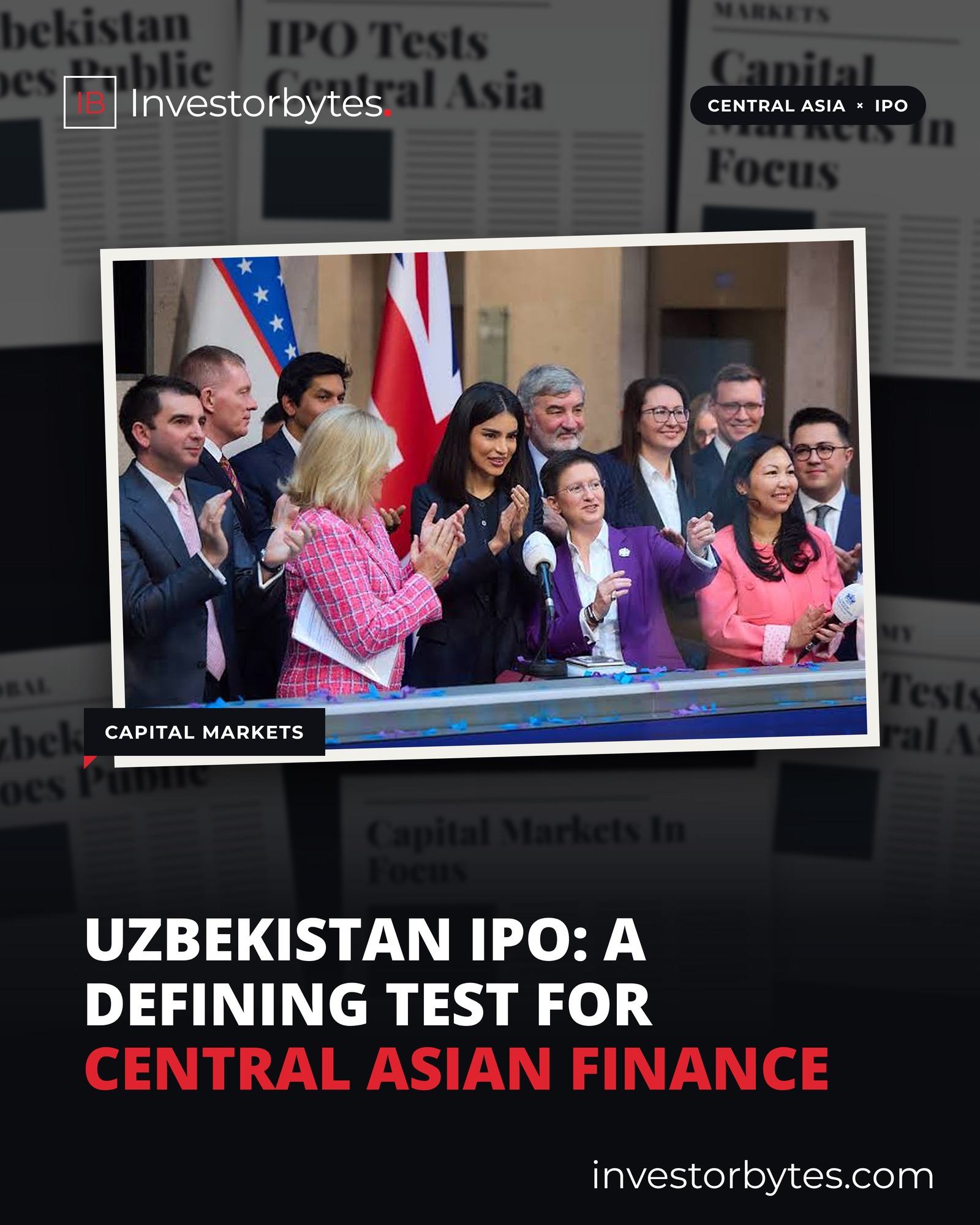
The Uzbekistan IPO of the National Investment Fund, known as UzNIF, is about far more than raising money for one government. Former Kyrgyz prime minister Djoomart Otorbaev argues that the London listing is a test of whether global investors are ready to view Central Asia as a region of genuine growth and credible governance, rather than a distant frontier market defined mainly by risk.
What the Uzbekistan IPO offers investors
UzNIF brings together minority stakes in 13 state-owned enterprises across transport, energy, telecommunications, utilities and banking. The fund holds about $2.4bn in assets and is valued at around $1.95bn, a discount of roughly 20 percent. It is managed by Franklin Templeton, one of the world’s major asset managers, and has secured an initial $300m commitment from anchor investors including BlackRock and Franklin Resources.
Otorbaev notes that this is the first time a Central Asian country has offered international investors a diversified basket of strategic assets through a London Stock Exchange listing. For investors, the structure provides exposure to a broad slice of the Uzbek economy in a single instrument, rather than requiring them to pick individual companies in a market with a limited track record of disclosure.
A structure built to answer risk concerns
Each design feature appears aimed at a familiar objection to frontier investing. The valuation discount compensates for perceived country risk. Placing the portfolio under an international manager addresses fears of political interference and opaque decision-making. The anchor commitments give the shares a stable base of demand once trading begins in the secondary market.
For global allocators, frontier markets are often overlooked not because of weak growth but because of the cost of due diligence, thin liquidity and the difficulty of exiting positions. A London listing, with familiar disclosure rules and settlement systems, lowers several of those barriers at once. It also places Uzbek assets in front of a pool of investors that would rarely venture onto the domestic exchange in Tashkent.
There is also a broader governance signal. By entrusting state assets to an outside manager, Tashkent is indicating a willingness to hold them to international standards of transparency, accountability and fiduciary discipline. That matters in a region where state ownership remains extensive and where foreign investors have often struggled to judge what public enterprises are really worth.
Central Asia’s quiet growth story
The economic backdrop is stronger than many investors assume. Over the past 25 years, Central Asian economies have grown at an average annual rate of about 4.8 percent, compared with roughly 3.4 percent for the global economy, and the region’s real output has roughly tripled. Growth held up through the Covid-19 pandemic, supply-chain disruptions and rising geopolitical tension.
The drivers differ by country. Uzbekistan has sustained annual growth above 5 percent, supported by domestic demand and a reform programme that includes gradual liberalisation. Kazakhstan is more exposed to commodity prices but has used its resource wealth and institutional reforms to maintain macroeconomic stability. Kyrgyzstan and Tajikistan have benefited from remittances, infrastructure investment and closer regional integration.
Demographics add to the appeal. Uzbekistan is the most populous country in Central Asia, with a young population and a growing labour force that support domestic demand for housing, energy, telecoms and financial services, precisely the sectors in which UzNIF holds stakes.
Geography turns from liability to asset
Landlocked Central Asia has historically been seen as remote and hard to reach. Today its position looks increasingly valuable. Instability linked to the Iran war and pressure on maritime chokepoints are encouraging governments and businesses to seek overland alternatives. The Middle Corridor, which links China with Europe via Central Asia, the Caspian Sea and the Caucasus, is expanding as a commercial route and attracting investment in rail, roads and ports.
Capital raised through vehicles such as UzNIF could, Otorbaev suggests, help finance large cross-border infrastructure, including Kyrgyzstan’s Kambarata-1 hydropower project and Tajikistan’s Rogun Dam. Both are long-gestation schemes that need patient, large-scale financing that domestic budgets alone struggle to provide, and both could reshape regional electricity supply if completed.
For investors, the corridor also links UzNIF’s holdings to a wider theme. Transport, energy and telecoms companies sit at the heart of any expansion in overland trade, so demand for their services could rise if more cargo moves across the region rather than around it by sea.
A benchmark and a political test
One underappreciated benefit of the listing is price discovery. Central Asia has lacked market-based valuation benchmarks for its major enterprises, and a traded fund would provide one. That could narrow the information gaps that have deterred foreign capital and pave the way for individual company listings in Uzbekistan and its neighbours, as well as hybrid models that combine public assets, private capital and international management. The full argument can be read in Otorbaev’s commentary for World Finance.
Otorbaev cautions against judging the outcome by first-day demand or early share-price moves. What investors will watch over the longer term is whether the government avoids political interference, keeps policy consistent and protects minority shareholders. In that sense, the Uzbekistan IPO is as much a political examination as a financial one, and its credibility will be earned over years rather than weeks.
The stakes extend beyond Tashkent. Neighbouring governments with large portfolios of state enterprises will be watching closely. A well-run fund that delivers steady returns could offer them a template for attracting foreign capital without surrendering control of strategic assets, while a poorly governed one would hand sceptics fresh ammunition.
Kazakhstan has pursued its own programme of selling stakes in state companies in recent years, and Uzbekistan’s experience will inevitably be compared with those efforts by investors weighing exposure to the region as a whole.
Conclusion
If the Uzbekistan IPO performs well, it could shift the narrative around Central Asia from one dominated by risk toward one centred on opportunity and returns, unlocking a pipeline of further deals across the region. If it stumbles on governance, it could reinforce old doubts. The question now is whether Uzbekistan can convert its current economic momentum into a lasting change in how the region is perceived and financed.