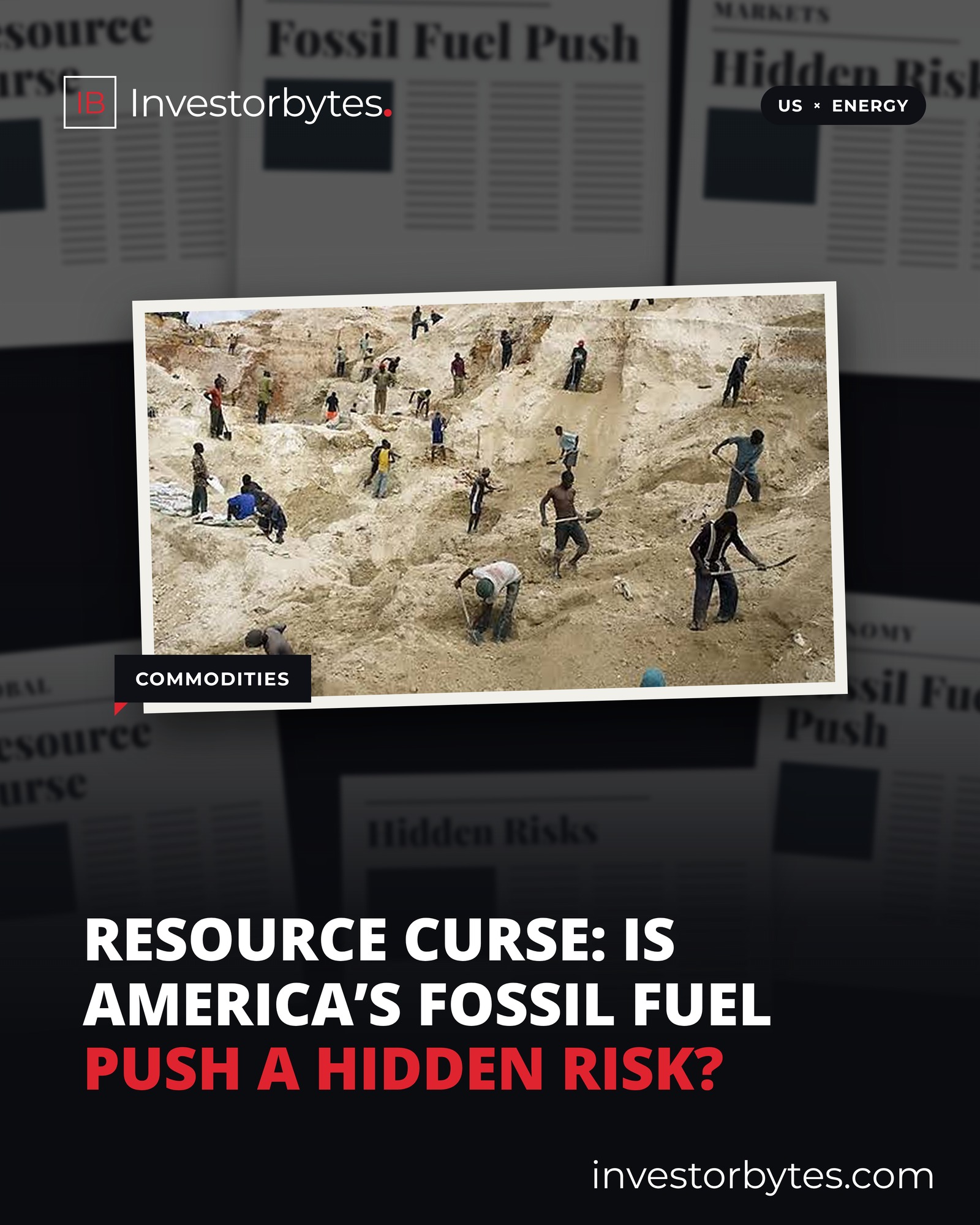
Natural resource wealth looks like a blessing. Countries with large reserves of oil, gas or minerals can earn export revenue, fund government budgets and attract foreign investment. Yet economists have long observed a paradox known as the resource curse: many resource-rich nations grow more slowly, suffer more volatility and develop weaker institutions than countries with fewer natural endowments. Now some economists are asking whether the United States, as it doubles down on fossil fuels under President Donald Trump, could be exposed to the same trap.
Harvard professor Jeffrey Frankel, a former economic adviser in Washington and one of the leading academic authorities on commodity economics, explores this question in a recent commentary. His argument is that the curse does not only affect developing economies. It works through investment, politics and long-term growth, and those channels can operate in large, diversified economies too.
What Is the Resource Curse?
The idea gained prominence in the 1990s, when research by economists including Jeffrey Sachs and Andrew Warner found that countries heavily dependent on natural resource exports tended to grow more slowly than others over long periods. Examples often cited include oil exporters that experienced booms followed by painful busts, persistent corruption or political instability.
Economists have identified several mechanisms behind the pattern. One is the so-called Dutch disease, named after the Netherlands’ experience following large natural gas discoveries in the 1950s and 1960s. A resource boom pushes up the value of the currency and draws labour and capital into the extractive sector, making manufacturing and other exports less competitive. When commodity prices later fall, the economy is left with a weakened industrial base.
A second mechanism is volatility. Commodity prices swing sharply, and governments that rely on resource revenue often spend freely during booms and are forced into harsh cuts during busts. A third is political: resource rents can encourage lobbying, cronyism and policy decisions that favour incumbent industries over the broader economy.
America’s Fossil Fuel Expansion
The United States is already the world’s largest producer of oil and natural gas, thanks largely to the shale revolution that began in the late 2000s. It has also become the world’s largest exporter of liquefied natural gas. The Trump administration has made expanding fossil fuel production a central policy goal, promoting new drilling, faster permitting and wider access to federal lands, while scaling back support for renewable energy and climate initiatives.
Supporters argue that this strategy strengthens energy security, lowers costs for consumers and gives Washington geopolitical leverage by supplying allies. Critics counter that tying the economy more closely to fossil fuels risks locking in exposure to price swings and to a sector that may face declining long-term demand as the world shifts towards cleaner energy.
How the Resource Curse Could Affect the US
The first risk is distorted investment. When policy tilts heavily towards oil and gas, capital and talent may be drawn away from sectors with stronger long-term growth potential, such as advanced manufacturing, clean technology and batteries. China has built a dominant position in many of these industries, and a US retreat from them could leave American companies further behind.
The second risk is political. One of the clearest lessons from resource-dependent economies is that concentrated resource wealth can shape policy in ways that protect incumbents rather than serve the wider public. Frankel’s framing in Jeffrey Frankel’s World Finance column stresses that the curse distorts politics as well as economics, as industries with large rents gain influence over regulation, taxation and trade policy.
The third risk concerns long-term growth. Fossil fuel extraction is capital-intensive but employs relatively few people compared with its share of output. If the economy’s growth engine becomes more reliant on commodity cycles, it may also become more volatile, with regional booms and busts in producing states. The oil price collapse of 2014 to 2016, which triggered bankruptcies across the shale sector and job losses in states such as Texas and North Dakota, offered a preview of how quickly fortunes can reverse. Communities that bet heavily on a single industry often struggle to recover when the cycle turns.
Why the US Is Not Venezuela
It is important to keep the risks in proportion. The US economy is vast and diversified, with world-leading technology, finance and services sectors. Energy accounts for a far smaller share of output and exports than it does in classic petrostates. American institutions, from independent courts to a free press and a central bank with a strong record, are also much stronger than those in countries most often associated with the resource curse.
Norway is frequently cited as proof that resource wealth can be managed well. By channelling oil revenue into a sovereign wealth fund and maintaining strict fiscal rules, it has avoided many of the problems that afflicted other producers. The difference lies in institutions and policy choices rather than geology.
Lessons for Investors and Policymakers
For investors, the debate highlights how policy can shape sector returns and macroeconomic risk. Energy companies may benefit from supportive regulation in the near term, but their earnings remain tied to volatile global prices. Meanwhile, cuts to support for clean energy could affect the outlook for renewable developers, manufacturers and their suppliers in the US, even as demand for these technologies grows elsewhere.
For policymakers, the lesson from history is that resource wealth needs careful management. Counter-cyclical fiscal policy, transparent governance and continued investment in education, research and diverse industries can help a country capture the benefits of its resources without becoming dependent on them. Frankel has long advocated such approaches for commodity exporters, including mechanisms to save windfall revenues during booms.
Conclusion
The United States is unlikely to suffer the dramatic economic decline seen in some petrostates. But the resource curse is not an all-or-nothing condition. It operates through subtler channels, misallocated investment, policy capture and greater exposure to commodity swings, that can erode long-term growth. As Washington leans harder into fossil fuels, those channels deserve close attention from anyone with a stake in the world’s largest economy.