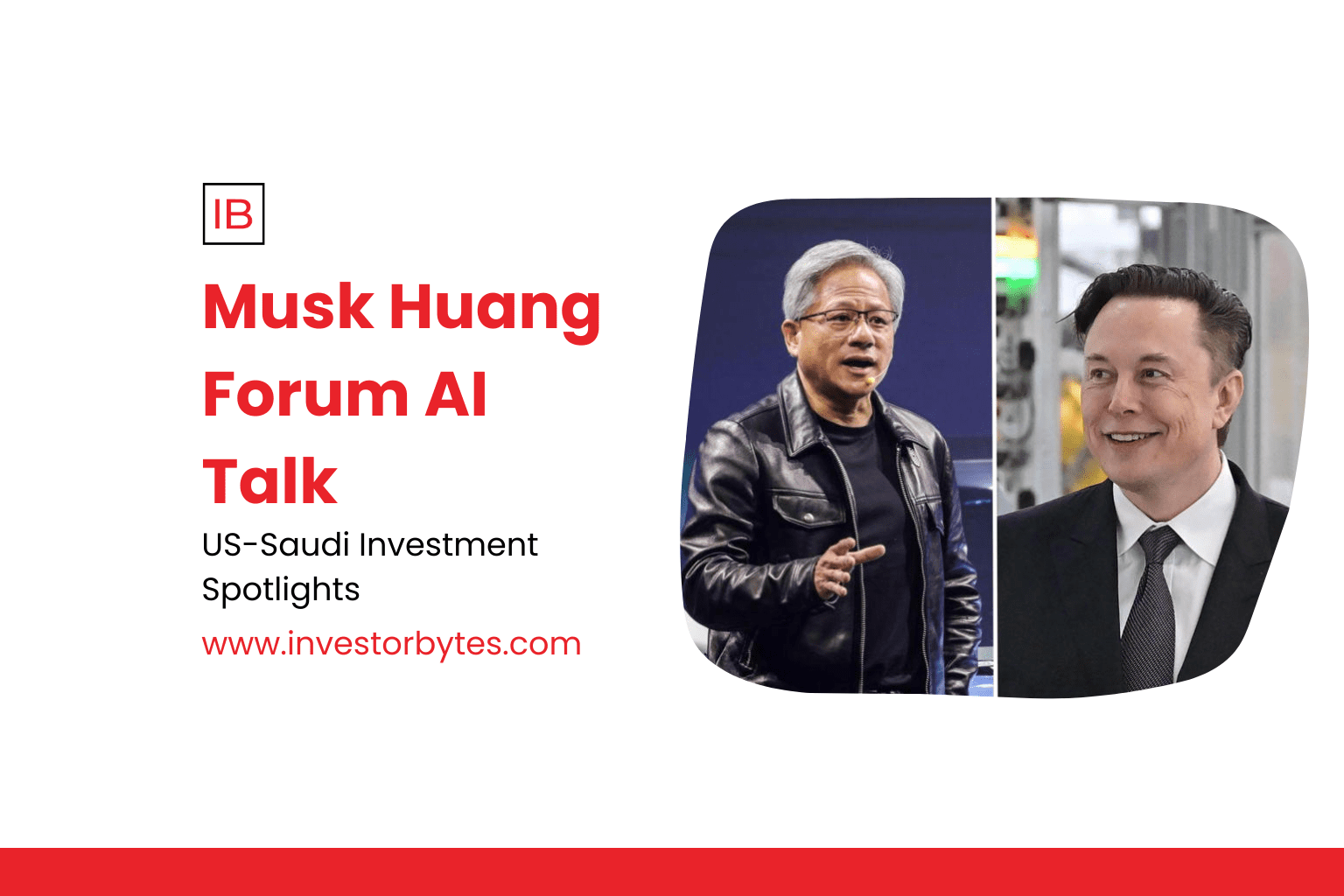
In a star-studded showdown at the U.S.-Saudi Investment Forum on November 19, 2025, Tesla and xAI visionary Elon Musk and Nvidia powerhouse Jensen Huang dissected AI‘s seismic trajectory, captivating Washington D.C.’s elite with prophecies of work’s obsolescence and cosmic computation frontiers. Moderated by Saudi Communications Minister Abdullah Alswaha at the Kennedy Center, the duo’s fireside chat—amid a $1 trillion Saudi AI pledge—blended optimism with urgency, spotlighting humanoid robots, reusable rockets, and “AI factories” as harbingers of economic metamorphosis. Musk, fresh from a Trump-hosted dinner with Crown Prince Mohammed bin Salman, quipped on Nvidia’s impending earnings: “Bernstein’s rolling,” drawing laughs before plunging into bold forecasts.
Musk envisioned a 10-20 year horizon where “work becomes an elective,” as abundance from AI-robotics renders money “irrelevant.” He championed xAI’s Memphis supercluster—boasting 100,000 Nvidia H100 GPUs—as a stepping stone to general intelligence, projecting terawatt-scale demands that Earth’s grids can’t sustain. “We’ll need gigawatts,” Huang interjected, underscoring energy bottlenecks, while advocating AI’s immediate workforce multiplier role: enhancing radiology diagnostics and drug discovery 30% faster. Their synergy shone in banter—Huang craving “R2-D2 in C-3PO’s body” for versatile bots—yet diverged on timelines: Musk’s utopian leap versus Huang’s pragmatic “busier short-term” grind.
This Musk Huang AI forum 2025 dialogue electrified stakeholders from Blackstone to Lockheed Martin, aligning with Saudi’s Vision 2030 to funnel petrodollars into silicon sovereignty. Huang touted Nvidia’s Blackwell chips enabling “vibe coding” for intuitive software genesis, while Musk teased SpaceX synergies: orbital data centers harnessing solar constancy and vacuum cooling to bypass terrestrial limits. “Earth can’t power the future,” Musk declared, floating Starship-launched AI habitats radiating heat effortlessly—potentially slashing costs 50% via lighter infrastructure. Huang nodded, revealing Nvidia’s desert “AI factory” collab with xAI and Saudi’s Humain, targeting 1 GW pilots by 2027.
Broader ripples? The forum catalyzed $600 billion in U.S.-Saudi tech pacts, per Reuters, boosting NVDA shares 2% intraday despite broader market jitters. Critics like EFF warn of unchecked AGI risks—job displacement hitting 8 million by 2027, per McKinsey—but proponents eye GDP surges: Saudi’s $100 billion AI kitty could yield 15% regional growth. For innovators tracking Musk Huang forum AI talk 2025, this wasn’t mere monologue—it’s manifesto: AI as elective endeavor demands ethical guardrails, from bias audits to energy pacts. As transcripts circulate—featuring Musk’s “text it off” quip to Huang—their visions converge on one truth: humanity’s next leap orbits innovation’s edge, where silicon dreams eclipse fiscal chains.