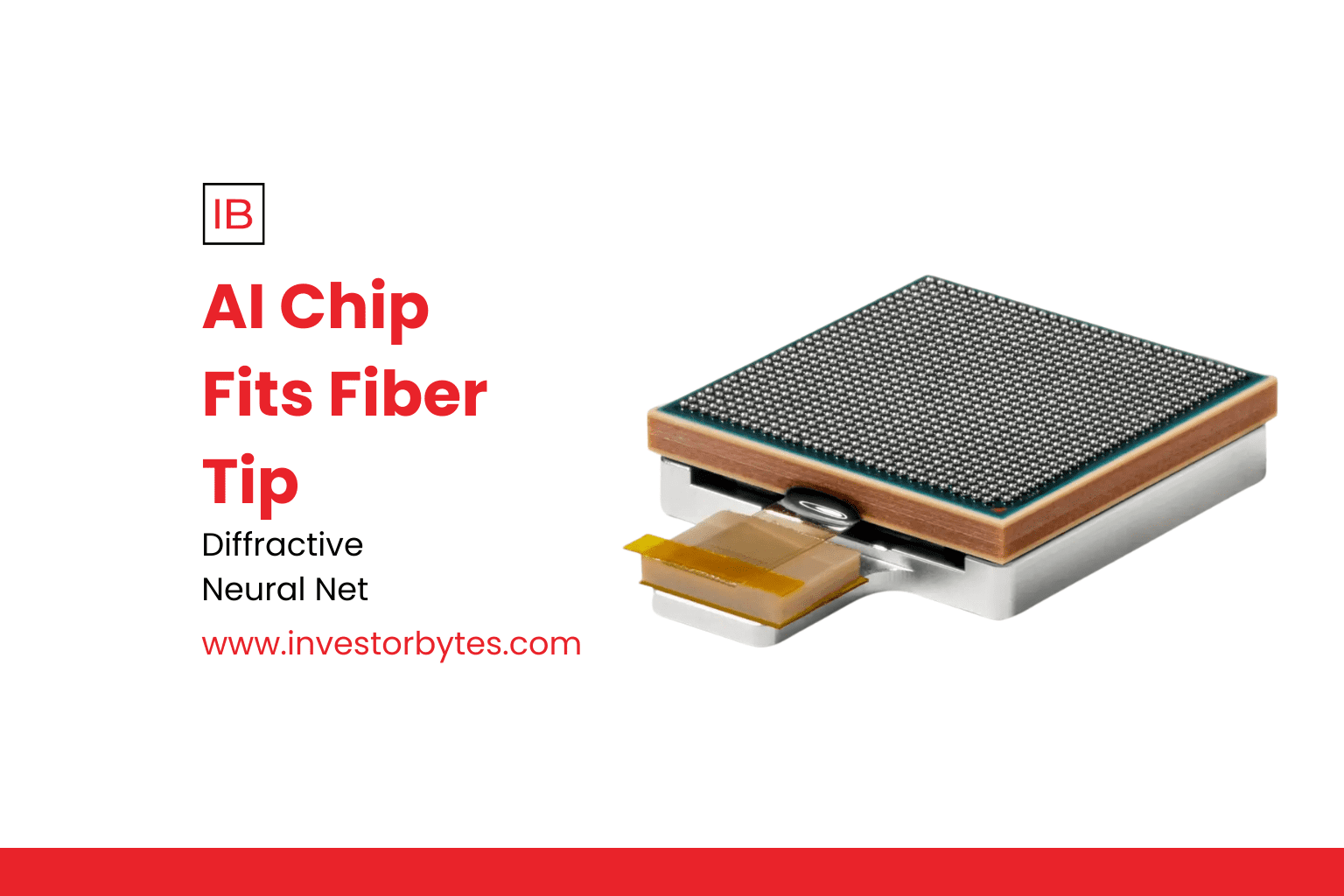
Engineers at the University of Shanghai for Science and Technology have pioneered a diffractive neural network (DNN) chip, tinier than a grain of salt, fused to optical fiber tips for passive, ultra-efficient AI computations. Fabricated via 3D glass-substrate two-photon nanolithography, this photonic marvel processes light-encoded data at picosecond speeds, decoding images with 98% accuracy while sipping mere nanowatts—thousands of times less energy than silicon counterparts. By diffracting photons through etched nanostructures, the chip performs matrix multiplications inherently, bypassing electronic conversions for seamless fiber-optic integration.
This breakthrough targets bandwidth-hungry AI in edge devices, from endoscopic medical imaging—enabling real-time, high-res tumor detection inside the body—to telecommunications, where it classifies signals without latency spikes. Experimental trials encoded numerals into light pulses, reconstructing them flawlessly post-fiber traversal, rivaling GPU performance at fractions of the power. Scaling to multi-layer DNNs could tackle complex tasks like natural language processing on a single fiber, revolutionizing IoT and 6G networks. As fabrication matures, this fiber-tip AI heralds a paradigm of distributed intelligence, where computation permeates infrastructure, slashing data center loads and democratizing high-fidelity sensing.