New PCIe 6.0 SSDs Aim to Power Next-Generation AI Infrastructure
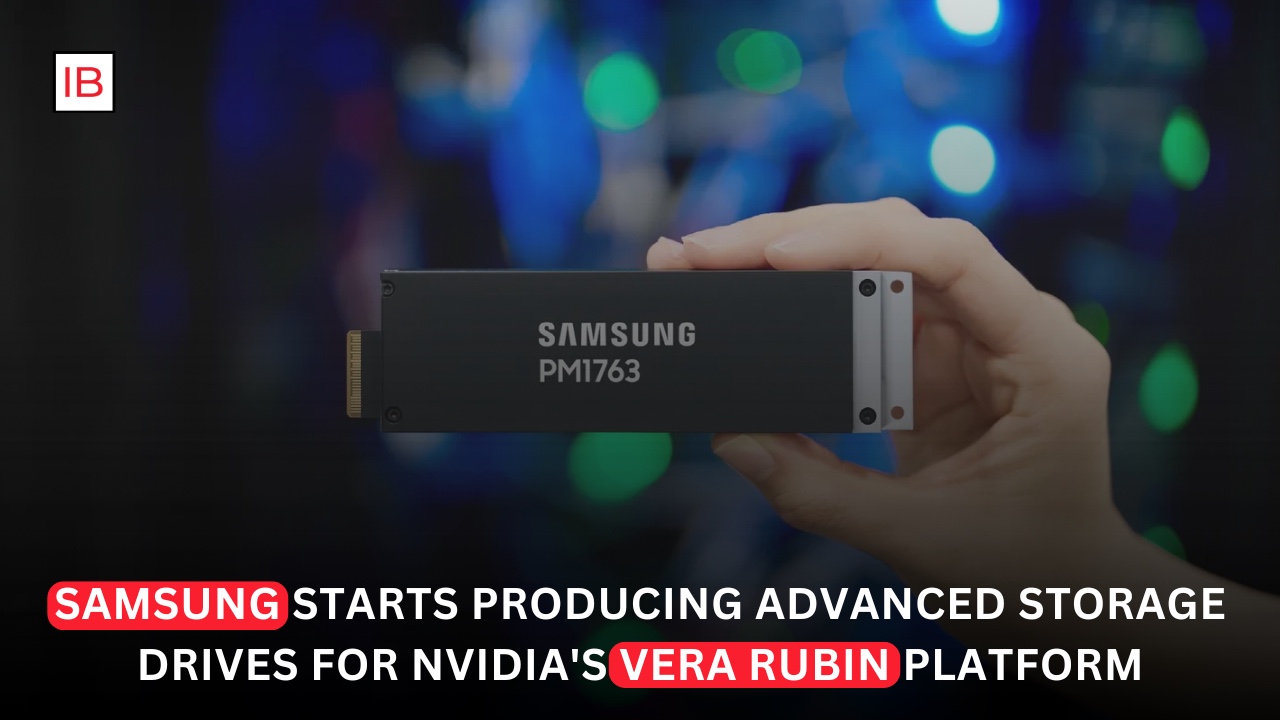
Samsung Electronics has begun mass production of its latest enterprise solid-state drives (SSDs) designed for Nvidia’s Vera Rubin AI platform, strengthening its position in the rapidly expanding artificial intelligence hardware market.
The new storage drives are built to meet the massive data processing demands of next-generation AI systems and data centers, where faster storage is becoming just as important as advanced GPUs and memory.
Advanced PCIe 6.0 SSDs for AI Workloads
Samsung’s flagship storage solution for the Vera Rubin platform is the PM1763 PCIe 6.0 SSD, which offers:
- Storage capacities of up to 64TB
- PCIe Gen 6 interface for higher bandwidth
- Ninth-generation TLC NAND flash
- A 4-nanometer storage controller
The company is also producing the PM1753 SSD, optimized for Nvidia’s BlueField-4 accelerated storage architecture, which is designed to support demanding AI inference and data-intensive workloads.
Supporting Nvidia’s Next AI Supercomputer
Nvidia’s Vera Rubin platform represents the company’s next generation of AI infrastructure, combining:
- Rubin GPUs
- Vera CPUs
- High-bandwidth memory (HBM4)
- Advanced enterprise storage
The platform is designed for increasingly complex agentic AI applications, where AI systems perform multi-step reasoning, retrieve information, and execute tasks with minimal human intervention. Initial customer deployments are expected during the second half of 2026.
Samsung Expands Beyond Memory Chips
Samsung is supplying more than storage for Nvidia’s AI ecosystem.
The company has also entered mass production of:
- HBM4 high-bandwidth memory
- SOCAMM2 memory modules
- Enterprise AI SSDs
By providing multiple components for Nvidia’s next-generation systems, Samsung aims to strengthen its role across the AI hardware supply chain rather than relying solely on memory chip sales.
AI Infrastructure Drives Storage Demand
Modern AI models require enormous amounts of storage to process and retrieve training data efficiently.
Industry analysts expect Nvidia’s Vera Rubin systems to consume millions of terabytes of enterprise storage over their deployment cycle.
That demand could tighten the global NAND flash market and increase demand for high-performance enterprise SSDs as hyperscale cloud providers continue expanding AI infrastructure.
Competition Intensifies in Enterprise Storage
Samsung is competing closely with:
- Micron Technology
- SK Hynix
While all three companies have been certified to supply key memory technologies for Nvidia’s Vera Rubin platform, Samsung is positioning its storage products as an important advantage in serving AI data centers.
The company is emphasizing:
- Higher throughput
- Improved energy efficiency
- Greater storage capacity
- Optimized performance for AI workloads
AI Data Centers Become a Major Growth Engine
The launch reflects a broader industry trend as semiconductor manufacturers shift their focus toward AI infrastructure.
Demand continues to grow for:
- High-performance GPUs
- Advanced memory
- Enterprise storage
- Networking hardware
- AI servers
These components are increasingly being developed together as integrated platforms capable of supporting large-scale generative AI and enterprise computing.
Looking Ahead
Samsung’s mass production of PCIe 6.0 SSDs for Nvidia’s Vera Rubin platform marks another milestone in the rapidly evolving AI hardware industry.
As organizations deploy increasingly powerful AI systems, storage performance has become a critical part of overall computing efficiency. By supplying both advanced memory and enterprise storage, Samsung is seeking to become one of Nvidia’s most important hardware partners for the next generation of AI infrastructure.