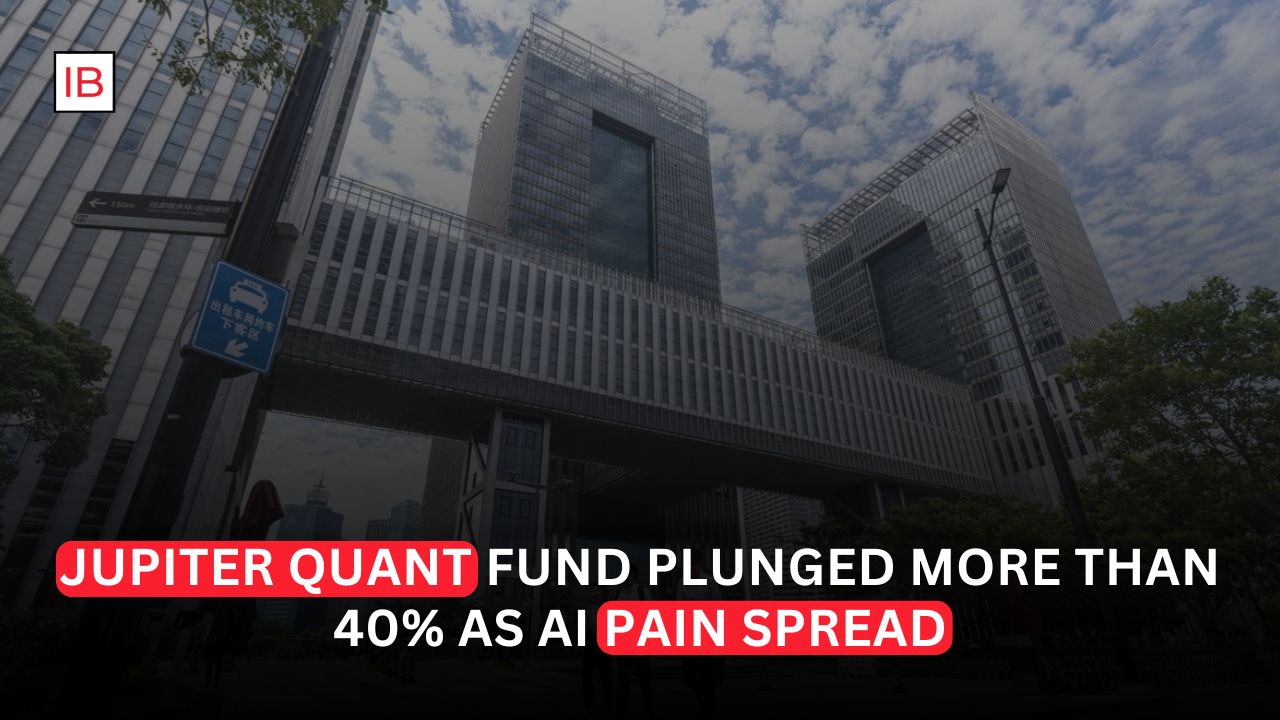
A fund tied to Shanghai Minghong Investment Management, one of China’s largest quantitative hedge funds, has plunged more than 40%, becoming one of the most dramatic casualties yet of the AI-driven selloff that has rocked Chinese quant trading desks in recent weeks.
A Firm Once Untouchable
Shanghai Minghong built its reputation as one of China’s premier quantitative trading houses, managing roughly $7 billion in assets and expanding overseas through its Hong Kong-based Jupiter Research arm and a New York office. Founded in 2014 by Qiu Huiming, a physics PhD, the firm rose to prominence using medium-to-high frequency statistical arbitrage strategies that for years delivered market-beating returns.
That reputation had already taken a hit once before, back in 2021, when the firm’s offshore fund fell 27% in a single quarter and triggered the largest wave of redemptions in its history. This latest plunge marks an even steeper drawdown, underscoring how violently the current market environment has turned against strategies that once seemed reliably profitable.
A Broader Meltdown Across China’s Quant Industry
The losses at Minghong’s Jupiter-branded fund did not happen in isolation. They are part of a much broader crisis sweeping China’s quantitative hedge fund industry since mid-July, when the CSI 1000 Index, which tracks 1,000 small and liquid China A-shares heavily weighted toward technology and industrials, plunged more than 12% in a single week — its worst performance since a similar quant-driven selloff in February 2024.
Other major names were hit hard during the same stretch. A fund tied to DeepSeek founder Liang Wenfeng’s Zhejiang High-Flyer Asset Management tumbled nearly 16% in a week, while rival HanTak Investment Management suffered a similar loss on a comparable strategy. More than ten Chinese hedge funds have since announced plans to inject their own proprietary capital into their funds to restore shaken investor confidence.
How Crowded Trades Turned Into a Freefall
Industry insiders describe the collapse as the product of a dangerous feedback loop that had been building for months. According to Li Minghong, investment director at E Tiger Private Fund Partners LLC, momentum and beta factors had pushed both traditional and machine-learning-driven quant models into increasingly similar positions within the same AI-linked small-cap stocks, creating a dangerously crowded trade.
As valuations climbed, fresh inflows from wealthy investors began drying up, leaving markets with less fresh buying power to sustain the rally. A sharp downturn in overseas AI and semiconductor shares then became, in Li’s words, the final straw, triggering a wave of redemptions that forced quant managers to unwind positions simultaneously, deepening the slide.
Volatility Unlike Anything Seen in Years
Volatility during the worst of the selloff ran roughly 50% above year-earlier levels, according to industry trackers, with factors that normally offset one another instead collapsing together — a phenomenon that overwhelmed the statistical models underpinning many quant strategies. For funds like Minghong’s, which rely heavily on these models functioning predictably, that kind of simultaneous breakdown proved devastating.
Some relief arrived when Chinese authorities and state-backed investors moved to shore up confidence, helping stocks stage a partial rebound, with China’s STAR 50 Index jumping nearly 11% in a single session and the Shenzhen-listed ChiNext Index rallying more than 7%. Even so, the scale of losses at funds like Minghong’s Jupiter product suggests the damage from the initial rout has been difficult to fully reverse.
A Wake-Up Call for China’s Quant Boom
The episode marks one of the most serious setbacks for China’s quant fund industry in years, an industry that had drawn billions from wealthy investors seeking market-neutral returns as one of the few reliable bright spots amid a prolonged property downturn and sluggish broader equity markets. The crisis has rattled confidence precisely when AI-driven trading strategies had been widely celebrated for outperforming traditional human stock pickers.
Regulators have taken notice too, with China’s securities regulator signaling tighter scrutiny of quant and AI-linked trading strategies going forward, a sign the fallout from this selloff could reshape how the industry operates even after markets stabilize.
What Comes Next
With Minghong and other major quant firms now working to rebuild investor trust, often by committing their own capital alongside client funds, the coming months will test whether China’s AI-driven quant boom can recover its footing or whether this episode marks a more lasting reckoning for an industry that grew increasingly concentrated in the same crowded trades. For funds like Jupiter that suffered the steepest losses, restoring confidence may prove considerably harder than the models that got them into trouble in the first place.