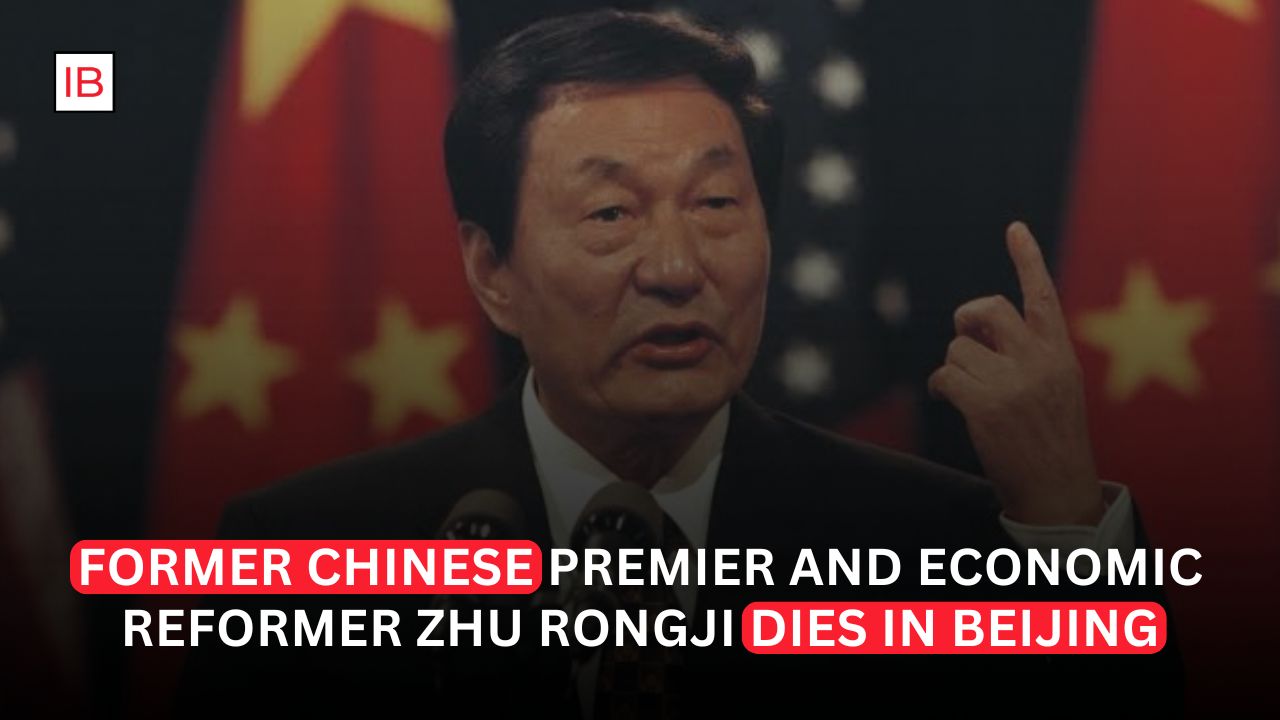
Former Chinese Premier Zhu Rongji, one of the most consequential economic reformers of the post-Mao era, has died at the age of 97, marking the end of an era for a leader who helped reshape China’s economy and prepare the country for its emergence as a global economic power. Zhu died in Beijing after an illness, according to Chinese state media.
Zhu served as premier from 1998 to 2003, after previously serving as vice premier and mayor of Shanghai. His tenure came during one of the most important periods in modern Chinese economic history. He pushed through painful reforms to state-owned enterprises, strengthened government finances, restructured parts of the banking system and played a decisive role in bringing China into the World Trade Organization.
His legacy is complicated. The reforms helped create the foundations for China’s extraordinary economic expansion, but some of the policies also produced social and economic costs that continued to shape the country long after he left office.
The Reformist Who Was Willing to Make Difficult Choices
Zhu developed a reputation for being blunt, impatient and unusually willing to confront powerful interests.
At a time when China’s economy still contained large numbers of inefficient state-owned companies, Zhu argued that the government could no longer protect enterprises simply because they were state-owned.
His administration pursued an aggressive restructuring of state-owned enterprises, including shutting down or privatizing inefficient businesses and reducing their workforces.
The reforms were painful.
Millions of workers lost their jobs as state companies were streamlined. But Zhu believed that maintaining inefficient enterprises indefinitely would prevent China from developing a more competitive economy.
This was one of the central contradictions of Zhu’s economic strategy: short-term disruption was accepted in pursuit of long-term productivity.
Fighting Inflation Was Another Priority
Zhu also confronted inflation and macroeconomic instability.
China had experienced rapid growth alongside periods of severe price pressure, exposing weaknesses in its economic management system.
As vice premier and later premier, Zhu supported reforms designed to strengthen fiscal and monetary management and bring greater discipline to government finances.
The World Bank has described the period as one in which Chinese policymakers were searching for more effective tools to control boom-and-bust cycles and manage inflation.
Zhu’s approach was generally pragmatic rather than ideological.
He was willing to use market mechanisms while maintaining a strong role for the state.
That combination became an important feature of China’s economic model.
WTO Accession Was His Defining Achievement
Perhaps Zhu’s most important international economic achievement was helping secure China’s entry into the World Trade Organization.
China joined the WTO in 2001 after years of difficult negotiations.
Zhu understood that membership would expose Chinese companies to significantly greater international competition.
But he also saw that pressure as an opportunity to force domestic reforms that might otherwise be politically difficult.
China accepted substantial commitments involving tariffs, trade restrictions, intellectual property and access for foreign companies.
A World Bank historical analysis describes Zhu’s 1999 effort to accelerate negotiations with the United States as a critical moment in China’s WTO accession process.
The logic was straightforward: instead of allowing domestic companies to remain protected indefinitely, China would use international competition to force them to become more efficient.
That decision helped transform the country’s role in global trade.
China’s Economic Takeoff Followed
The timing of Zhu’s reforms was crucial.
After WTO accession, China’s exports expanded rapidly and foreign investment surged.
Manufacturing became increasingly integrated into global supply chains.
Chinese companies gained access to larger international markets while foreign companies gained greater access to China’s rapidly growing economy.
The results were enormous.
China’s economy expanded at extraordinary rates over the following decade, eventually becoming the world’s second-largest economy.
Zhu cannot be credited with all of that transformation.
Deng Xiaoping’s reforms, Jiang Zemin’s leadership, China’s enormous labor force, infrastructure investment, foreign capital and global demand all played major roles.
But Zhu helped create the institutional and economic conditions that allowed those forces to operate at much greater scale.
His Housing Reforms Had Lasting Consequences
Zhu’s government also helped accelerate the transition toward private home ownership.
China moved away from the old system in which housing was largely provided through state employers.
The development of private housing markets contributed to the growth of China’s property sector and helped create a new source of household wealth.
But this legacy is more controversial.
China’s enormous property boom eventually became one of the country’s biggest economic vulnerabilities.
Decades after Zhu’s reforms, excessive property investment, high household leverage and large developer debts became major problems.
That does not mean Zhu’s housing reforms directly caused today’s property crisis.
But it illustrates an important feature of his legacy: policies that helped modernize China also created new risks as the economy evolved.
Banking and Fiscal Reform
Zhu also targeted China’s financial system.
State banks were burdened with large amounts of non-performing loans, while government finances were fragmented.
His administration strengthened central fiscal authority and worked to improve the health of the banking sector.
These changes were critical because rapid economic growth requires financial institutions capable of allocating capital efficiently.
Without banking reform, China’s industrial expansion could have been constrained by weak financial institutions.
Zhu’s reforms helped create a more modern financial system while preserving significant state control.
A Reputation for Accountability
Zhu was also unusual in the way he communicated.
He was known for direct language and sometimes openly acknowledged government failures.
That style helped establish an image of a politician willing to accept responsibility rather than hide behind bureaucratic language.
Reuters notes that his speeches reflected an uncompromising approach toward corruption, inefficient governance and economic mismanagement.
That reputation contributed to his popularity among some Chinese citizens and reform-minded officials.
It also made him a distinctive figure within China’s political leadership.
The Costs Were Real
It would be misleading to describe Zhu simply as an economic hero.
The restructuring of state enterprises caused enormous social disruption.
Workers who had relied on state companies for employment, housing and social benefits suddenly faced a much less secure environment.
The reforms also increased inequality and contributed to major changes in China’s labor market.
Some economists have argued that Zhu’s policies created long-term problems in areas such as regional fiscal relations and agriculture.
So his legacy should be judged on both sides.
He accelerated modernization, but millions of people paid the immediate price.
Zhu’s China Was Different From Today’s China
Perhaps the most interesting aspect of Zhu’s death is the contrast between the economic philosophy associated with his era and China’s current direction.
Zhu operated during a period when Beijing was increasingly embracing markets, globalization and international integration.
The objective was to make China more competitive by exposing domestic companies to foreign competition.
Today’s China remains deeply integrated into global trade, but the political environment is different.
The state plays a much more prominent role in strategic industries, technology and national economic planning.
That does not mean China has abandoned markets.
Instead, the balance between markets and state control has shifted.
Zhu’s economic legacy therefore remains relevant partly because it represents an earlier phase of China’s development.
The WTO Bet Changed China
The biggest lesson from Zhu’s career may be the scale of the bet he made on globalization.
When China joined the WTO, the country was still a developing economy with large numbers of inefficient state companies.
Zhu believed international competition could be used as a mechanism for domestic reform.
It worked to an extraordinary extent.
China became the world’s manufacturing center and eventually one of the most important exporters of industrial goods, electronics and machinery.
But the global system that helped China rise has also produced tensions.
Chinese industrial capacity now competes directly with established manufacturers in Europe, Japan, South Korea and the United States.
The trade policies of major economies toward China have become increasingly confrontational.
In that sense, Zhu’s success helped create the economic giant that today’s geopolitical competitors are trying to manage.
His Legacy Is Larger Than His Premiership
Zhu left office in 2003, but the consequences of his policies continued for decades.
The industrial restructuring he initiated changed the relationship between the state and Chinese companies.
WTO accession transformed China’s role in the global economy.
Banking and fiscal reforms strengthened the foundations of economic growth.
Housing reforms helped create a massive property market.
And his emphasis on efficiency helped push China away from some of the rigidities of the centrally planned economy.
Few Chinese economic officials have had such a direct influence on the country’s transformation.
What Zhu’s Death Means Historically
Zhu Rongji belonged to a generation of Chinese leaders who believed that economic reform could fundamentally change the country’s position in the world.
He did not dismantle China’s state-led system.
Instead, he tried to make that system more efficient and internationally competitive.
That distinction is important.
His approach was never simply about replacing the state with the market.
It was about using markets, competition and global integration to strengthen China’s economy while maintaining political control.
That model became one of the defining characteristics of China’s rise.
Zhu’s death therefore represents more than the passing of a former premier.
It closes another chapter in the history of the generation that transformed China from a relatively isolated economy into a central player in global commerce.
His record contains both achievements and consequences.
But the scale of the transformation associated with his tenure is difficult to dispute.
Zhu Rongji helped make the economic China of the 21st century possible — and many of the opportunities and problems facing China today can be traced, at least in part, to the reforms that defined his era.