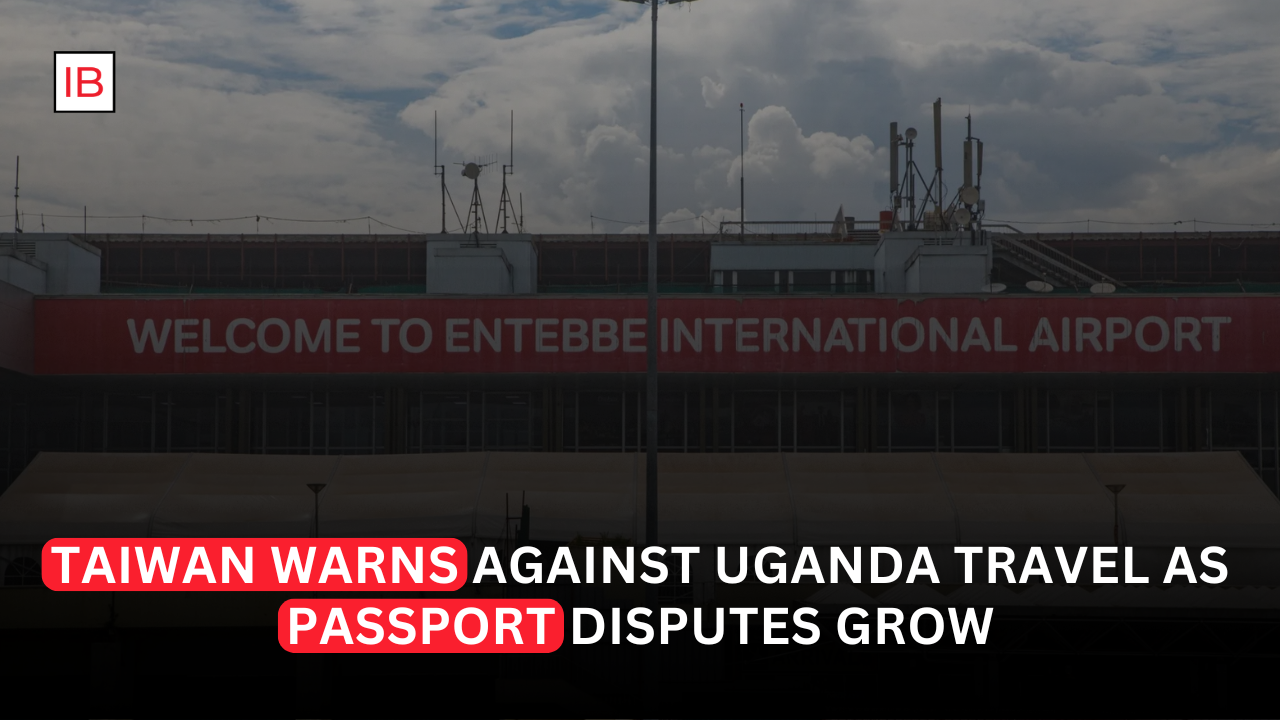
Taiwan has advised its citizens to postpone nonessential travel to Uganda following a dispute involving the treatment of Taiwanese travelers at Entebbe International Airport, adding another layer of tension to the island’s already complicated diplomatic relationship with countries that recognize Beijing.
The warning follows an incident involving three Taiwanese travelers at Entebbe, according to Taiwan News. The dispute centers on how Taiwanese passports and travelers are identified and handled by Ugandan authorities.
A Passport Dispute With Diplomatic Consequences
On the surface, the issue appears to involve travel documents.
But the underlying problem is political.
Taiwan’s passport is issued by the Republic of China, while Uganda recognizes the People’s Republic of China rather than Taiwan as a separate diplomatic entity.
That creates complications when Taiwanese citizens travel to countries that follow Beijing’s position on Taiwan.
Passport terminology, country names and official documentation can therefore become politically sensitive.
Why Uganda Matters
Uganda is an important East African transportation and business hub.
Its main international gateway, Entebbe International Airport, connects the country with destinations across Africa, the Middle East, Europe and Asia.
Any dispute involving travelers at the airport can therefore have consequences beyond a small number of individuals.
Taiwan’s decision to advise its citizens to postpone travel signals that officials consider the situation serious enough to warrant caution.
Taiwan Faces a Difficult Diplomatic Environment
Taiwan maintains formal diplomatic relations with only a limited number of countries.
Most governments recognize Beijing and maintain unofficial economic or cultural relations with Taipei instead.
That means Taiwanese travelers can encounter different rules depending on the country they visit.
A passport that is widely accepted for international travel can nevertheless become politically controversial in countries that closely follow China’s diplomatic position.
The Broader China-Taiwan Dimension
Beijing considers Taiwan part of China and opposes international moves that could imply recognition of Taiwan as an independent state.
Taiwan’s government, meanwhile, maintains that its people have the right to conduct international relations and travel under their own institutions.
That disagreement frequently appears in seemingly technical areas such as:
- Passport naming
- Immigration forms
- Airport databases
- Airline booking systems
- Visa documentation
- Country listings
- International organizations
What looks like an administrative dispute can therefore quickly become a diplomatic issue.
Why Travelers Are Particularly Vulnerable
Airports are often where these political disagreements become visible.
Airlines and immigration authorities need to determine exactly which passport category a traveler belongs to.
If government databases use different terminology from airline systems, travelers can face delays or additional questioning.
For Taiwanese citizens, the problem can be particularly sensitive in countries where officials have been instructed to avoid treating Taiwan as a separate country.
Taiwan’s Travel Warning Is Significant
Travel advisories are not necessarily an indication that an entire country has become unsafe.
In this case, the issue appears to be specifically connected to passport and diplomatic disputes, rather than a general warning about all travel risks in Uganda.
That distinction matters.
Taiwan is effectively telling its citizens that the political and administrative risks associated with traveling to Uganda have increased.
The Impact on Business Travel
The issue could have consequences for Taiwanese companies operating in Africa.
Uganda has growing links with international investors and businesses in sectors including:
- Infrastructure
- Telecommunications
- Manufacturing
- Agriculture
- Logistics
- Energy
Taiwanese executives and technical personnel may need to reconsider travel arrangements if uncertainty over passport recognition persists.
Companies could potentially route employees through alternative destinations or seek clarification from Ugandan authorities before sending staff.
It Could Also Affect Tourism
For ordinary travelers, uncertainty is often enough to discourage trips.
Even if the number of affected travelers is small, a warning from Taiwan’s government can cause airlines, tour operators and businesses to become more cautious.
Travelers may also face concerns about:
- Immigration processing
- Passport recognition
- Visa documentation
- Transit arrangements
- Consular assistance
That makes a diplomatic dispute a practical travel issue.
The Bigger Issue Is International Recognition
Taiwan’s passport is accepted in many parts of the world, but the political status of Taiwan remains disputed.
Taiwan has developed extensive unofficial relationships with countries that do not formally recognize it.
Those relationships allow trade, investment and travel to continue despite the absence of diplomatic recognition.
But incidents such as the Uganda dispute demonstrate the limits of that arrangement.
When an immigration authority decides to follow Beijing’s preferred terminology or policy, Taiwan has limited formal diplomatic leverage in countries that recognize China.
Uganda Has Its Own Diplomatic Considerations
Uganda maintains diplomatic relations with China.
China has become a major economic partner for many African countries through trade, infrastructure investment and financing.
That broader relationship provides important context for why Taiwan-related issues can become politically sensitive in African countries.
The dispute should therefore not be viewed simply as an isolated airport incident.
It sits within a much larger geopolitical contest between Beijing and Taipei over international recognition.
What Happens Next?
The immediate question is whether Taiwan and Uganda can resolve the passport dispute through diplomatic channels.
If the issue is settled quickly, Taiwan could eventually reduce or withdraw its travel warning.
If disagreements continue, however, the dispute could create longer-term complications for Taiwanese travelers and businesses.
The outcome may also influence how Taiwan handles similar incidents in other countries that recognize Beijing.
A Small Dispute With a Larger Message
The Uganda episode illustrates an important reality of international politics.
Diplomatic recognition is not just about embassies.
It can affect everyday systems that people normally take for granted:
A passport.
An airport database.
A visa application.
A boarding pass.
An immigration stamp.
These seemingly technical mechanisms can become expressions of national sovereignty.
For Taiwan, that makes passport recognition particularly important.
Every time another government accepts Taiwan’s travel documents without qualification, it provides practical space for Taiwan’s international participation.
When a government challenges that recognition, Taipei has to respond.
The Bigger Picture
Taiwan’s warning over Uganda is unlikely to transform the broader China-Taiwan relationship by itself.
But it highlights the increasingly complicated environment in which Taiwanese citizens and businesses operate.
The immediate concern is the treatment of travelers at Entebbe.
The larger issue is Taiwan’s ability to maintain practical international access while operating in a world where most governments recognize Beijing.
For travelers, the lesson is straightforward: political disputes over Taiwan can have very practical consequences at borders and airports.
For businesses, the incident is a reminder that international operations depend not only on commercial relationships but also on the diplomatic environment surrounding passports, visas and official recognition.
And for Taiwan, the episode demonstrates why maintaining unofficial international relationships remains strategically important.