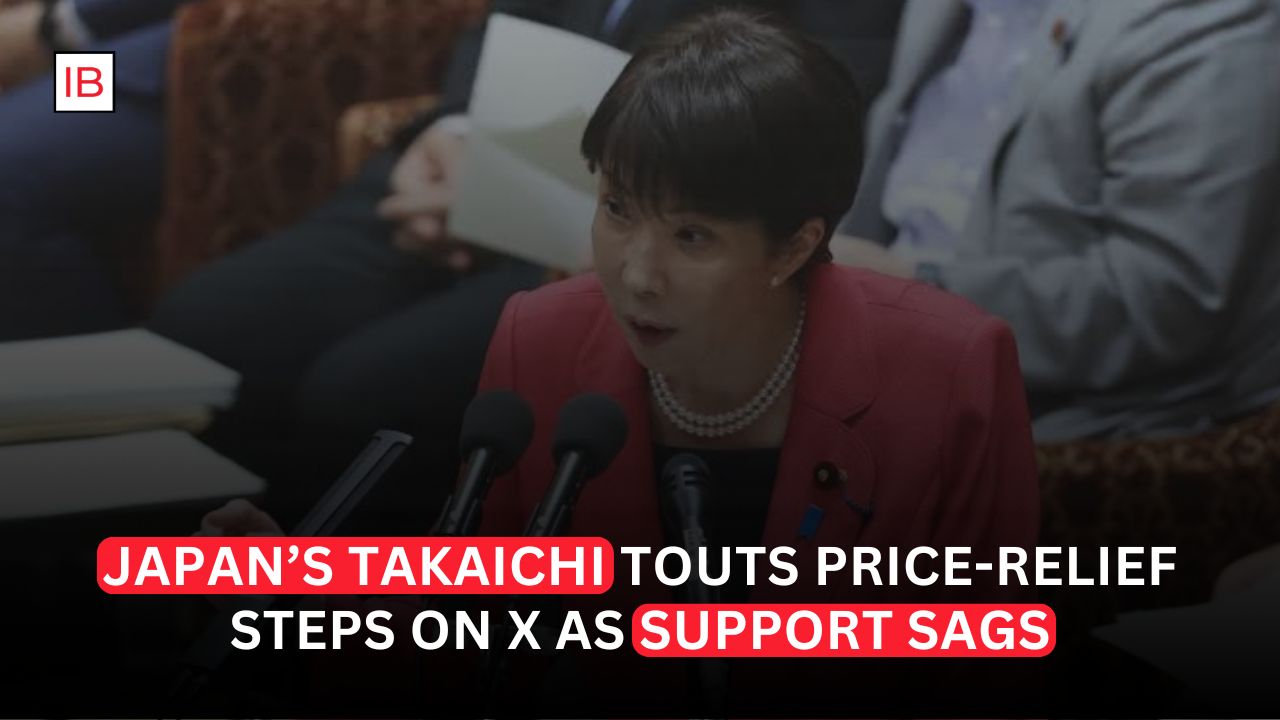
Japan’s Prime Minister Sanae Takaichi is leaning harder on measures to ease household costs as public support for her government comes under pressure.
The political problem is straightforward: voters care more about whether prices feel affordable than whether headline economic indicators look healthy.
Takaichi has promoted measures including reductions in household costs and a proposed temporary cut to the consumption tax on food. The proposal would reduce the tax from 8% to 1% for two years beginning in April 2027, but it faces resistance inside the ruling Liberal Democratic Party because of the roughly ¥10 trillion funding gap it could create for social security.
The Cost-of-Living Problem Is Political
Japan has spent years trying to escape its deflationary past.
Now the problem is almost the opposite.
Consumers are facing higher prices while wage gains have not necessarily translated into a comparable improvement in purchasing power.
That creates a difficult political equation:
Inflation → weaker household purchasing power → dissatisfaction → pressure on the government.
Takaichi’s response has been to emphasize direct relief rather than rely solely on longer-term economic reforms.
Tax Cuts Are Popular — But Expensive
A temporary food-tax reduction is politically attractive because it is easy for voters to understand.
Lower tax on groceries means an immediate reduction in the price paid at checkout.
The problem is the fiscal cost.
Japan already carries one of the world’s largest government-debt burdens, and bond yields have been rising. Fiscal conservatives within the LDP are concerned that the food-tax cut could create a ¥10 trillion shortfall in social-security financing over two years.
So Takaichi is caught between two objectives:
Give households relief now
versus
Protect confidence in Japan’s public finances.
The BOJ Creates Another Constraint
The Bank of Japan is also under pressure.
Markets have increasingly priced in the possibility of another rate hike, with expectations for a September increase rising sharply after recent yen-support operations.
That creates an awkward combination for Takaichi.
Her government wants fiscal support to cushion households and stimulate growth.
The BOJ needs to maintain credibility around inflation and monetary normalization.
More aggressive fiscal stimulus can potentially push bond yields higher and complicate the BOJ’s job.
The Yen Is Part of the Problem
Japan’s weak yen has amplified the cost of imported goods, particularly energy and food.
The recent joint efforts by Japan, the US and South Korea to support the yen underline how politically sensitive the currency has become.
A weaker yen helps exporters.
But for households, it makes imported goods more expensive.
That means the government cannot judge the economy purely through corporate profits or exports.
Consumers experience the economy through grocery bills, utility bills and gasoline prices.
Takaichi’s Fiscal Strategy Has a Bigger Ambition
The price-relief measures are only one part of her economic agenda.
Her government has also pursued large-scale fiscal spending aimed at strategic industries, infrastructure and national security.
An analysis by Mitsubishi UFJ Research and Consulting described the strategy as providing some short-term economic support while warning that expansionary fiscal policy could produce side effects through higher interest rates and yen depreciation.
That is the central tension.
Fiscal stimulus can support growth.
But if investors start demanding significantly higher yields to finance Japanese government debt, some of that benefit can be offset.
The Political Risk Is That Relief May Not Be Enough
This is the weak point in Takaichi’s strategy.
Price relief is visible, but it doesn’t solve Japan’s underlying economic problems.
Japan still faces:
- An aging population
- Labor shortages
- Weak productivity in some sectors
- A large public-debt burden
- Rising defense spending
- Pressure on the yen
- A difficult monetary-policy transition
Temporary tax cuts can ease household pressure.
They cannot fix those structural problems.
Why the Consumption-Tax Debate Matters
The proposed food-tax cut is therefore more than a consumer-relief measure.
It is a test of Takaichi’s broader economic philosophy.
Her approach favors aggressive fiscal intervention, strategic investment and tax relief.
Critics argue that Japan needs more supply-side reforms and stronger fiscal discipline instead.
That debate is becoming more important as bond yields rise.
The Bond Market Is Watching
Japan’s government bond market has become a constraint that politicians cannot ignore.
Higher yields mean higher borrowing costs for the government.
They can also affect mortgages, corporate financing and the broader cost of capital.
Reuters has reported concerns that Takaichi’s expansionary fiscal agenda is already complicating the BOJ’s attempt to normalize monetary policy, with government-bond yields approaching the psychologically important 3% level.
That creates a dangerous feedback loop:
Fiscal expansion → higher bond yields → higher debt-service costs → weaker fiscal credibility → pressure for more austerity or higher taxes.
What Takaichi Needs to Prove
For the strategy to work, the government needs to demonstrate that temporary relief is accompanied by stronger long-term growth.
That means improving:
Productivity
Labor supply
Private investment
Real wages
Corporate competitiveness
Without those improvements, repeated stimulus packages risk becoming increasingly expensive ways of temporarily supporting demand.
The Bigger Picture
Takaichi’s push to highlight price relief reflects a political reality: Japan’s voters are judging the economy through their household budgets.
The government can point to growth, investment and strategic economic programs, but those arguments lose political force if food and utility bills continue rising.
The problem is that the easiest measures to sell politically — tax cuts, subsidies and cash relief — are also the measures most likely to worsen Japan’s fiscal position if they aren’t properly funded.
And with the BOJ facing growing pressure to raise rates, the margin for fiscal experimentation is narrowing.
So Takaichi’s challenge is bigger than winning back support.
She has to convince voters that she can lower the cost of living without convincing bond investors that Japan’s fiscal position is becoming less sustainable.