The UK is stepping up scrutiny of its defense supply chain after a recent incident exposed how Chinese-linked components can enter sensitive military equipment without being identified early enough.
The immediate concern is bigger than one faulty component. It raises a much harder question for Britain: How much of its military capability ultimately depends on supply chains it does not fully control?
A Drone Exposed the Problem
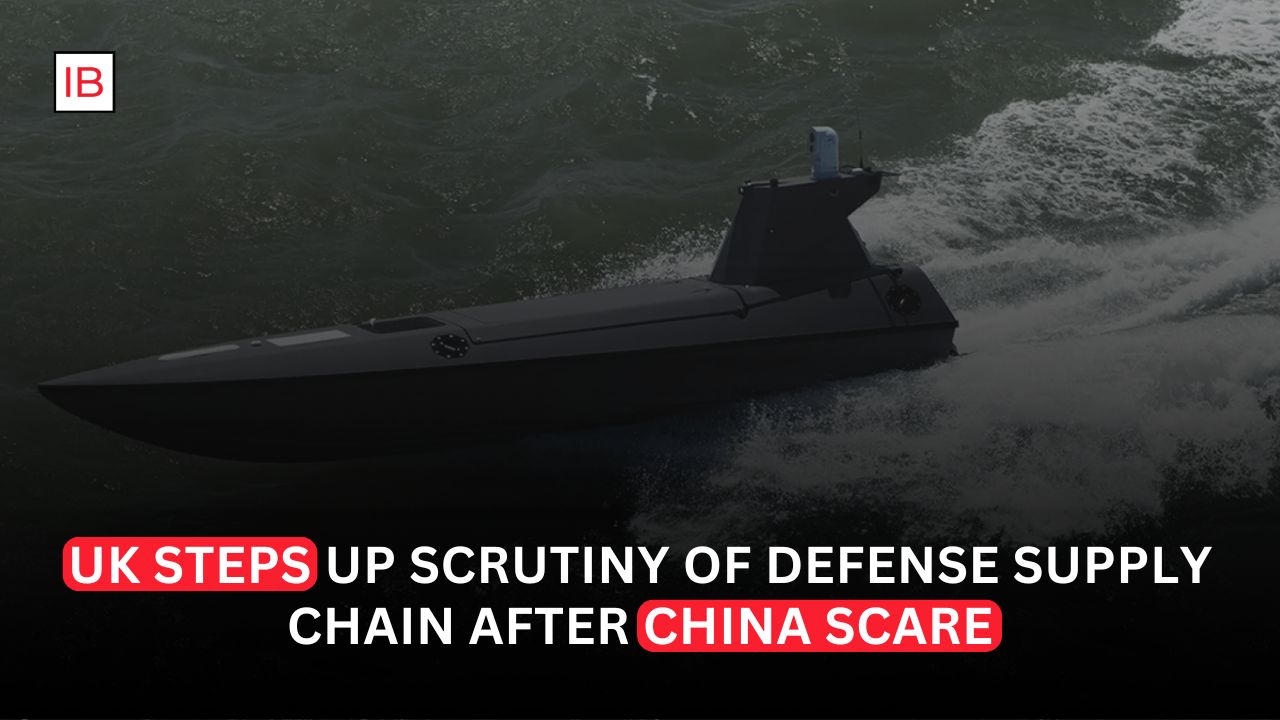
The latest scare involved British naval surveillance drones whose cameras were found sending “heartbeat” communications to an internet address in China.
The Ministry of Defence said there was no evidence that sensitive information had been compromised, but the incident prompted the removal of the affected internet connectivity.
That distinction matters.
This was not a confirmed Chinese espionage operation.
But it demonstrated a vulnerability: the UK military had incorporated a component whose communications behavior had not been adequately understood before deployment.
The Real Problem Is the Supply Chain
The UK does not simply buy complete weapons systems from foreign companies.
Modern military equipment contains thousands of components:
- Cameras
- Sensors
- Chips
- Batteries
- Motors
- Communications modules
- GPS equipment
- Semiconductors
- Rare-earth materials
- Software
Many of these are produced through complex international supply networks.
That makes complete “Made in Britain” defense hardware almost impossible without significant restructuring.
The UK government has already acknowledged that Chinese-manufactured goods are used within its defense supply chain, while saying procurement and security frameworks are designed to manage those risks.
China Is Particularly Difficult to Replace
The problem isn’t simply that China is cheap.
China has built enormous manufacturing capacity across strategically important industries.
One UK parliamentary debate highlighted an especially uncomfortable statistic: around 85% of global drone components come from China.
That means replacing Chinese components isn’t necessarily a matter of finding another supplier.
It can require creating an entirely new supply chain.
And that costs money.
Security vs. Cost
This creates a difficult trade-off for defense procurement.
A Chinese component might cost significantly less and be readily available.
A trusted alternative could be:
More expensive + slower to obtain + harder to manufacture at scale.
Governments therefore have to decide whether the additional security is worth the additional cost.
For ordinary consumer electronics, that calculation is relatively straightforward.
For military equipment, the answer is different.
A cheap component that creates a strategic vulnerability isn’t actually cheap.
BAE Systems Adds to the Pressure
The timing is particularly uncomfortable for the UK defense industry because BAE Systems has just agreed to pay a $36 million US penalty over 104 violations of American arms-export regulations.
The violations included unauthorized transfers of technical data involving China and other countries.
That case isn’t evidence that BAE deliberately compromised military systems.
But it reinforces the broader issue: defense companies need extremely strong controls over where sensitive technology, data and components move.
US regulators specifically criticized weaknesses in BAE’s compliance systems and training.
Britain Has Been Warning About This for Years
This isn’t a completely new concern.
UK parliamentary committees have previously warned about foreign involvement in the defense supply chain and argued that Britain needs to preserve sovereign industrial capabilities.
The government has also been developing mechanisms under the National Security and Investment framework to screen potentially sensitive foreign involvement.
More recently, the UK has said it is working with NATO, the G7, Australia and other partners to improve visibility into critical-mineral supply chains and reduce dependence on single sources.
The latest drone incident therefore looks less like a new policy direction and more like a catalyst for accelerating an existing one.
Critical Minerals Are the Bigger Problem
Components are only part of the vulnerability.
Defense manufacturing also depends on materials such as:
- Rare earth elements
- Gallium
- Germanium
- Graphite
- Specialty metals
China has major influence over the processing of several critical minerals.
That creates a strategic vulnerability even if the final weapon is assembled entirely in Britain.
You can build the missile domestically and still depend on a foreign-controlled supply chain for materials inside it.
Complete Decoupling Isn’t Realistic
This is where the political rhetoric can become misleading.
Britain cannot simply eliminate every Chinese component from its defense ecosystem overnight.
Doing so could:
- Increase procurement costs
- Delay military programs
- Reduce production capacity
- Create new bottlenecks
- Make smaller defense companies less competitive
The realistic goal is therefore risk reduction rather than total isolation.
That means identifying the components where Chinese dependence creates the greatest strategic danger and replacing those first.
The UK Is Moving Toward “Trusted Supply Chains”
The emerging model is likely to involve more aggressive screening of suppliers and components.
Instead of asking only:
“Does this component meet the technical specification?”
procurement teams increasingly need to ask:
“Who owns the supplier?”
“Where was the component manufactured?”
“What software does it contain?”
“Where does it communicate?”
“Who can modify or update it?”
“What happens if the supplier stops supplying us?”
That is a much more demanding procurement process.
It Could Benefit British Defense Companies
There is an economic upside.
If the UK decides that strategic components must come from trusted suppliers, domestic companies could receive more government orders.
That could stimulate investment in:
- Sensors
- Drone technology
- Semiconductors
- Batteries
- Electronic warfare
- Secure communications
- Critical minerals
- Advanced manufacturing
The UK government has already said it is supporting onshoring and assured supply chains to improve resilience.
But It Will Also Raise Costs
There is no free lunch here.
A more secure supply chain will probably be more expensive.
That means defense budgets will need to cover not only weapons and platforms, but also the cost of maintaining strategic redundancy.
The UK may increasingly have to pay for:
security + resilience + redundancy, rather than simply lowest-cost procurement.
The Bigger Geopolitical Shift
The issue extends beyond Britain.
The US and European allies are increasingly treating supply chains as part of national security.
The recent US restrictions and tariffs targeting Chinese drone technology show the same direction: Washington is also trying to reduce dependence on Chinese components and encourage domestic and allied production.
So this is becoming a broader Western policy shift.
Defense supply chains are being treated as strategic infrastructure.
What Investors Should Watch
UK Defense Spending
More spending on domestic supply chains could create long-term opportunities for British defense manufacturers.
Component Suppliers
Companies producing sensors, electronics, batteries, communications systems and drone components could benefit from localization.
Critical Minerals
The ability to secure non-Chinese sources of rare earths and other strategic materials will become increasingly important.
Procurement Costs
Greater security requirements could increase the cost of major defense programs.
BAE Systems
The company’s US compliance settlement shows how closely defense supply chains are being scrutinized across allied markets.
China Exposure
Investors should increasingly examine not only where a defense company manufactures its final product, but where its second- and third-tier suppliers manufacture theirs.
The Bigger Picture
The UK isn’t discovering that China is a potential supply-chain risk for the first time.
What has changed is that the vulnerability is becoming harder to ignore.
The naval-drone incident demonstrated how something as seemingly insignificant as a camera can create a security concern inside a military platform.
The lesson is broader than drones.
Modern defense systems are only as secure as their weakest critical component.
Britain therefore faces a difficult balancing act:
Reduce Chinese dependence without making its defense industry so expensive and slow that it becomes less capable.
That is the real challenge behind the UK’s new scrutiny.