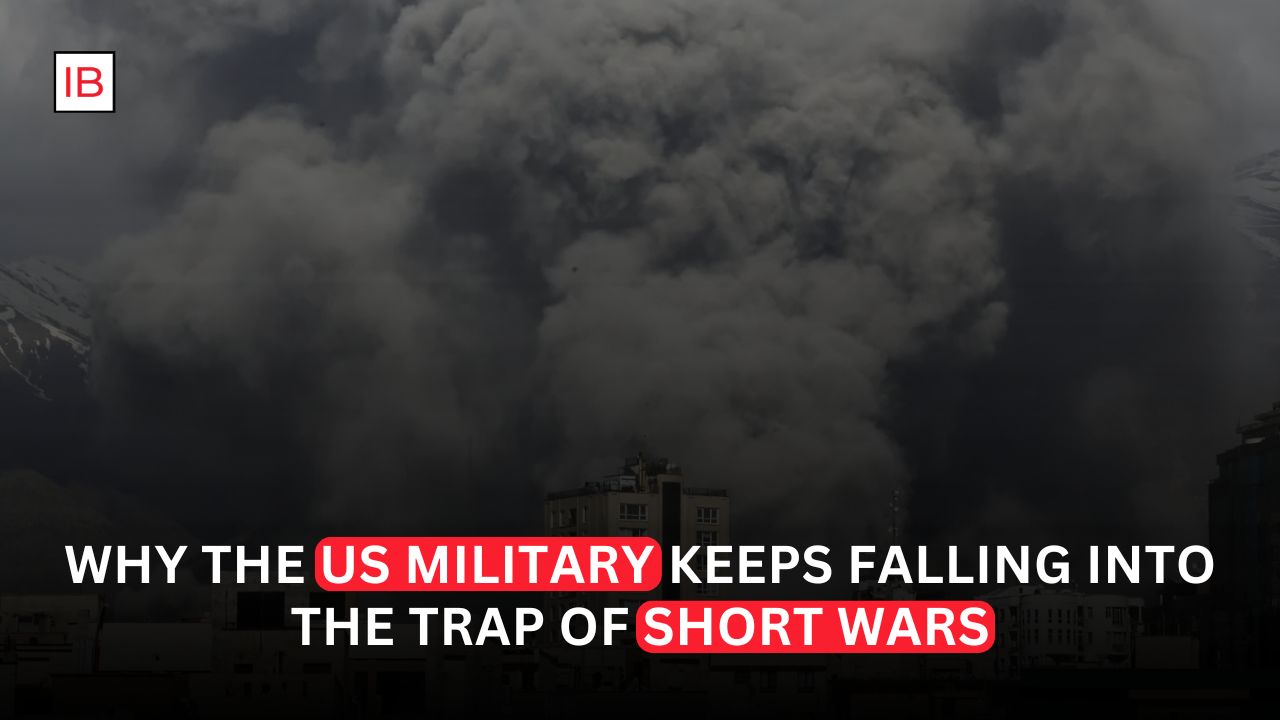
The central mistake in US strategy toward Iran is assuming that military force can produce a decisive outcome quickly.
That assumption is dangerous because destroying targets is not the same thing as ending a war.
The short-war mentality treats Iran as if enough airpower, missiles and economic pressure will rapidly force Tehran to surrender or accept Washington’s preferred settlement. But Iran has geography, missiles, proxies, energy leverage and a large population. A conflict can therefore become much more expensive and complicated once the initial strikes are over.
The Problem With the “Short War” Assumption
The logic is straightforward:
Strike Iran → cripple its military → force concessions → leave.
The weakness is the second half of that equation.
What happens if Iran refuses to concede?
The US then faces a choice between:
- Escalating further
- Accepting an inconclusive outcome
- Negotiating from a weaker position
- Remaining militarily engaged for much longer than planned
That is how supposedly limited wars become open-ended conflicts.
Iran Doesn’t Need to Defeat America Militarily
This is an important distinction.
Iran doesn’t need to destroy the US military to make the war strategically costly.
It only needs to make the conflict expensive enough that Washington eventually decides the additional cost isn’t worth the additional objective.
Iran can pursue asymmetric strategies involving:
- Missiles
- Drones
- Cyber operations
- Regional armed groups
- Attacks on infrastructure
- Disruption of shipping
- Pressure on Gulf energy facilities
The objective isn’t necessarily battlefield victory.
It is raising the political and economic price of continued war.
The Strait of Hormuz Is the Biggest Wild Card
Iran’s most powerful economic weapon isn’t necessarily its military.
It is geography.
The Strait of Hormuz connects the Persian Gulf with the wider global energy market.
Any sustained disruption there could affect:
- Oil prices
- LNG markets
- Shipping costs
- Insurance premiums
- Inflation
- Asian energy security
- Global economic growth
That gives Tehran leverage far beyond its conventional military capabilities.
And the US faces a difficult trade-off:
Keeping the strait open could require sustained military operations.
A Short War Could Become an Oil Shock
The economic consequences could arrive much faster than the military consequences.
If traders begin pricing a prolonged disruption to Gulf energy exports, crude prices can react before physical shortages appear.
Higher oil prices then feed into:
Transport → manufacturing → electricity → food → inflation.
That creates another political problem for Washington.
A war that was supposed to demonstrate strength can instead become an inflationary shock for American households.
Iran Can Absorb Punishment
Another flawed assumption is that military damage automatically produces political capitulation.
Iran has experienced decades of sanctions, isolation and military pressure.
Its political system has mechanisms for absorbing substantial economic and military stress.
That doesn’t mean Iran is invulnerable.
It means the threshold for political surrender may be much higher than Washington expects.
This is the same basic strategic mistake that has appeared repeatedly in modern conflicts: assuming the opponent’s willingness to fight will collapse when the material costs become sufficiently high.
It often doesn’t.
Regime Change Is Even Harder
If the ultimate objective goes beyond changing Iranian behavior to changing Iran’s government, the problem becomes dramatically larger.
Removing leadership is one thing.
Replacing the political system is another.
A military campaign can destroy:
- Command centers
- Missile sites
- Nuclear facilities
- Military bases
It cannot easily manufacture:
- A legitimate replacement government
- Political stability
- Public acceptance
- Security
- Economic recovery
That is where the short-war assumption becomes particularly dangerous.
Iraq and Afghanistan Should Still Matter
The US has already experienced the difference between winning the opening phase of a war and achieving the political outcome that follows.
In Iraq and Afghanistan, American military superiority was never seriously in doubt.
The difficulty was what came afterward.
Iran is a much larger and more complicated country than either battlefield.
That doesn’t mean an Iran conflict would necessarily become another Iraq.
It means policymakers should be extremely cautious about assuming that military superiority guarantees a quick political settlement.
The US Has an Advantage — But It Isn’t Unlimited
America has overwhelming advantages in:
- Airpower
- Naval power
- Intelligence
- Satellites
- Long-range weapons
- Logistics
- Global military infrastructure
But those advantages don’t eliminate the problem of time.
The longer a conflict continues, the more important other variables become:
Ammunition stocks
Political support
Alliance cohesion
Economic costs
Oil prices
Civilian casualties
Regional escalation
Domestic opinion
A war can therefore become harder for the stronger military to sustain even when it is winning individual battles.
Iran’s Best Strategy May Be to Wait
This is where the short-war fallacy becomes particularly dangerous.
If Washington expects Iran to collapse quickly, Tehran has an incentive to do the opposite.
It can attempt to:
Survive → retaliate selectively → create economic pressure → wait for political fatigue.
Iran doesn’t necessarily need to win every confrontation.
It needs to make the US question whether another month of fighting will actually improve its position.
Israel Creates Another Strategic Complication
US and Israeli objectives are not necessarily identical.
Israel may prioritize:
- Eliminating Iran’s military capabilities
- Destroying nuclear infrastructure
- Reducing regional threats
Washington has additional concerns:
- Protecting US forces
- Global energy markets
- Gulf allies
- International shipping
- Relations with Europe and Asia
- Avoiding a prolonged occupation or intervention
Those objectives can overlap.
But they aren’t the same.
The longer the conflict continues, the more likely those differences become politically significant.
The Alliance Problem
A prolonged Iran war could also place pressure on America’s allies.
European and Asian governments have strong incentives to avoid:
- Energy disruption
- Shipping disruptions
- Higher inflation
- Another major Middle Eastern war
Some may support US security objectives while simultaneously opposing an open-ended military campaign.
That distinction matters.
Military capability is not the same thing as coalition support.
China Has a Different Calculation
China is particularly exposed to Gulf energy disruption because it is heavily dependent on imported energy.
Beijing therefore has an incentive to prevent the conflict from destabilizing regional energy flows.
At the same time, a prolonged US-Iran confrontation could distract Washington and consume American military resources.
That creates an unusual strategic situation:
The US bears the direct military burden while China can potentially gain geopolitical opportunities from the resulting distraction.
Russia Also Benefits From a More Distracted US
Russia has similar incentives in some respects.
A prolonged Middle Eastern conflict can:
- Consume US military resources
- Increase energy prices
- Complicate Western alliances
- Create new geopolitical divisions
That doesn’t mean Moscow controls Iranian strategy.
It means the geopolitical consequences extend well beyond Washington and Tehran.
The Real Question Is the End State
Before expanding a war, policymakers need a credible answer to one question:
What does victory actually look like?
Is it:
- Destruction of Iran’s nuclear infrastructure?
- A halt to uranium enrichment?
- Reduced missile capabilities?
- An end to support for regional proxies?
- Regime change?
- A negotiated settlement?
Each objective requires a different strategy.
If Washington has a military plan but no realistic political end state, the war can continue long after the original mission has been accomplished—or after it becomes clear that the mission cannot be accomplished at acceptable cost.
The Biggest Economic Risk
Markets don’t necessarily need a catastrophic war to react badly.
They need uncertainty.
A prolonged conflict could create:
Oil volatility → inflation pressure → higher interest rates → weaker growth → lower corporate earnings.
That would turn an Iranian conflict into a global macroeconomic problem.
The effects would be especially painful for energy-importing economies in Asia and Europe.
What Investors Should Watch
Oil
The fastest signal of whether markets believe the war is becoming prolonged.
Strait of Hormuz
Any sustained disruption would dramatically raise the economic stakes.
US Military Spending
A prolonged campaign would increase pressure on ammunition and defense budgets.
Inflation
Higher energy prices could complicate US monetary policy.
Gulf Infrastructure
Attacks on energy facilities could be more economically important than battlefield developments.
Diplomacy
Even limited negotiations could sharply reduce the probability of a prolonged conflict.
The Bigger Picture
The most dangerous assumption isn’t that the US can’t defeat Iran militarily.
It probably can inflict enormous damage.
The dangerous assumption is that military damage automatically produces a political victory.
History suggests otherwise.
A short war requires more than overwhelming firepower. It requires an opponent willing to stop fighting, a clearly defined end state, manageable economic consequences and a credible path back to diplomacy.
If those conditions don’t exist, the “short war” can become a long strategic problem.
And that is the real fallacy: winning the first weeks of a conflict says very little about who benefits from the next several years.