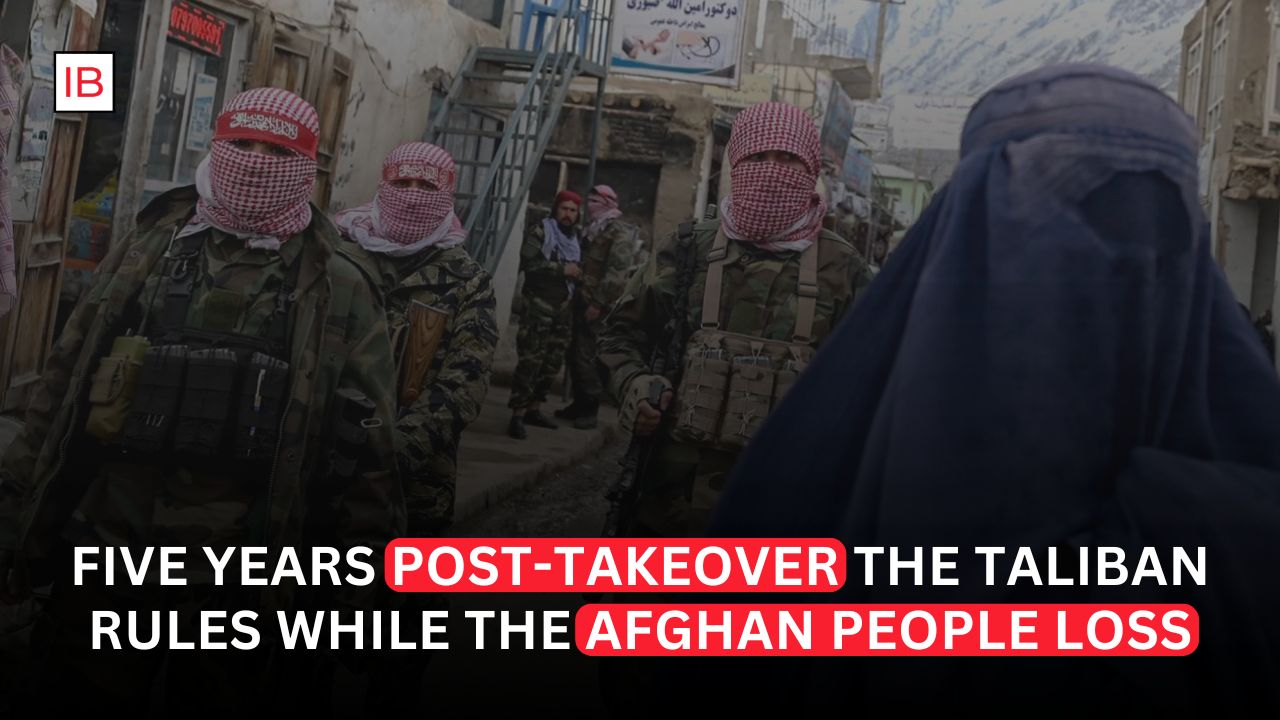
Five years after the Taliban seized Kabul, Afghanistan is more secure in some narrow respects but far more restrictive for women, girls and political opponents. The Taliban is presenting its rule as a victory over foreign intervention, while humanitarian agencies and rights groups describe a country facing severe economic hardship, repression and growing humanitarian needs.
The anniversary exposes the central contradiction of Taliban rule:
The government has achieved greater territorial control, but not broader political legitimacy or a better future for much of the population.
Five Years After Kabul Fell
The Taliban returned to power on August 15, 2021, after the collapse of the US-backed Afghan government and the withdrawal of American forces.
Five years later, the Taliban controls the country without facing a conventional nationwide insurgency capable of threatening its rule.
That is the government’s strongest argument.
Taliban authorities have emphasized security, independence and the end of foreign military intervention as evidence of success. Celebrations in Kabul on the fifth anniversary prominently featured those themes.
But political stability has come with a very high social cost.
Women Have Paid the Highest Price
The most consequential change has been the systematic restriction of women and girls.
Women and girls have been pushed out of:
- Secondary and higher education
- Much of the workforce
- Public life
- Many forms of political participation
- Numerous public spaces
The United Nations says Afghan women have been systematically stripped of rights over the past five years, while Human Rights Watch describes the situation as one of the world’s gravest human-rights crises.
This isn’t simply a disagreement over social policy.
It has economic consequences.
When roughly half the population is prevented from fully participating in education and employment, Afghanistan loses workers, entrepreneurs, teachers, doctors and professionals.
The Education Ban Is a Long-Term Economic Problem
The restrictions on girls’ education may be the most damaging policy for Afghanistan’s future.
A generation of girls is growing up with severely limited access to secondary and higher education.
That creates a compounding problem:
No education → fewer skilled workers → weaker productivity → lower incomes → greater dependence on aid.
The damage doesn’t appear only this year.
It can persist for decades.
Even if restrictions were lifted tomorrow, Afghanistan would still have to rebuild a generation of lost educational opportunities.
Healthcare Is Also Being Affected
Restrictions on women’s education and employment have implications for healthcare because Afghan women often require access to female medical professionals.
Human Rights Watch has warned that restrictions on women entering medical education and employment can directly undermine healthcare access for women and children.
That creates a particularly damaging feedback loop:
Restrictions on women → fewer female healthcare workers → reduced healthcare access → worse health outcomes.
The Economy Remains Extremely Fragile
The Taliban inherited an economy heavily dependent on foreign assistance.
After the takeover, international aid and financial flows were sharply disrupted.
Although economic activity has stabilized from the immediate post-2021 shock, Afghanistan remains deeply vulnerable to poverty, unemployment, displacement and humanitarian emergencies.
The current crisis is being compounded by natural disasters and large numbers of Afghans returning or being deported from neighboring countries.
For ordinary Afghans, the question isn’t simply whether GDP is growing.
It’s whether there are:
Jobs + income + food + healthcare + education.
Those remain serious problems.
Security Has Improved — But Not Completely
The Taliban can legitimately claim that the country is no longer experiencing the same level of nationwide fighting that existed during the final years of the US-backed government.
But that doesn’t mean Afghanistan is peaceful.
The Islamic State Khorasan Province remains an important security threat, and Taliban officials have themselves faced attacks and assassinations.
There are also growing tensions with neighboring Pakistan.
Cross-border conflict creates another complication for a government that wants to portray itself as having restored national stability.
The Pakistan Relationship Is Deteriorating
Pakistan once had a particularly close relationship with the Taliban.
That relationship has become considerably more complicated.
Islamabad is increasingly concerned about militants operating from Afghan territory, while the Taliban rejects Pakistani pressure over its security policies.
The deterioration matters economically as well as militarily.
Afghanistan depends heavily on regional trade routes, while Pakistan remains an important transit and commercial partner.
A prolonged deterioration could therefore hurt both sides.
The Taliban Wants International Recognition
The Taliban has another major problem:
It controls Afghanistan, but international recognition remains limited.
Russia is currently the only country to have formally recognized the Taliban government, according to recent reporting. Other countries—including China, Iran, India and Central Asian states—have increasingly engaged with Taliban authorities for pragmatic reasons.
That produces an unusual diplomatic situation.
Governments increasingly talk to the Taliban because they need to deal with whoever controls Afghanistan.
But talking to the Taliban isn’t necessarily the same as recognizing or endorsing its political system.
China Has Economic Reasons to Engage
China has an obvious interest in Afghanistan.
It wants:
- Regional stability
- Counterterrorism cooperation
- Access to potential mineral resources
- Greater influence in Central Asia
- Protection of its western border
Beijing can therefore engage with the Taliban without necessarily endorsing its domestic policies.
That is part of the broader shift toward pragmatic engagement.
The West Faces a Difficult Choice
Western governments face an uncomfortable dilemma.
If they isolate the Taliban completely:
Pressure increases, but influence decreases.
If they engage:
They gain diplomatic access, but risk legitimizing the regime.
This is why international engagement has become fragmented.
Regional powers are increasingly pursuing their own interests, while human-rights organizations warn that the international community is losing leverage over women’s rights.
The Recognition Question Is Becoming Harder
The Taliban is trying to convert control into legitimacy.
Its argument is essentially:
We control the country, provide security and maintain the state—therefore the world should deal with us as Afghanistan’s government.
The counterargument is:
A government that systematically excludes women and suppresses political opposition should not receive unconditional legitimacy simply because it controls the territory.
That tension will remain central to Afghanistan’s foreign policy.
The Humanitarian Crisis Is Becoming More Complicated
Afghanistan’s humanitarian problems aren’t only a legacy of the 2021 collapse.
They now interact with:
- Natural disasters
- Economic weakness
- Restrictions on women
- Refugee returns
- Cross-border tensions
- Limited international funding
Humanitarian organizations are warning that needs remain extremely high five years after the Taliban takeover.
That means Afghanistan cannot easily transition from an aid-dependent emergency economy to a self-sustaining one.
The Taliban Has Consolidated Power
This is the uncomfortable reality that international policymakers have to confront.
Five years later, the Taliban has not collapsed.
It has not been removed by an internal uprising.
It has not been defeated by an organized military opposition.
Instead, it has consolidated control.
That doesn’t mean the system is stable indefinitely.
But it does mean policies based on the assumption that the Taliban will simply disappear have not worked.
The Bigger Risk Is a Lost Generation
The most important measure of Afghanistan’s future may not be military.
It may be demographic and educational.
A girl excluded from school today may become:
A worker who never enters the formal economy.
A doctor who never receives training.
A teacher who never teaches.
An entrepreneur who never starts a business.
Multiply that across millions of people and the long-term economic consequences become enormous.
What the World Should Watch
Women’s Education
Any meaningful reopening of schools and universities to girls would be a major policy shift.
Women’s Employment
Restrictions on female employment remain one of the biggest obstacles to economic development.
Pakistan Relations
Cross-border tensions could become a major source of instability.
International Recognition
More formal recognition would significantly strengthen the Taliban’s diplomatic position.
China and Regional Investment
Greater Chinese and regional economic involvement could reduce Afghanistan’s dependence on Western aid.
Humanitarian Funding
The ability of aid agencies to continue operating will remain critical.
The Bigger Picture
Five years after the Taliban returned to Kabul, Afghanistan has achieved something the group desperately wanted:
The foreign military presence is gone and the Taliban controls the state.
But control isn’t the same as prosperity.
The country still faces severe humanitarian needs, economic weakness, diplomatic isolation and an increasingly institutionalized system of restrictions on women and girls.
The Taliban can point to improved security and the absence of the large-scale war that preceded its takeover.
Its critics can point to what that security has been built upon.
The real test for Afghanistan isn’t whether the Taliban can remain in power for another five years.
It is whether the country can build an economy and society capable of supporting its population while the government continues excluding a huge part of that population from public life.
So far, that contradiction remains unresolved.