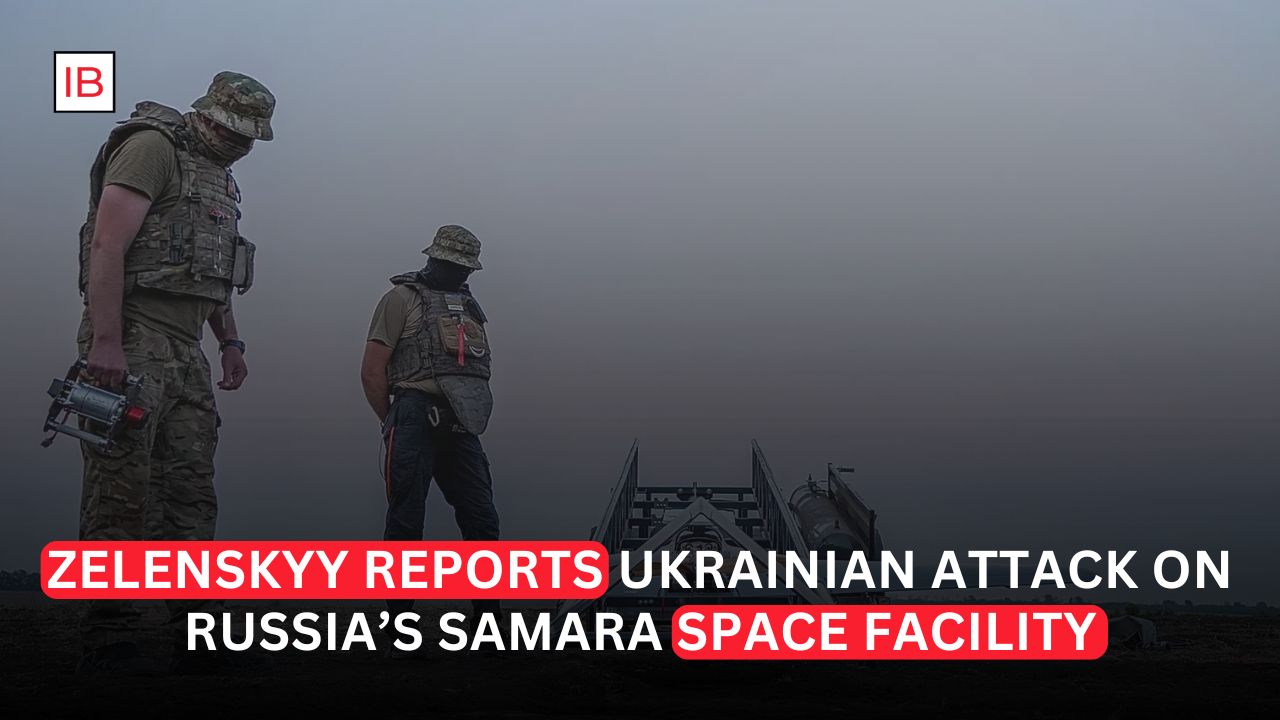
Kyiv Says Long-Range Attack Hit Key Roscosmos Rocket Center as Ukraine Expands Strikes Deep Inside Russia
Ukraine says it has struck a major Russian rocket and space facility in the Samara region, marking another significant expansion of Kyiv’s campaign against strategic infrastructure far behind the front line.
President Volodymyr Zelenskyy said Ukrainian forces targeted a facility belonging to Russia’s state space corporation, Roscosmos, during overnight strikes on August 15. Ukraine’s General Staff later confirmed that the Progress Rocket and Space Center in Samara was hit and that a fire broke out at the site.
The attack comes as Ukraine increasingly relies on domestically produced long-range weapons to strike military, industrial and energy targets inside Russia.
Key Russian Space Facility Targeted
The Progress Rocket and Space Center is one of Russia’s most important aerospace enterprises.
The Samara facility is associated with the production of Soyuz-family launch vehicles, which Russia uses to place satellites and spacecraft into orbit. Ukrainian officials say the site also contributes to systems used for reconnaissance and communications.
The Ukrainian General Staff said the strike hit the facility and caused a fire, although the full extent of the damage was still being assessed.
Local Russian authorities acknowledged that an industrial facility in the Samara region had been targeted. Samara Governor Vyacheslav Fedorishchev said two people were injured, while Russian authorities did not publicly provide a detailed assessment of damage to the space facility.
Ukraine Says Flamingo Missiles Were Used
Zelenskyy said the attack involved Ukraine’s domestically produced Flamingo cruise missiles.
The weapon has become an important part of Kyiv’s effort to develop longer-range strike capabilities without relying entirely on Western-supplied systems.
The reported strike on Samara is particularly notable because the facility is located roughly 900 kilometers from Ukraine, demonstrating the increasing reach of Ukrainian weapons.
Ukraine has increasingly sought to manufacture its own missiles and drones as it attempts to sustain pressure on Russian targets deep inside the country.
Why the Facility Matters
The Progress center is strategically important because Russia depends on the Soyuz rocket family for space launches.
The rockets have been used to deploy communications, reconnaissance and other satellites.
Ukrainian officials say some of the spacecraft associated with Russia’s expanding satellite capabilities support military communications and surveillance.
That makes the facility relevant to the war even though it is not a conventional battlefield target.
Ukraine has increasingly focused on weakening Russia’s broader military-industrial ecosystem rather than limiting strikes to front-line positions.
Another Target: Savasleyka Airfield
The Samara attack was part of a broader overnight operation.
Ukraine’s General Staff also confirmed a strike against Savasleyka airfield in Russia’s Nizhny Novgorod region. A fire was reported at the airfield, although officials were still assessing the damage.
The airfield is associated with Russian military aviation, including MiG-31 aircraft.
The combination of an aerospace facility and a military airfield suggests that Ukraine’s operation was aimed at multiple elements of Russia’s strategic military infrastructure.
Moscow Reports Large-Scale Ukrainian Attack
Russia’s Defense Ministry said its air defenses intercepted 598 Ukrainian drones across Russian regions and areas of the Black Sea during the overnight attack, according to the Associated Press.
The unusually large number highlights the scale of the latest Ukrainian operation.
Russia has increasingly faced attacks on facilities far from the Ukrainian border, including refineries, oil terminals, military bases and industrial plants.
Kyiv argues that these operations are designed to increase the economic and military costs of Russia’s invasion.
Ukraine Expands Deep-Strike Campaign
The Samara operation is part of a broader Ukrainian strategy that has intensified throughout 2026.
Kyiv has increasingly targeted Russia’s energy infrastructure, defense factories, military bases and logistics networks.
The objective is not simply to destroy individual facilities but to disrupt the systems that allow Russia to sustain its military campaign.
Recent Ukrainian strikes have also targeted Russian oil infrastructure deep inside the country. The Associated Press reported that Ukrainian long-range attacks have increased substantially this year.
The attacks demonstrate how the battlefield increasingly extends far beyond the front line.
Pressure on Russia’s Aerospace Sector
Any significant disruption at the Progress center could have implications for Russia’s space program.
The facility is involved in manufacturing launch vehicles, meaning damage to production infrastructure could potentially affect the pace at which Russia can launch satellites.
However, the actual impact remains uncertain.
Ukrainian authorities have not yet provided a detailed damage assessment, and Russia has not publicly confirmed the extent of disruption to rocket production.
It is therefore too early to determine whether the strike will create a long-term interruption to Russian space-launch capabilities.
Russia Faces Multiple Infrastructure Threats
The strike comes as Russia’s industrial infrastructure faces growing pressure from Ukrainian attacks.
Oil refineries and petrochemical plants have repeatedly been targeted in recent weeks.
Those attacks have raised concerns about Russia’s ability to maintain fuel production and export capacity.
The expansion toward aerospace and military facilities suggests Kyiv is broadening its target list beyond energy infrastructure.
The Strategic Message
The attack also carries a political message.
Zelenskyy has repeatedly argued that Russia must face increasing costs for continuing its war against Ukraine.
By demonstrating the ability to strike facilities hundreds of kilometers inside Russian territory, Kyiv is signaling that geographic distance provides less protection than it once did.
The strategy is intended to force Moscow to devote additional resources to air defense and infrastructure protection while disrupting military production.
Escalation Risks
Deep strikes inside Russia also carry risks.
Moscow has repeatedly responded to Ukrainian attacks with missile and drone strikes against Ukrainian cities and infrastructure.
The continued expansion of long-range attacks could therefore contribute to another cycle of escalation.
At the same time, Ukraine views long-range strikes as an important way to compensate for its disadvantages in conventional military resources.
The campaign allows Kyiv to attack Russian capabilities without attempting to capture territory.
Russia Continues Strikes on Ukraine
The latest Ukrainian operation occurred alongside continuing Russian attacks on Ukrainian targets.
According to the Associated Press, Russian strikes damaged Ukrainian infrastructure, including port facilities in Odesa, Izmail and Yuzhnyi.
Ukraine’s air force also reported intercepting a large number of Russian drones.
The continuing attacks on both sides demonstrate that the conflict remains heavily focused on long-range weapons and infrastructure.
A New Phase of the War
The strike on Samara illustrates how the geography of the conflict is changing.
Targets once considered safely distant from the battlefield are increasingly vulnerable.
Russia’s vast territory provides strategic depth, but Ukraine’s growing missile and drone capabilities are reducing that advantage.
For Moscow, protecting critical industrial and military facilities across such a large area requires significant air-defense resources.
For Kyiv, the ability to strike those facilities provides another method of weakening Russia without directly engaging its forces on the battlefield.
Looking Ahead
The reported strike on the Progress Rocket and Space Center represents a significant development in Ukraine’s long-range campaign against Russia.
The facility is an important component of Russia’s aerospace industry and is associated with the production of Soyuz-family launch vehicles. Ukraine says the strike caused a fire, while the full extent of the damage remains under assessment.
The reported use of Ukrainian-made Flamingo missiles is equally significant.
The operation demonstrates Kyiv’s growing ability to conduct long-range attacks using domestically produced weapons rather than relying exclusively on Western systems.
The target selection also reveals the broader strategy behind Ukraine’s deep strikes.
Kyiv is increasingly attacking the infrastructure that supports Russia’s military capabilities, including oil facilities, industrial plants, airfields and aerospace infrastructure.
The objective is to make the war more costly for Russia and disrupt its ability to maintain military operations.
The strike on Savasleyka airfield adds another dimension to the operation.
Together, the attacks indicate that Ukraine is attempting to hit multiple layers of Russia’s military system in a single campaign.
However, the ultimate impact remains uncertain.
Damage to the Progress facility could affect Russia’s rocket-production capabilities if critical manufacturing areas were seriously damaged, but there is currently insufficient information to determine the scale or duration of any disruption.
Russia’s response will also be closely watched.
The Kremlin has already demonstrated its willingness to respond to Ukrainian attacks with large-scale strikes against Ukrainian cities and infrastructure.
That means the latest operation could increase pressure on both sides as they continue to expand the range and sophistication of their attacks.
For Ukraine, the ability to reach deep into Russian territory provides a valuable strategic tool.
For Russia, the growing number of attacks means that protecting military and industrial facilities across the country’s vast territory is becoming increasingly difficult.
The Samara strike therefore represents more than another attack behind the front line. It is evidence that the geographic boundaries of the Russia-Ukraine war are continuing to expand.
As Ukraine develops more long-range missiles and drones, facilities once considered beyond practical reach are increasingly becoming potential targets.
The resulting contest over Russia’s military-industrial infrastructure could become an increasingly important element of the war during the months ahead.