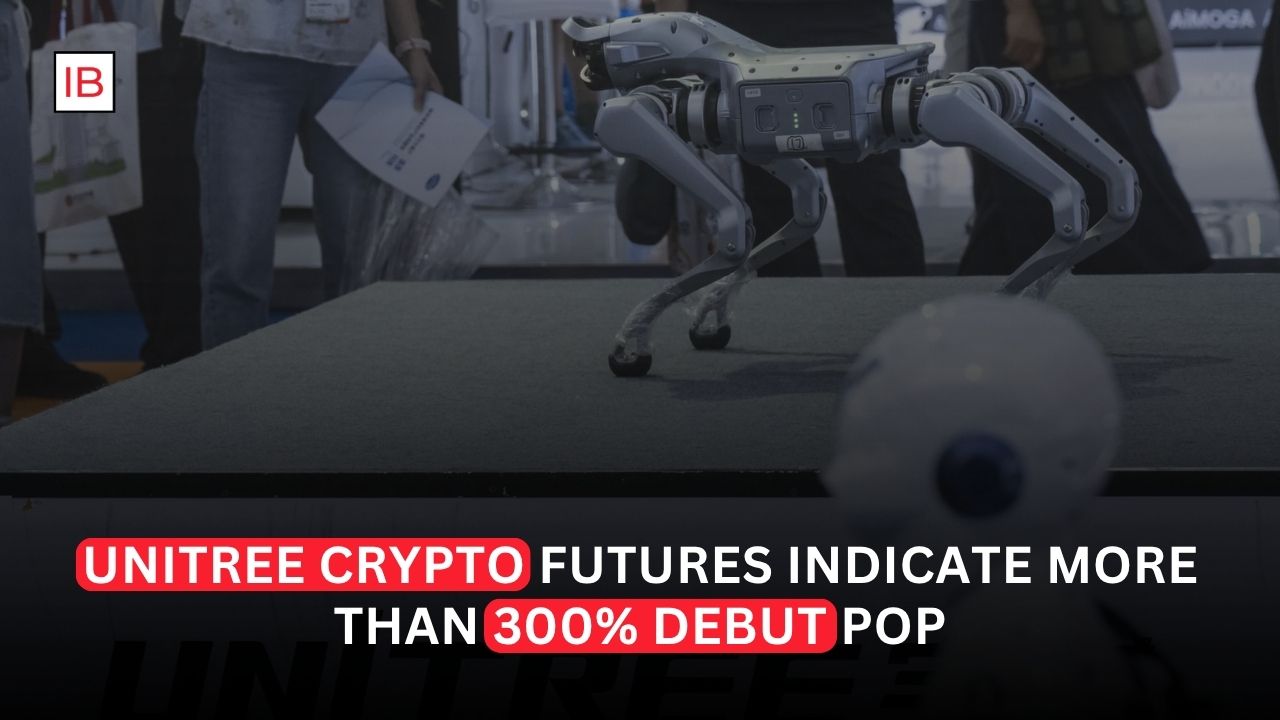
Unitree Robotics is heading into its Shanghai stock-market debut with extraordinary investor expectations. Derivatives trading in crypto markets suggests the Chinese humanoid-robot maker could see its shares jump by more than 300% from the IPO price when trading begins.
That would give Unitree a valuation dramatically above the roughly $9 billion level implied by its offering price, showing just how aggressively investors are betting on China’s robotics industry.
But there is an important catch: crypto futures are not the same thing as an actual stock-market price.
The enormous implied upside reflects speculation, scarcity and leverage as much as it reflects Unitree’s underlying business fundamentals.
Unitree Has Become One of China’s Hottest Tech IPOs
Unitree has attracted enormous attention because it is one of China’s leading humanoid robotics companies.
The Hangzhou-based company makes both humanoid and quadruped robots and has become known internationally for machines capable of running, dancing and performing complex movements.
The company has reportedly produced and delivered around 18,000 bipedal humanoid robots across its various models as of July.
Its IPO has generated extraordinary demand.
Retail investors reportedly oversubscribed the offering by more than 8,000 times, a record for Shanghai’s technology-focused STAR Market.
That level of demand has created the conditions for a potentially explosive first trading session.
Crypto Traders Are Betting on a Huge Premium
The unusual part of the Unitree story is the role being played by crypto-based derivatives.
Before the shares begin trading on Shanghai’s exchange, traders can take positions linked to Unitree’s expected value through offshore derivative markets.
Those contracts have traded at levels implying a valuation several times higher than the IPO valuation.
Earlier reports showed Unitree-linked contracts trading around $90 or more, compared with an IPO price equivalent to roughly $22 per share. That implied a valuation approaching $38 billion—more than four times the IPO valuation.
The latest Bloomberg report points to expectations of a more than 300% debut pop.
That is an extraordinary gap.
It also illustrates how much speculative demand has built around the company before conventional stock trading has even started.
Why Investors Are So Bullish
There are several reasons for the excitement.
First, Unitree is entering one of the world’s fastest-growing technology themes: humanoid robotics.
China has made robotics a strategic industrial priority as it attempts to strengthen its position in advanced manufacturing and artificial intelligence.
Second, Unitree already has commercial products rather than simply a prototype.
Third, the company is reportedly profitable, distinguishing it from many robotics startups that are still spending heavily on research while generating limited revenue.
And fourth, Unitree has backing from major Chinese technology companies, including Tencent and Alibaba, while its founder Wang Xingxing has gained significant visibility within China’s technology ecosystem.
Scarcity Is Making the Valuation More Extreme
One of the most important factors behind the expected surge is the relatively small portion of the company being sold.
Unitree raised approximately 6.1 billion yuan ($905 million) by issuing shares representing about 10% of its enlarged capital.
That creates scarcity.
Thousands of investors may want exposure to Unitree, but only a limited number of shares are available through the IPO.
When demand vastly exceeds supply, the secondary market can establish a price dramatically above the offering price.
This is particularly powerful in China’s retail-heavy IPO market.
But a 300% Jump Would Not Prove the Company Is Worth 300% More
This is where investors need to be careful.
A stock rising 300% on its first day does not mean the company’s fundamental value suddenly increased by 300%.
It means investors are willing to pay 300% more for the shares than the IPO price.
Those are very different things.
The IPO price is determined before trading begins.
Once the market opens, price discovery takes over.
If investors become more optimistic than the IPO underwriters anticipated, the stock can surge.
But the opposite can happen just as quickly.
Crypto Futures Have Their Own Risks
The Unitree-linked contracts are particularly unusual because they trade in crypto-based markets.
That introduces additional risks.
These instruments can be leveraged.
They may have limited liquidity.
They can experience large price swings.
And they do not necessarily represent the same market as the underlying Shanghai-listed shares.
As a result, the implied price should be treated as an indication of speculative expectations—not as a reliable forecast of where Unitree’s stock will settle.
The distinction matters enormously.
A trader willing to take a leveraged position at $90 isn’t necessarily saying Unitree is fundamentally worth $90.
They may simply be betting that someone else will pay more later.
China’s Robotics Boom Is Real—but Still Young
The bullish case for Unitree shouldn’t be dismissed.
China has become one of the world’s most important robotics manufacturing centers.
The country has enormous industrial capacity, a deep electronics supply chain and a large domestic market.
Humanoid robots could eventually be used in factories, warehouses, logistics, healthcare and consumer applications.
If the technology becomes commercially viable at scale, companies like Unitree could benefit enormously.
But the industry remains relatively immature.
Many potential applications have not yet reached large-scale commercial deployment.
That means today’s valuations are heavily dependent on expectations about future growth.
Competition Will Increase
Unitree also faces increasingly strong competition.
Tesla is developing Optimus.
Boston Dynamics remains a major robotics player.
China itself has numerous humanoid robotics startups pursuing similar opportunities.
As the sector grows, competition could drive down hardware prices.
That creates a difficult question for investors:
Can Unitree maintain strong margins as humanoid robots become increasingly commoditized?
Being first to market can provide an advantage.
But it doesn’t guarantee long-term dominance.
Unitree Has an Important Advantage
The company’s strongest argument is the combination of scale, profitability and manufacturing capability.
Many robotics companies can demonstrate impressive robots.
Far fewer can manufacture them at meaningful scale while generating profits.
That distinction is why Unitree’s IPO has attracted so much attention.
If it can continue increasing production while maintaining margins, the company’s valuation could eventually be supported by real earnings growth.
But investors buying at several times the IPO valuation would be assuming a lot of future success.
The China Technology Factor
Unitree is also benefiting from a broader revival in Chinese technology stocks.
The STAR50 Index has rebounded roughly 15% from its three-month low reached in early August, helping improve investor sentiment toward China’s technology sector.
That creates a favorable backdrop for Unitree.
But it also means the company’s IPO is arriving during a period when investors are already enthusiastic about Chinese technology.
Strong sentiment can drive valuations higher.
It can also make the eventual correction more severe if expectations become unrealistic.
The Bigger Question Is Whether Robotics Can Support the Hype
The Unitree debut is effectively becoming a test of China’s humanoid-robotics investment thesis.
If shares explode higher, other Chinese robotics companies could receive higher valuations.
That could make it easier for startups to raise capital and accelerate research.
But if Unitree’s valuation collapses after the initial excitement, investors may become more skeptical of the entire sector.
The first-day move therefore matters beyond Unitree itself.
The Bottom Line
Unitree’s upcoming Shanghai debut has all the ingredients of a blockbuster IPO: a hot technology sector, enormous retail demand, limited share supply and a company already associated with China’s push into humanoid robotics.
Crypto derivatives now suggest investors are positioning for a 300% or greater first-day gain.
But that doesn’t mean Unitree is suddenly worth four times its IPO valuation.
It means speculative demand has become extraordinarily strong.
The real test begins after the debut.
Once the initial scarcity premium fades, investors will have to judge Unitree on revenue growth, profitability, robot shipments, commercial applications and competitive pressure.
If those fundamentals catch up with the hype, today’s enthusiasm could eventually look justified.
If they don’t, the same scarcity and speculation that can produce a spectacular debut could also produce an equally spectacular reversal.
Unitree’s IPO is therefore more than a robotics listing. It is a test of whether investor enthusiasm for humanoid robots can survive the transition from futuristic promise to public-market valuation.