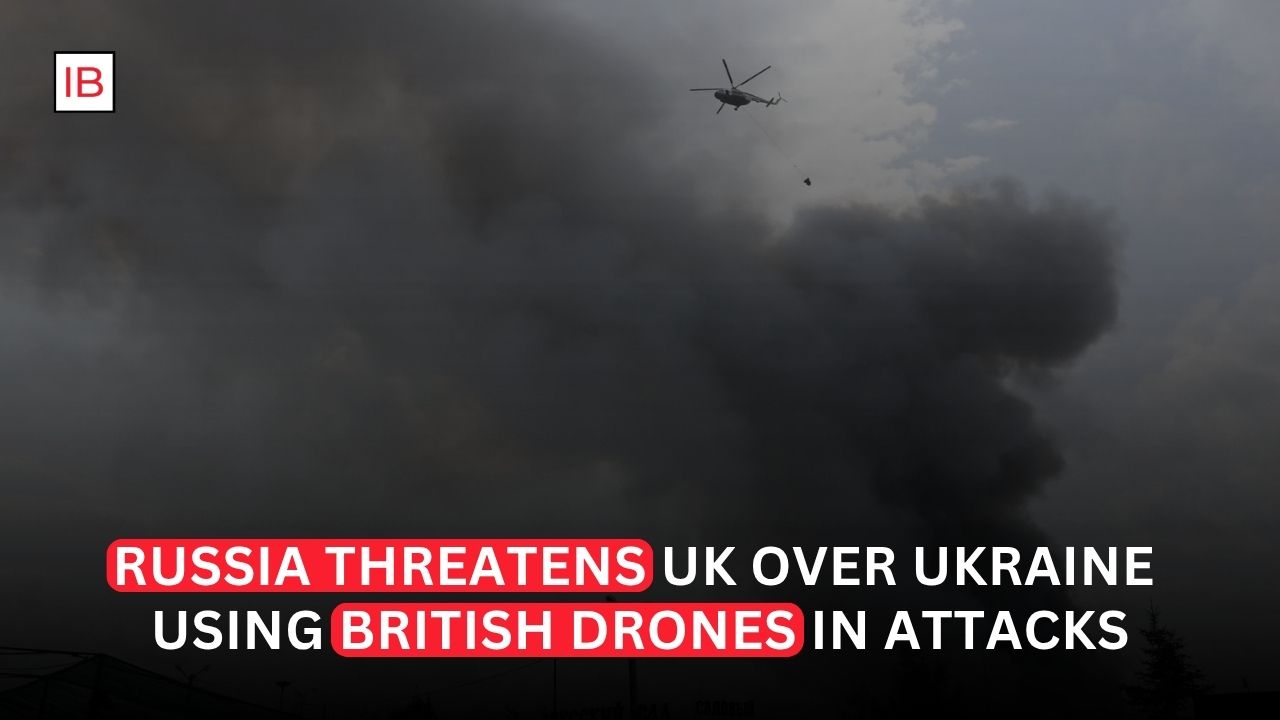
Russia has issued a sharp warning to Britain after reports that Ukraine has used British-made drones in long-range strikes against targets deep inside Russian territory, adding another layer of tension between Moscow and London as the war continues to expand into a broader confrontation between Russia and its Western opponents.
The warning came from the Russian Embassy in London after reports that British-built drones supplied to Ukraine had been used in attacks on Russian military and industrial facilities. Moscow accused Britain of becoming increasingly involved in the conflict and warned that its support for Ukraine could lead to consequences.
The reports represent a significant development because Ukraine has increasingly relied on long-range unmanned weapons to strike targets far from the front line. The latest allegations suggest that drones manufactured by British companies have been incorporated into those operations, allowing Ukrainian forces to attack Russian infrastructure from considerable distances.
Among the systems reported to have been used is the Nyan drone, developed by British company Callen-Lenz, which is part of BAE Systems. Reports have linked British-made drones to attacks against Russian oil and industrial facilities, including targets in the Volgograd and Yaroslavl regions. The reported use of these weapons marks a new stage in Ukraine’s expanding long-range strike campaign.
Moscow has responded by accusing Britain of deliberately escalating the conflict. The Russian Embassy said Britain’s military support for Ukraine made it increasingly involved in attacks against Russia. Russian officials have repeatedly warned Western countries that supplying weapons to Kyiv could eventually make them direct participants in the conflict.
The latest statement is therefore more than a routine diplomatic protest. It reflects Moscow’s continuing effort to draw a distinction between Western countries providing defensive assistance and weapons that can be used to conduct attacks deep inside Russian territory.
Britain, however, has shown no indication that it intends to reduce its support for Ukraine. The UK Ministry of Defence reiterated its commitment to helping Ukraine defend itself against Russia’s invasion. Britain has announced substantial military assistance for Kyiv, including a plan to provide 150,000 drones by the end of 2026 as part of a £752 million funding package.
The disagreement comes as drone warfare has become one of the most important features of the Russia-Ukraine conflict. Both countries are increasingly using unmanned aircraft to strike military positions, industrial facilities, logistics centers and energy infrastructure.
Ukraine has significantly expanded its ability to launch attacks deep inside Russia. Earlier this week, Ukrainian forces carried out one of their largest aerial offensives of the war, with hundreds of drones reportedly launched against targets across Russia. Russian authorities said they intercepted hundreds of drones, while the attacks caused deaths and damage in several regions.
The attacks are designed not only to damage individual facilities but also to put pressure on Russia’s wider war effort. Ukrainian strikes have increasingly targeted oil infrastructure, military-industrial facilities and logistics networks. By disrupting these systems, Kyiv hopes to increase the cost of Russia’s continued military operations.
Russia has responded with its own extensive drone and missile attacks against Ukraine. Ukrainian energy infrastructure has been particularly heavily targeted, with Naftogaz reporting 13 attacks on its facilities in a single week and nearly 300 attacks since the beginning of the year. Ukrainian officials have warned that Russia is attempting to weaken the country’s energy system ahead of the winter season.
This escalation creates a difficult strategic problem for Britain and other Western countries supporting Ukraine. Providing weapons gives Kyiv additional capabilities against Russian forces, but longer-range systems also increase the possibility of Russian retaliation against Western interests.
The issue is particularly sensitive because Britain has already become one of Ukraine’s most important European military supporters. Moscow has repeatedly criticized London’s role and has warned that Western weapons deliveries could make their suppliers legitimate targets.
At the same time, there is an important distinction between Russia’s political warnings and evidence of an imminent attack on Britain. Moscow’s latest statement threatens unspecified consequences, but it does not establish that Russia has decided to carry out a direct military strike against the UK. The language is nevertheless significant because it shows how quickly the conflict can create pressure between Russia and NATO members.
For Ukraine, the use of foreign-made drones provides another way to compensate for limitations in traditional long-range missile capabilities. Drones can be produced and deployed in large numbers and can force Russian air defenses to defend a much larger area. Ukraine has also developed its own long-range systems, making unmanned warfare increasingly central to its military strategy.
For Russia, the growing number of attacks deep inside its territory represents both a military and political challenge. Successful strikes can disrupt infrastructure, force Moscow to move air-defense systems away from the front and demonstrate that distance alone cannot protect important facilities.
The latest dispute between Moscow and London therefore reflects a broader transformation of the war. The battlefield is no longer defined only by the front line in Ukraine. Long-range drones are extending the conflict hundreds or even thousands of kilometers beyond it, while Western military assistance is becoming increasingly important to Ukraine’s ability to conduct those operations.
Whether Russia responds with actions against British interests remains uncertain. But its latest warning shows that the risks surrounding Western weapons deliveries are increasing. As Ukraine expands its long-range strike capabilities and Britain continues supplying military equipment, the possibility of further confrontation between Russia and Western governments will remain one of the most serious dangers surrounding the war.