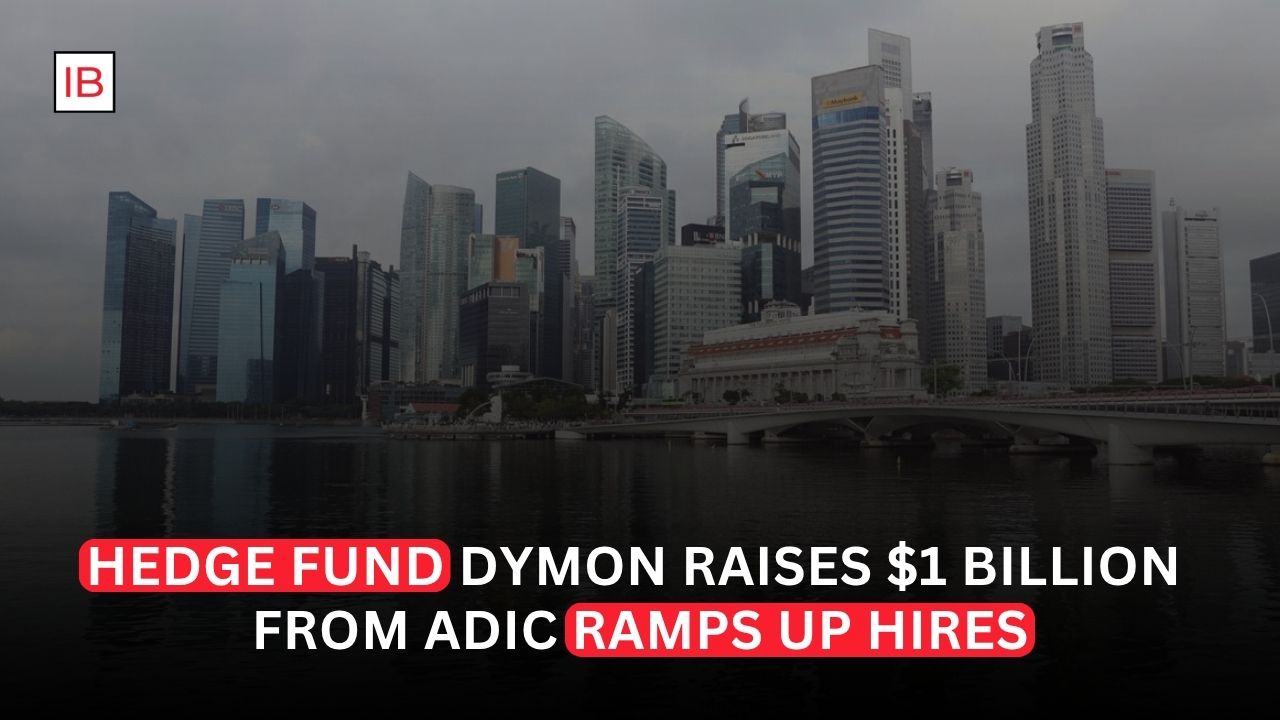
Dymon Asia Capital is accelerating its expansion after attracting about $1 billion in fresh capital from Abu Dhabi Investment Council, adding to a rapid increase in assets and a broader hiring campaign as institutional investors continue to pour money into large multi-strategy hedge funds.
The Singapore-based investment manager has become one of Asia’s fastest-growing hedge fund firms. Its assets have risen rapidly during 2026, reaching roughly $9 billion, according to recent industry reporting. The firm was managing about $7.5 billion as of May, already well ahead of its earlier target of reaching $5 billion by the end of the year.
The new capital from Abu Dhabi is significant because sovereign wealth funds have become increasingly important sources of long-term funding for hedge fund managers. Institutional investors such as sovereign funds, pensions and endowments are attracted to multi-strategy firms because they can potentially generate returns from different markets while reducing dependence on a single investment approach.
Dymon’s expansion comes as the hedge fund industry experiences strong demand for managers capable of navigating volatile markets. Higher interest rates, geopolitical tensions, currency movements and large differences between economies have created opportunities for macro and multi-strategy investors.
Dymon has built its business around precisely those types of opportunities. The firm has traditionally focused heavily on Asian markets, trading across areas including currencies, equities, bonds and macroeconomic themes. Its newer multi-strategy structure gives portfolio managers greater flexibility to pursue opportunities across different asset classes.
The company has also been expanding beyond its traditional Asian base. Dymon is strengthening its presence in London and Dubai while adding experienced investment professionals from major global hedge funds and banks.
One of the firm’s recent hires is Stuart Wilson, a former managing director at Eisler Capital, who is expected to become Dymon’s chief operating officer for Europe later this year. The appointment comes ahead of Dymon’s planned London expansion and follows the recruitment of other senior professionals.
In May, former UBS O’Connor executive Bernie Ahkong joined Dymon as a partner and head of its London office. The firm has also hired Jay Radia from BlueCrest Capital Management to strengthen its commodities business, while its Dubai operation has added professionals from Hudson Bay and Bank of America.
The hiring campaign shows that Dymon is not simply trying to gather more assets. It is attempting to build the infrastructure and investment teams required to manage a substantially larger pool of institutional money.
That distinction matters. Raising capital can be relatively straightforward when investors are attracted by strong recent performance, but maintaining returns becomes more difficult as a fund grows. Larger pools of capital can reduce flexibility, particularly in less liquid markets, and successful managers need to find enough opportunities to deploy the additional money without weakening their investment discipline.
Dymon’s recent performance provides part of the explanation for the inflows. Its multi-strategy fund gained about 18% last year, according to industry reports, and posted a 5% gain in January 2026, its strongest monthly performance since the strategy was reorganized in 2020.
The performance has not been uniformly positive. The fund lost about 6.5% in July, according to recent reporting, although it remained up roughly 7.5% for the year through July 31. That volatility highlights one of the challenges facing multi-strategy managers: even firms with strong long-term records can experience substantial monthly swings when markets move sharply.
For Abu Dhabi Investment Council, the investment fits into a wider effort to increase exposure to alternative investments. ADIC has recently backed other major hedge fund businesses, including ExodusPoint, reflecting growing interest from Gulf sovereign investors in strategies that can provide diversification and potentially attractive risk-adjusted returns.
The Gulf’s sovereign investors have become increasingly influential in the global hedge fund industry. Their large pools of capital and relatively long investment horizons allow them to provide substantial allocations that traditional investors may be unable or unwilling to commit.
That capital is especially valuable as competition among hedge funds intensifies. The largest firms have attracted enormous amounts of institutional money, while smaller and mid-sized managers are competing for investors by offering specialized strategies, capacity for differentiated trades and potentially higher returns.
Dymon’s growth also reflects the increasing importance of Asian investment opportunities. Global investors have become more interested in strategies capable of capturing differences between Asian economies, currencies and financial markets. A manager with an established presence in the region can potentially exploit opportunities that are less accessible to firms based primarily in New York or London.
The firm’s relationship with major institutional investors is not new. Dymon has previously worked with investors including Temasek, Singapore’s state investment company. In July, Temasek committed an initial $500 million to a new venture with Dymon focused on investing in new hedge fund managers and strategies.
That partnership illustrates how Dymon is expanding beyond simply managing its own traditional hedge funds. The company is increasingly positioning itself as a broader platform for alternative investment strategies, potentially giving institutional investors access to multiple managers and investment approaches.
The challenge now is execution. Rapid asset growth can increase revenues and strengthen a firm’s market position, but it also raises expectations. Investors providing billions of dollars will demand consistent risk management, strong infrastructure and performance that justifies the fees associated with alternative investments.
Dymon’s recent hiring spree suggests management is preparing for that challenge. Expanding into London and Dubai gives the firm access to deeper pools of investment talent and institutional capital while allowing it to operate closer to major global financial centers.
For the wider hedge fund industry, Dymon’s rise highlights the continuing concentration of institutional capital in sophisticated multi-strategy managers. Investors are increasingly looking for firms capable of trading across markets rather than relying on a single asset class or geographic region.
Dymon now has an opportunity to turn its rapid fundraising and hiring into a durable global platform. The $1 billion Abu Dhabi allocation provides additional capital, while the firm’s expanding international team gives it greater capacity to pursue opportunities around the world.
The next test will be whether Dymon can maintain performance as its assets grow. Its ability to do that will determine whether the latest capital influx becomes a temporary boost or another step in the transformation of Dymon into one of Asia’s leading global multi-strategy investment firms