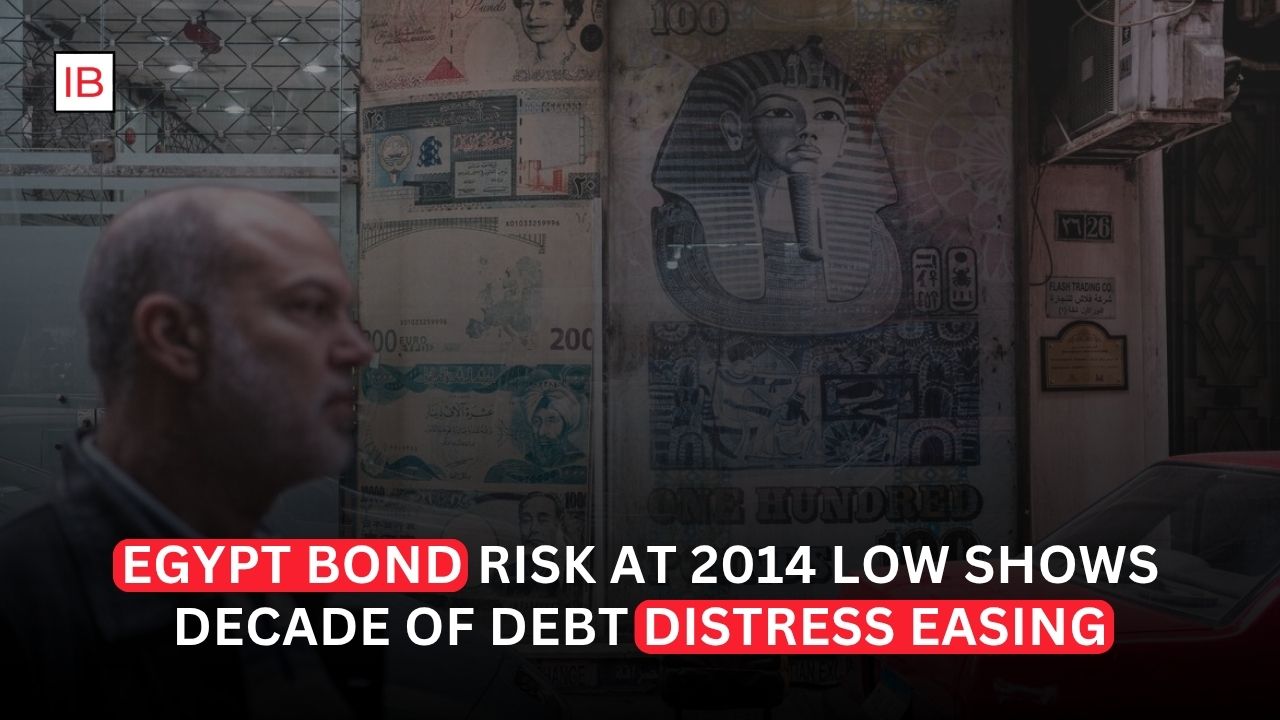
Egypt’s sovereign bond market is showing its strongest confidence in the country’s finances in more than a decade, with measures of bond risk falling to levels not seen since 2014 as investors respond to improving foreign-exchange conditions, stronger external financing and progress in the government’s efforts to stabilize its debt burden.
The improvement marks a significant change for a country that spent much of the past decade struggling with repeated currency crises, shortages of foreign exchange and rising borrowing costs. Egypt’s financial position deteriorated sharply after successive external shocks, including the pandemic, Russia’s invasion of Ukraine and the resulting pressure on food, energy and tourism revenues.
Now, investors are increasingly betting that the worst of the crisis has passed.
Egypt’s sovereign spreads have narrowed substantially from the extreme levels reached during the 2023-24 period of financial stress. The improvement reflects a combination of factors, including support from the International Monetary Fund, major Gulf investment, greater exchange-rate flexibility and stronger foreign participation in the domestic bond market.
The change in investor sentiment is particularly important because Egypt remains one of the world’s largest emerging-market borrowers. The government still carries a substantial debt burden and faces significant refinancing requirements, meaning access to affordable financing is critical to maintaining economic stability.
The key difference today is that Egypt has more foreign currency available to meet those obligations.
The country’s exchange-rate reform was a major turning point. After years of attempting to manage the Egyptian pound, authorities moved toward greater flexibility in 2024. The adjustment initially caused significant disruption, but it also helped reduce the gap between official and parallel-market exchange rates and encouraged foreign investors to return to Egyptian assets.
The IMF has described the resulting improvement in the external position as one of the main reasons financing conditions have strengthened. Exchange-rate flexibility, foreign inflows and tighter economic policies have helped rebuild reserves and improve market access.
Gulf investment has played an equally important role.
Large investments from Gulf countries have provided Egypt with much-needed foreign currency and reduced immediate pressure on its balance of payments. The country has also been selling state assets as part of its broader economic reform program, with authorities committing a significant portion of divestment proceeds toward reducing debt.
These inflows have changed how international investors view Egypt’s ability to meet its obligations.
The IMF’s latest assessment shows that Egypt’s outstanding credit with the Fund has fallen substantially from the beginning of its current program, while reserves have improved and market access has strengthened. The Fund said Egypt’s economic environment and near-term outlook have improved as stabilization policies take effect.
That does not mean Egypt’s debt problem has disappeared.
The country still has enormous financing requirements, particularly because much of its domestic debt has relatively short maturities. Short-term borrowing creates a significant rollover risk because the government must repeatedly refinance large amounts of debt.
The IMF has identified this as one of Egypt’s most important remaining vulnerabilities. It has urged the authorities to extend debt maturities, strengthen debt management and reduce gross financing needs.
Egypt has responded by attempting to lengthen the maturity of its domestic debt and develop new financing instruments, including longer-term bonds and sukuk. The government has also pursued debt swaps and other liability-management operations designed to reduce the amount of debt that must be refinanced in the near term.
The strategy is intended to make the government less vulnerable to sudden changes in investor sentiment.
That matters because Egypt cannot rely indefinitely on favorable international markets. Global interest rates remain relatively high, and emerging-market borrowers can face sharp increases in financing costs when investors become more risk-averse.
For now, however, demand for Egyptian assets has improved significantly.
Foreign participation in the local debt market has recovered from crisis lows, and the IMF reported record nonresident inflows into domestic government securities by the end of 2025.
The attraction is straightforward. Egyptian government securities offer relatively high yields, while the country’s improved external position has reduced fears of another sudden currency crisis.
Investors are effectively being paid a substantial return to take on a risk that now appears lower than it did two years ago.
That combination has helped push sovereign risk indicators toward levels last seen in 2014.
But investors should be careful about interpreting the decline as evidence that Egypt has completely escaped its debt problems.
The country still faces very large external obligations. Data cited from the World Bank indicate that Egypt has about $62.8 billion in external debt payments due between April 2026 and March 2027, including principal and interest.
That is an enormous financing requirement.
Egypt therefore remains dependent on continued foreign-currency inflows from tourism, remittances, exports, investment, Gulf partners and international institutions. A major geopolitical shock that damages tourism or reduces traffic through the Suez Canal could quickly put pressure back on the external accounts.
The Middle East conflict is an obvious risk.
Egypt benefits from its geographic position but is also exposed to regional instability. Tourism receipts can fall when travelers perceive the region as unsafe, while disruptions to shipping can reduce revenue from the Suez Canal.
The country has so far demonstrated greater resilience than many investors feared, with the IMF noting that the economy has remained relatively resilient to spillovers from the regional war.
Another major issue is interest costs.
Egypt’s debt-service burden remains extremely high, and interest payments consume a substantial share of government revenue. The IMF has warned that the interest-to-revenue ratio remains one of the country’s most binding fiscal constraints.
This means that even if the debt-to-GDP ratio falls, the government can still face significant pressure if borrowing costs remain elevated.
Reducing the cost of debt therefore matters almost as much as reducing the amount of debt.
This is where the improvement in bond-market risk becomes important. If investors demand a smaller premium to hold Egyptian debt, the government can refinance existing obligations at lower costs and potentially extend maturities.
A virtuous cycle could emerge: stronger investor confidence lowers yields, lower yields reduce financing costs, lower financing costs improve fiscal conditions and better fiscal conditions further strengthen investor confidence.
Egypt is trying to establish exactly that cycle.
The government has also been pursuing fiscal consolidation. The IMF says authorities have delivered significant primary fiscal adjustment and reduced demand pressures through tighter public spending. Economic growth has begun to recover, while inflation has fallen from its earlier peaks.
But the reform process remains incomplete.
The IMF has specifically highlighted slow progress on privatization and state-asset sales, weaknesses in debt management and concerns surrounding state-owned banks. These issues could become obstacles if the government fails to maintain momentum.
For investors, the most important question is whether Egypt can maintain market confidence without relying excessively on emergency external support.
The country has already received substantial assistance, but long-term stability requires stronger domestic sources of foreign currency and a more sustainable fiscal structure.
That means increasing exports, attracting productive foreign investment, expanding tourism and improving the competitiveness of the private sector.
If those reforms succeed, Egypt could emerge from the current crisis with a stronger and more diversified economy.
The bond market is already pricing in some of that improvement.
The dramatic decline in sovereign risk does not erase Egypt’s debt burden, but it suggests investors believe the probability of another acute financing crisis has fallen substantially. That is a major change from the situation only a few years ago.
For Cairo, the next challenge is to make the improvement permanent.
The country cannot afford to treat lower bond spreads as the end of the debt crisis. They are better understood as an opportunity: cheaper financing and stronger investor confidence give Egypt time to reduce refinancing risks, extend maturities and implement deeper structural reforms.
If policymakers use that window effectively, the fall in bond risk could mark the beginning of a genuine stabilization rather than another temporary recovery.
If reforms stall, however, investors could quickly become less forgiving.
For now, the market is signaling that Egypt’s decade-long debt distress is easing. The hard part will be proving that the improvement can survive without another external shock or emergency financial rescue.