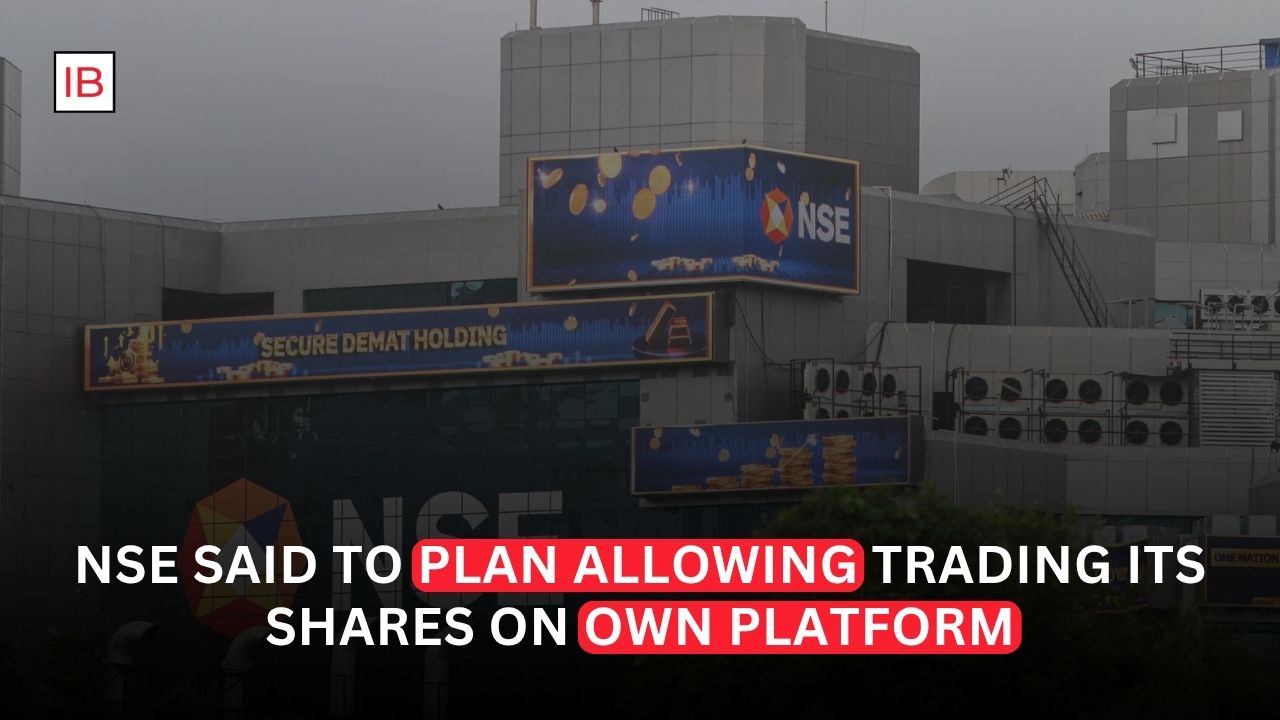
The National Stock Exchange of India is considering allowing its own shares to trade on its platform, a move that could mark a major change for the country’s largest exchange as it prepares for a long-awaited public listing.
The proposal comes at a critical time for NSE. The exchange is working toward an initial public offering that could value the company at more than 5 trillion rupees, potentially making it one of India’s largest-ever listings. Recent reports indicate that NSE is seeking a valuation of as much as 5.26 trillion rupees, with shares being marketed to institutional investors at around 2,000 to 2,100 rupees each.
Allowing NSE shares to trade directly on its own platform would be symbolically significant.
Stock exchanges typically have strict rules separating their commercial operations from the securities that trade on their markets. NSE itself is not currently a publicly traded company, meaning investors cannot buy and sell its shares through the exchange in the same way they can trade shares of listed Indian companies.
That could change if regulators approve the proposed arrangement.
The move would give NSE an unusual position in India’s capital markets: the exchange would effectively become both the operator of a trading venue and the marketplace where its own shares are bought and sold.
That creates obvious regulatory questions.
The Securities and Exchange Board of India, or SEBI, would need to ensure that trading in NSE shares is conducted fairly and that the exchange’s own commercial interests do not influence market operations.
Investor confidence would depend heavily on those safeguards.
NSE is already preparing for a major transformation as it moves toward becoming a publicly listed company. Its planned IPO is expected to consist entirely of an offer for sale, meaning existing shareholders would sell their stakes rather than the exchange issuing new shares to raise fresh capital.
That structure is important because NSE itself would not receive the IPO proceeds.
Instead, the listing would provide liquidity to existing investors and allow the broader market to establish a public valuation for one of India’s most important financial institutions.
The exchange has become a dominant force in India’s stock and derivatives markets.
Its trading volumes have expanded dramatically as millions of retail investors have entered Indian equities and derivatives. NSE is also the world’s leading venue for equity derivatives by trading volume, giving it an enormous position in India’s financial ecosystem.
That dominance is one of the reasons investors are interested in the IPO.
NSE generates revenue from transaction fees, market data, listing services and other activities linked to the growing Indian capital market.
But its dominant position has also attracted regulatory scrutiny.
Indian regulators have increasingly focused on competition, derivatives trading, market structure and the risks associated with retail participation in options.
SEBI is currently pursuing a broader package of reforms intended to improve India’s stock market infrastructure and attract foreign investors. The regulator is considering measures involving collateral requirements, stock lending, short selling and the closing auction process.
Those changes could influence how investors assess NSE before its IPO.
The exchange’s strong market position is clearly an advantage, but investors also need to consider the possibility of regulatory intervention.
One of the biggest questions concerns derivatives.
India has experienced enormous growth in futures and options trading, particularly among individual investors. NSE has benefited heavily from this activity because derivatives generate substantial trading volumes and transaction-related revenue.
However, regulators have become increasingly concerned about the risks faced by retail traders.
Any future rules that reduce speculative derivatives activity could affect NSE’s revenue growth.
That is one of the central risks investors will have to weigh against the exchange’s dominant market position.
The proposed trading of NSE shares on its own platform adds another layer to the story.
A public market for NSE stock would provide investors with continuous price discovery after the IPO. Instead of relying on occasional private transactions or valuation estimates, investors would be able to observe the market’s assessment of NSE in real time.
That could make the company considerably more transparent.
It could also make NSE itself more closely connected to daily movements in India’s stock market.
If the broader market performs strongly, NSE shares could benefit from expectations of higher trading activity and stronger corporate earnings. During periods of market stress, however, the exchange could face the opposite effect.
There is an important counterargument to the enthusiasm surrounding the listing.
NSE’s enormous trading volumes do not automatically guarantee unlimited future growth.
Indian equity markets have expanded rapidly, but regulators are increasingly focused on making trading safer and more sustainable. The exchange could therefore face a future in which transaction volumes continue growing but the most lucrative parts of the derivatives business become more tightly regulated.
Investors will need to distinguish between temporary trading booms and sustainable structural growth.
The IPO valuation will make that distinction particularly important.
At a potential valuation above 5 trillion rupees, investors would be paying a significant price for NSE’s dominant position. The company would need to demonstrate that earnings can continue growing despite regulatory changes and increasing competition.
Competition is another factor.
The Bombay Stock Exchange remains NSE’s main domestic rival. While NSE dominates many areas of the Indian market, BSE has strengthened its position in several segments and continues to compete for listings, trading activity and market share.
A public NSE would therefore have to operate in a more closely scrutinized competitive environment.
The IPO could also change the incentives of NSE’s existing shareholders.
Once listed, shareholders will have a liquid market in which to monetize their holdings. The exchange’s performance will be judged not only by regulators and industry participants but also by public investors demanding earnings growth and returns.
That could increase pressure on management to maintain profitability.
At the same time, public ownership could strengthen corporate governance.
Regular financial reporting, analyst coverage and shareholder oversight would provide investors with more information about NSE’s business than is currently available.
The exchange’s own shares trading on its platform would make that transparency even more visible.
However, the arrangement would require strict controls to prevent conflicts of interest.
The exchange would have access to sensitive information about trading activity, market participants and potentially its own security. Regulators would need to ensure that no participant receives an unfair advantage.
The technical and regulatory framework for trading NSE shares would therefore be closely watched.
The idea also highlights just how important India’s exchange infrastructure has become.
India’s equity market has expanded rapidly as household savings increasingly move into financial assets. Millions of new investors have entered the market through online brokers, while foreign institutional investors continue to treat India as one of the world’s most important emerging markets.
That growth has created an enormous business opportunity for exchanges.
NSE sits at the center of that ecosystem.
Its IPO could therefore become a major test of how investors value financial-market infrastructure in India.
The exchange is also seeking to capitalize on strong investor demand for exposure to India’s capital-market growth. Recent reports suggest it is conducting meetings with global institutional investors ahead of the listing and seeking a valuation of roughly 5.2 trillion to 5.3 trillion rupees.
If successful, the IPO would give NSE a public market valuation comparable with some of India’s largest financial companies.
But the biggest attraction may not be the IPO itself.
It is the possibility that investors will finally gain direct exposure to the infrastructure powering India’s enormous trading economy.
Allowing NSE shares to trade on NSE would make that transformation even more visible.
The exchange would move from being an influential but privately held market institution to a publicly traded company whose own shares participate in the market it operates.
That is a powerful symbol of India’s rapidly developing capital markets.
Still, the proposal is not without complications.
SEBI approval, market-integrity safeguards and the final structure of the IPO will determine whether the plan can move forward smoothly.
Investors will also need to assess whether NSE can sustain its exceptional profitability if regulators continue tightening rules around derivatives and retail trading.
For now, the planned listing represents a major milestone.
NSE has already become one of the most important exchanges in the world by trading activity. Bringing its own shares to the market would take the company into a new phase, giving investors direct exposure to the business while forcing the exchange to meet the higher transparency and governance standards expected of a listed company.
If regulators approve trading of NSE shares on its own platform, the symbolism will be hard to miss.
India’s largest stock exchange would, quite literally, become a market for its own stock.