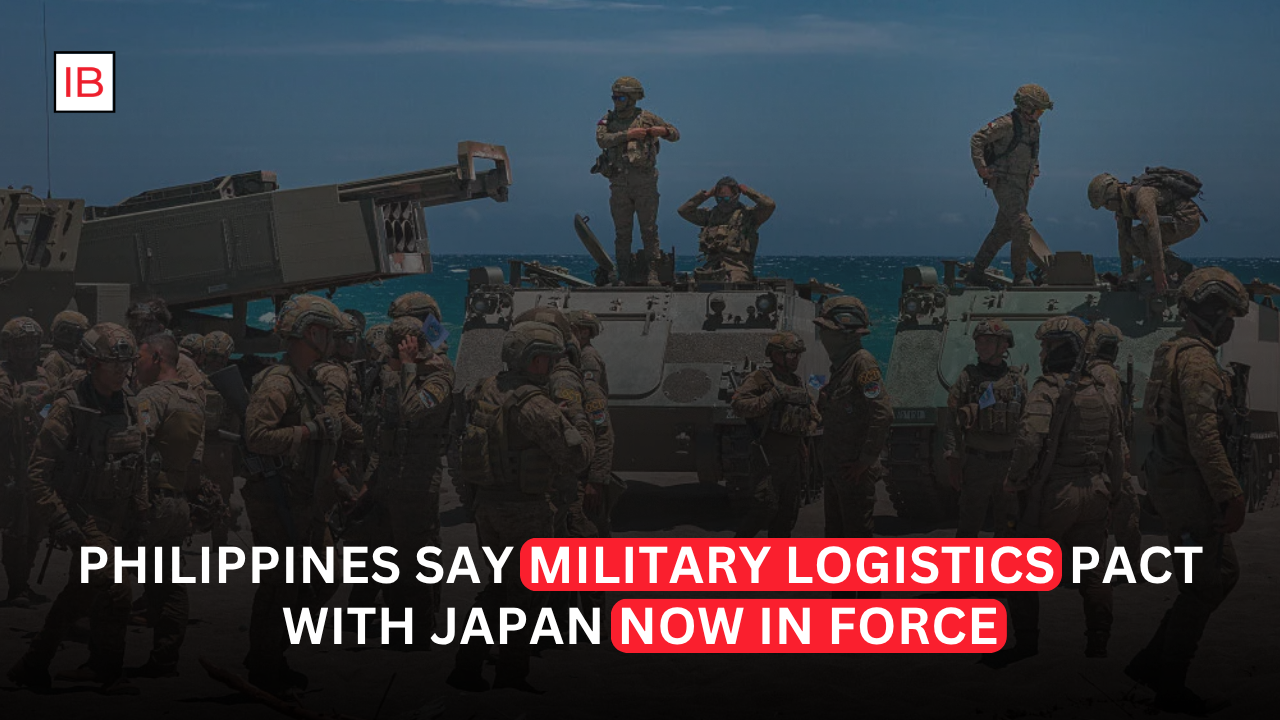
The Philippines and Japan have taken another significant step toward closer military cooperation, bringing a defense logistics agreement into force on August 22. The Acquisition and Cross-Servicing Agreement (ACSA) creates a formal framework for the two countries’ armed forces to provide supplies and services to one another, making joint exercises, humanitarian operations and other military activities easier to conduct.
The agreement may sound technical, but its strategic significance is much broader.
It gives Manila and Tokyo a practical mechanism for supporting each other’s forces and reflects the rapid expansion of their security relationship at a time when tensions across the Indo-Pacific remain elevated.
What the New Agreement Does
The ACSA establishes procedures allowing the Armed Forces of the Philippines and Japan Self-Defense Forces to exchange supplies and services during authorized activities.
That can include logistical necessities such as:
- Fuel
- Food
- Water
- Transportation
- Other military supplies
- Maintenance and related services
The important point is not simply that one country can provide supplies to the other.
The agreement creates a standardized legal and administrative framework for doing so.
That means military cooperation can become faster and more predictable instead of requiring separate arrangements every time the two countries conduct an operation or exercise.
Signed in January, Activated in August
The Philippines and Japan signed the agreement in Manila on January 15, 2026.
It formally entered into force on August 22, following an exchange of diplomatic notes between the two governments.
The timing matters.
The agreement is not an isolated development.
It is part of a broader sequence of military arrangements between Manila and Tokyo that have steadily moved the relationship from political cooperation toward more practical defense integration.
It Builds on the Reciprocal Access Agreement
The logistics agreement follows the Japan-Philippines Reciprocal Access Agreement (RAA), which entered into force in September 2025.
The RAA established procedures for military personnel from one country to conduct cooperative activities in the territory of the other.
The ACSA adds the logistical infrastructure needed to make those activities more efficient.
Put simply:
The RAA helps determine how forces can operate across borders, while the ACSA helps them obtain the supplies and services required to operate effectively.
That makes the two agreements complementary.
Why Logistics Matter So Much
Military power is not only about ships, aircraft and soldiers.
It is also about logistics.
An aircraft needs fuel.
A ship needs food, water, maintenance and spare parts.
Military personnel conducting exercises need transportation and other support.
During humanitarian disasters, military forces may need supplies rapidly to deliver assistance.
A country can have sophisticated weapons but still struggle to sustain operations if its logistics system is inefficient.
The new Philippines-Japan arrangement therefore strengthens an often-overlooked part of military cooperation.
Joint Exercises Become Easier
One of the most immediate benefits will likely come during military exercises.
The Philippines and Japan have been increasing the scale and frequency of their defense activities.
The ACSA provides a mechanism for supporting those activities with fewer logistical complications.
That should improve interoperability.
Military interoperability means forces from different countries can communicate, coordinate and operate together effectively.
It becomes increasingly important when several countries participate in the same exercises.
Humanitarian Assistance Is Another Major Purpose
The agreement is not limited to combat-related activities.
Both governments have emphasized humanitarian assistance and disaster response as important areas of cooperation.
That matters particularly for the Philippines.
The country is frequently affected by typhoons, earthquakes, volcanic activity and other natural disasters.
Japan also has extensive experience with disaster response.
Closer military coordination can therefore provide practical benefits that have nothing directly to do with warfare.
If a major disaster occurs, forces from both countries can potentially coordinate support more efficiently.
Japan’s Expanding Role in Southeast Asian Security
The agreement also reflects a broader change in Japan’s regional security role.
For decades after World War II, Japan maintained significant restrictions and political sensitivities around military activity.
That environment has gradually changed.
Japan has increasingly sought deeper defense partnerships with countries across the Indo-Pacific.
The Philippines has become particularly important because of its geographic position.
It sits near the South China Sea and relatively close to Taiwan.
That makes the country strategically significant for regional maritime security.
The South China Sea Is an Important Background Factor
The Philippines has longstanding disputes with China over areas of the South China Sea.
Those disputes have increasingly involved coast guard encounters, maritime confrontations and competing territorial claims.
Japan has its own serious strategic concerns about China’s military expansion.
Tokyo and Manila therefore share an interest in maintaining a regional order in which maritime disputes are managed through established rules rather than coercion.
The two governments describe their cooperation in terms of a free and open Indo-Pacific and a rules-based international order.
This Is Not a Mutual Defense Treaty
One important distinction should not be lost.
The ACSA does not mean Japan and the Philippines have created a NATO-style mutual-defense alliance.
It is a logistics agreement.
It establishes procedures for exchanging supplies and services.
That makes it less dramatic legally than a formal treaty promising military intervention.
But its practical effects can still be significant.
Defense relationships are often built through a network of smaller agreements rather than one massive alliance treaty.
The United States Is an Important Part of the Background
The Philippines is a longstanding US treaty ally.
Japan is also a major US ally.
That means closer military cooperation between Manila and Tokyo fits into an existing network of US security partnerships across the Indo-Pacific.
The emerging structure is increasingly interconnected.
The United States conducts exercises with both countries.
Japan and the Philippines conduct their own exercises.
Australia has also become increasingly involved in regional defense cooperation.
The result is a more connected security architecture across the western Pacific.
Japan’s First Postwar Ground Exercises in the Philippines
The growing relationship has already moved beyond diplomatic agreements.
In April 2026, Japanese ground forces participated in military exercises in the Philippines for the first time since World War II, with Japanese personnel joining the annual Salaknib exercises alongside Philippine and US forces.
That was a significant symbolic development.
For decades, Japanese military forces operating on Philippine soil would have been politically unthinkable given the history between the two countries.
Today, the same military presence is increasingly being presented as part of regional security cooperation.
That illustrates how dramatically the strategic environment has changed.
From Historical Rivals to Security Partners
The historical dimension makes the relationship particularly interesting.
Japan occupied the Philippines during World War II, and the occupation remains a painful part of Philippine history.
Yet contemporary strategic pressures have encouraged the two countries to build much closer security ties.
The transformation demonstrates how geopolitical interests can reshape international relationships.
The Philippines and Japan now increasingly view each other as partners facing common strategic challenges.
The Agreement Also Improves Readiness
Another benefit is military readiness.
Regular exercises are useful only if forces can sustain them.
If every exercise requires lengthy negotiations over supplies, transportation and payment arrangements, cooperation becomes inefficient.
A standing logistics framework removes some of those obstacles.
That means the two militaries can potentially respond faster when conducting exercises, disaster relief or other approved operations.
The Philippine defense department described the agreement as strengthening operational cooperation through more efficient and coordinated provision of supplies and services.
ACSA Could Become More Important During a Crisis
The real significance of the agreement may only become obvious during a serious regional crisis.
In normal circumstances, logistics arrangements may seem bureaucratic.
During a crisis, they can become critical.
Military forces may need fuel, food, transportation or maintenance support quickly.
Having pre-agreed procedures can reduce delays.
That does not mean the ACSA automatically commits either country to military action.
But it creates infrastructure that could make cooperation much easier if both governments decide to respond to a regional emergency.
China’s Likely Perspective
Beijing has closely watched the expansion of Japan’s defense relationships across the Indo-Pacific.
The Philippines’ growing military cooperation with Japan, the United States and Australia could be viewed by China as part of a broader effort to strengthen the regional security network around it.
From Manila’s perspective, however, the partnerships are largely about deterrence and protecting its sovereignty.
This creates a familiar regional dilemma.
One country’s effort to improve security can be interpreted by another as a threat.
That can encourage further military cooperation on both sides.
The Philippines Is Diversifying Its Defense Partnerships
Manila is also increasingly diversifying its security relationships.
Historically, the United States has been the Philippines’ most important military partner.
That remains the case.
But cooperation with Japan provides another layer.
Australia has also increased defense engagement.
Other countries are becoming involved in exercises and security initiatives.
This diversification gives Manila more options and reduces dependence on a single external partner.
Japan Gains Strategic Access and Partnerships
The relationship also benefits Japan.
The Philippines occupies a strategically important location between the South China Sea and the western Pacific.
Closer defense cooperation gives Japan more opportunities for exercises, training and humanitarian operations in Southeast Asia.
It also strengthens relationships with another major US ally.
That matters because Japan’s security increasingly depends on developments beyond its immediate territory.
The Agreement Has an Economic Dimension Too
Defense cooperation can eventually influence the wider security industry.
As countries train and operate together more frequently, they may become more interested in compatible equipment, maintenance systems and defense technology.
The Philippines has been modernizing its military.
Japan has also been expanding its defense cooperation and security assistance.
Closer institutional relationships could therefore create opportunities for deeper defense-industrial cooperation in the future.
Official Security Assistance Adds Another Layer
The ACSA was signed alongside an exchange of notes related to Japan’s Official Security Assistance (OSA) for fiscal year 2025.
That is important because Japan’s security engagement with the Philippines is no longer limited to diplomatic statements.
Tokyo is increasingly providing practical assistance designed to strengthen the capabilities of partner countries.
The Philippines is one of the clearest examples of this expanding Japanese role.
The Bigger Indo-Pacific Picture
The Philippines-Japan relationship is part of a much larger shift.
Across the Indo-Pacific, countries are increasingly building overlapping defense relationships.
Japan has agreements with Australia, the UK and the Philippines.
The Philippines cooperates closely with the US, Japan and Australia.
India is expanding its own partnerships.
Countries across Southeast Asia are strengthening maritime security cooperation.
The goal is not necessarily to create one formal alliance.
Instead, countries are building a network of partnerships.
Why Logistics Could Matter More Than Headlines
Military headlines often focus on missiles, fighter jets, warships and defense budgets.
But logistics can determine whether those capabilities can actually be used effectively.
A country can purchase sophisticated equipment and still struggle to sustain operations.
Agreements such as ACSA address that problem.
They create the administrative infrastructure that makes military cooperation more practical.
That is why the Philippines-Japan agreement deserves attention even though it does not involve a dramatic weapons announcement.
What Happens Next?
The next stage will likely involve using the agreement in increasingly frequent military activities.
That could include:
- Joint military exercises
- Humanitarian assistance
- Disaster-response operations
- Training activities
- Peacekeeping-related engagements
- Other mutually agreed defense activities
The Philippine defense department has specifically highlighted exercises, humanitarian assistance, disaster relief and peacekeeping as areas that can benefit from the agreement.
The Main Strategic Question
The bigger question is whether these agreements remain limited to cooperation or gradually develop into something resembling a broader security partnership.
For now, neither country needs to describe the relationship as a formal alliance.
The practical cooperation is already increasing.
More exercises lead to greater familiarity.
Greater familiarity makes additional agreements easier.
Additional agreements make future cooperation easier still.
That is how defense partnerships often deepen.
Conclusion
The Philippines and Japan’s new military logistics agreement is technically about supplies and services.
Strategically, it is about much more.
The Acquisition and Cross-Servicing Agreement, which entered into force on August 22, creates a formal mechanism for the two countries’ militaries to exchange logistical support and services.
It builds directly on the Reciprocal Access Agreement that took effect in 2025 and supports a broader expansion of defense cooperation.
For the Philippines, the agreement can improve military readiness, disaster-response capabilities and interoperability with an increasingly important regional partner.
For Japan, it strengthens ties with a strategically located Southeast Asian country and expands Tokyo’s role in the Indo-Pacific.
For the wider region, it adds another connection to an increasingly dense network of security partnerships involving Japan, the Philippines, the United States and Australia.
The most important point is that this is not simply a logistics deal.
Fuel, food, transportation and maintenance may sound mundane, but they are the foundations that allow military cooperation to function.
As the Philippines and Japan conduct more exercises and coordinate more closely, those logistical links will become increasingly valuable.
The agreement does not create a mutual-defense treaty, nor does it automatically commit either country to fight alongside the other.
But it does something more practical.
It makes cooperation easier, faster and more predictable.
And in an Indo-Pacific increasingly shaped by strategic competition, the ability to cooperate quickly may itself become a significant source of deterrence.