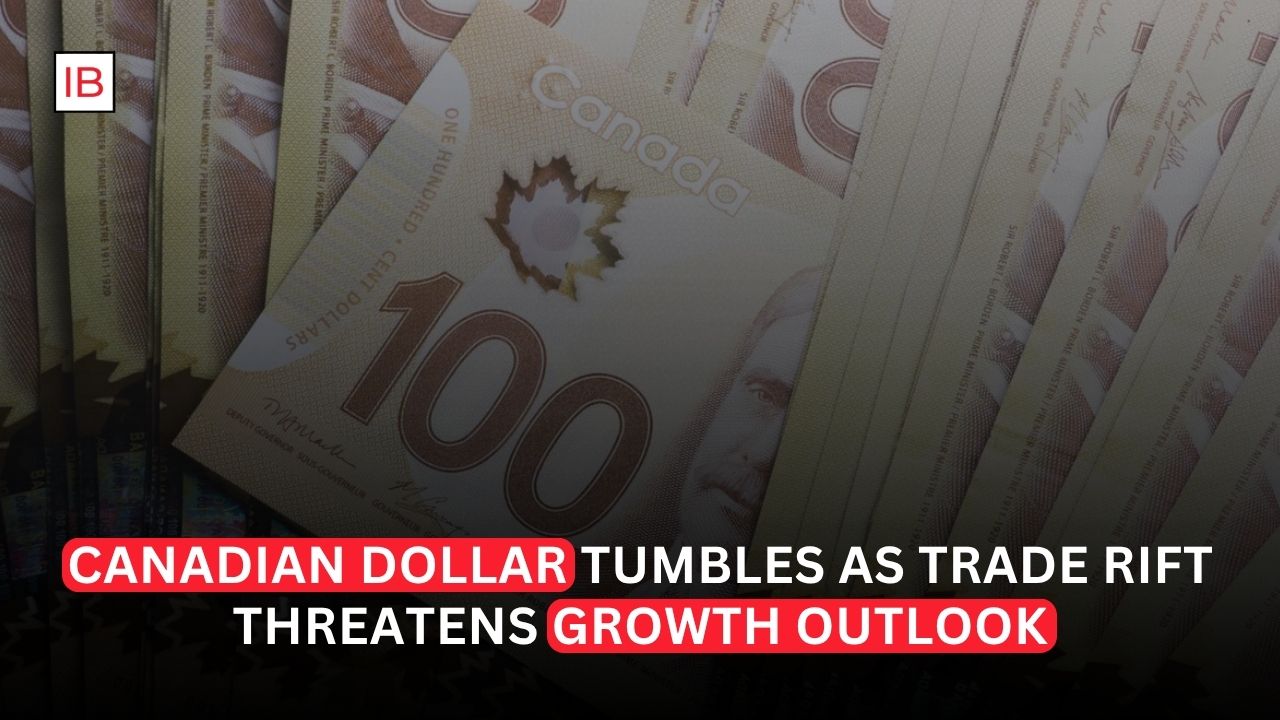
The Canadian dollar came under renewed pressure on Monday after trade negotiations between Canada and the United States collapsed, raising fears that a prolonged tariff dispute could weaken Canada’s economic growth and undermine investor confidence.
The Canadian dollar fell as markets reacted to the breakdown in talks and the introduction of new US tariffs. The US dollar climbed to around C$1.3839, compared with C$1.3741 at the end of the previous week.
The currency’s decline reflects more than a short-term reaction to tariffs. Investors are increasingly concerned that the dispute could damage Canadian exports, business investment and consumer confidence at a time when the economy is already adjusting to trade uncertainty.
Trade Talks Collapse
The immediate catalyst was the collapse of negotiations between Ottawa and Washington late Friday.
The two countries had been working toward an agreement that could have reduced some of the pressure facing Canadian exporters. Instead, the talks broke down after Canada rejected what Prime Minister Mark Carney described as an unacceptable deal.
Carney said Canada was unwilling to sacrifice its economic independence and sovereignty simply to obtain better access to the US market. His government has emphasized that most Canadian businesses should retain tariff-free access to the United States while Canada diversifies its international trade relationships.
The failure of negotiations has now turned what was already a difficult trade relationship into a much more serious economic confrontation.
50% US Tariffs Increase Pressure
Following the collapse in negotiations, Washington imposed 50% tariffs on about $20 billion of Canadian goods.
The affected products include steel, dairy, paper, electronics, appliances and agricultural equipment. Canada has responded by preparing equivalent tariffs on US goods.
For investors, the concern is that this could become a cycle of retaliation.
Higher tariffs raise the cost of imported goods.
Businesses then face higher production expenses.
Consumers may ultimately pay some of those costs through higher prices.
At the same time, exporters can lose market share as their products become more expensive.
That combination can weaken economic growth while creating additional inflationary pressure.
Why the Canadian Dollar Is Vulnerable
The Canadian dollar is particularly sensitive to developments in US-Canada trade because the United States is Canada’s dominant trading partner.
Around 75% of Canadian exports go to the US, according to reporting on the dispute.
That dependence creates a major vulnerability.
If Canadian companies face higher tariffs, they may reduce production, delay investment or look for alternative markets.
Foreign investors may also become more cautious about Canada if they believe the country’s access to its biggest export market is becoming less reliable.
Currency markets tend to price those risks quickly.
The loonie’s decline therefore reflects concerns about Canada’s future economic performance rather than simply the immediate cost of tariffs.
Growth Outlook Faces New Risks
The Bank of Canada has already warned that US tariffs and uncertainty surrounding the Canada-US-Mexico trade framework are major factors affecting Canada’s economic outlook.
Its projections indicate that economic activity remains on a lower path than previously expected because of trade uncertainty.
The latest escalation makes that problem more serious.
Canadian manufacturers that depend on US customers could face weaker demand.
Companies importing US components could face higher costs.
Businesses that had been waiting for clarity before investing may delay projects even further.
That can create a negative feedback loop in which uncertainty itself becomes an economic drag.
Carney Chooses Confrontation Over a Bad Deal
Prime Minister Mark Carney is taking a politically risky position.
Rather than accept Washington’s terms, his government has chosen to retaliate and accelerate efforts to diversify Canada’s economy.
Carney has argued that Canada must become less dependent on the United States and develop stronger relationships with other international markets. The government’s stated objectives include protecting Canadian businesses while maintaining flexibility and sovereignty in future trade negotiations.
The strategy could eventually make Canada more economically independent.
But diversification takes time.
Replacing a huge and highly integrated US market cannot happen quickly.
That creates a difficult period in which Canada may absorb substantial economic costs before alternative trade relationships become large enough to compensate.
Investors Are Watching the Bank of Canada
The trade conflict also complicates monetary policy.
Normally, weaker economic growth could strengthen the case for lower interest rates.
But tariffs can simultaneously push prices higher.
That creates a difficult situation for the Bank of Canada.
If economic growth slows sharply, policymakers could consider monetary easing.
If tariffs cause inflation to accelerate, however, aggressive rate cuts could become more difficult.
The central bank therefore faces a potential conflict between supporting growth and containing inflation.
That uncertainty can increase currency volatility.
Oil Provides Some Protection
Canada has one major advantage: it is a significant energy exporter.
Higher oil prices can increase export revenues and provide some support for the Canadian economy.
The Bank of Canada has noted that higher oil prices can have broadly offsetting effects on Canada’s economy because increased energy revenues can benefit the country while higher prices also raise inflation.
However, energy cannot fully offset a broad trade shock.
Canada’s economy is diversified across manufacturing, services, agriculture and other sectors.
A major deterioration in access to the US market would therefore still have consequences even if energy exports remain strong.
Business Investment Could Be the Hidden Problem
One of the biggest risks may not appear immediately in economic data.
It could be investment.
Companies generally prefer to commit capital when they understand future costs and market access.
A prolonged trade dispute creates the opposite environment.
Manufacturers may hesitate to expand factories.
Foreign companies may reconsider establishing operations in Canada.
Canadian firms may delay hiring or equipment purchases.
That can weaken productivity and potential economic growth over time.
The longer the trade dispute lasts, the more significant this effect could become.
Canada Wants to Diversify
Ottawa is attempting to respond by reducing its dependence on the US economy.
The government says Canada has already been working to build new international partnerships and diversify trade relationships.
That strategy could ultimately benefit Canada.
A country that sells heavily into multiple markets is less vulnerable to political decisions by one trading partner.
But diversification has limits.
The US is geographically close, deeply integrated into Canadian supply chains and enormous in economic size.
European and Asian markets may offer opportunities, but they cannot immediately replicate the scale and convenience of the American market.
Markets May Be Pricing a Longer Conflict
The Canadian dollar’s decline suggests investors are increasingly considering the possibility that this dispute will not be resolved quickly.
The currency had previously strengthened on hopes of a trade agreement, but those gains reversed after negotiations collapsed.
That is an important signal.
Currency markets often respond not only to current economic conditions but also to expectations.
If traders believe tariffs will remain in place for months or years, they will adjust their forecasts for Canadian growth, interest rates and corporate earnings.
That can put sustained pressure on the loonie.
The US Also Faces Costs
Canada is not the only economy exposed to the dispute.
US companies that rely on Canadian materials or customers can also face higher costs.
Retaliatory Canadian tariffs could hurt American exporters.
Industries with integrated cross-border supply chains may be particularly vulnerable.
This is why trade wars can produce economic damage on both sides even when one country is substantially larger.
The United States has greater economic power, but that does not mean American businesses are completely insulated from the consequences.
A New Era in Canada-US Relations
The dispute could represent a structural change in the relationship between the two countries.
Canada and the US have historically maintained one of the world’s most integrated economic partnerships.
That relationship was built through agreements including NAFTA and its successor, CUSMA.
The current conflict is challenging the assumption that this integration will remain stable.
Carney has explicitly said that Canada should not expect to return to the old relationship with Washington.
If that becomes the long-term reality, Canadian companies may permanently alter how they manage supply chains, investment and export markets.
What Happens Next?
The biggest question is whether negotiations eventually restart.
A compromise could stabilize the Canadian dollar quickly if markets conclude that the worst economic risks have passed.
But another escalation could push the currency lower.
Investors will therefore monitor tariff exemptions, Canadian economic data, corporate guidance and statements from both governments.
The Bank of Canada will also be crucial because changes in interest-rate expectations can amplify currency movements.
Conclusion
The Canadian dollar’s latest decline reflects a growing concern that the breakdown in US-Canada trade negotiations could become more than a temporary diplomatic dispute.
The introduction of 50% US tariffs on roughly $20 billion of Canadian goods, followed by Canada’s promise of reciprocal measures, has increased the risk of weaker exports, reduced investment and slower economic growth.
Canada has chosen to resist US pressure rather than accept what Carney considers an unfavorable agreement.
That decision could strengthen Canada’s economic independence over the long term, but the transition will not be painless.
For now, the Canadian dollar is carrying much of the market’s concern.
The currency’s weakness shows that investors are increasingly pricing in a difficult economic period ahead, particularly if the trade conflict persists.
The central challenge for Canada will be balancing three objectives: protecting national economic sovereignty, maintaining growth and controlling inflation.
Achieving all three will be difficult if the dispute with Washington continues.