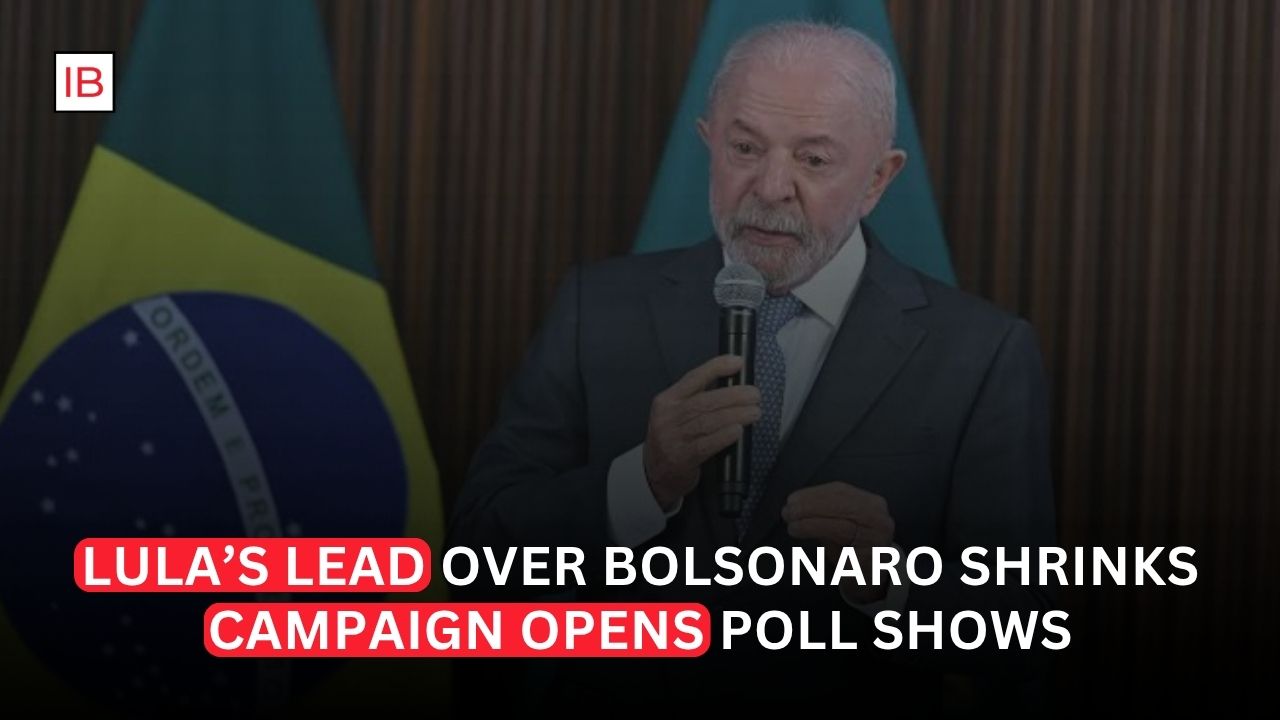
Brazil’s 2026 presidential election is becoming significantly more competitive as President Luiz Inácio Lula da Silva’s advantage over right-wing challenger Flávio Bolsonaro continues to narrow. Recent polling shows that Lula still leads in several scenarios, but the gap has become small enough to make the October election increasingly difficult to predict.
The tightening race is important for financial markets as well as Brazilian politics. Investors are watching the election closely because the eventual government will have to deal with public finances, economic growth, inflation, interest rates and relations with major trading partners.
Lula Still Leads, But the Advantage Is Shrinking
The latest polls show a clear trend: Lula remains ahead, but Bolsonaro is closing the gap.
A Datafolha poll published Aug. 21 showed Lula leading Flávio Bolsonaro 47% to 43% in a simulated second-round contest. The previous Datafolha survey had Lula ahead 48% to 43%. The change is within the poll’s two-point margin of error, meaning it should not automatically be interpreted as a decisive shift.
An even newer BTG/Nexus poll released Aug. 24 showed an extremely close race. In a potential runoff, Lula received 46%, compared with 45% for Flávio Bolsonaro.
That effectively puts the two candidates in a statistical tie.
The First Round Looks Different
The first-round numbers still give Lula a clearer advantage.
The latest BTG/Nexus survey puts Lula at 41% and Flávio Bolsonaro at 37% in the first round.
That four-point difference suggests Lula currently has a stronger base going into the campaign.
But Brazil uses a two-round presidential system.
If no candidate receives more than half of the valid votes in the first round, the two leading candidates advance to a runoff.
That means Lula’s first-round lead does not guarantee victory.
The second-round numbers are much closer.
Flávio Bolsonaro Is Becoming a Serious Challenger
Flávio Bolsonaro, the eldest son of former President Jair Bolsonaro, has emerged as the leading candidate of Brazil’s political right.
His campaign is attempting to inherit the political coalition built by his father while presenting Flávio as a candidate capable of challenging Lula directly.
Recent polling suggests that strategy is working to some extent.
The latest BTG/Nexus survey shows Flávio only one percentage point behind Lula in a runoff.
That is a substantial change from earlier polling.
A Quaest poll released Aug. 15 showed Lula leading Flávio 43% to 40% in a runoff, down from a five-point advantage earlier in August and an eight-point advantage in July.
The Race Is Still Highly Uncertain
It would be a mistake to conclude that Flávio is already overtaking Lula.
The available polls do not show a consistent Bolsonaro lead.
Instead, they show a race moving toward a much closer contest.
The latest surveys differ depending on methodology, timing and sample.
Datafolha has Lula ahead by four points in a runoff, while BTG/Nexus has the candidates essentially tied.
This means the safest conclusion is that Brazil’s presidential race has become competitive, not that one candidate has definitively taken control.
Lula Faces an Approval Problem
One weakness for Lula is his declining public approval.
A recent Datafolha survey found that 41% of Brazilians rated his government negatively, up from 38% previously. Positive evaluations stood at 33%, while the share describing the government as regular fell to 25%.
The same survey found that 50% disapproved of Lula’s performance, compared with 48% who approved.
These numbers matter because a president seeking another term normally needs a strong connection with voters beyond his core political base.
If dissatisfaction remains elevated throughout the campaign, Bolsonaro’s path to victory becomes easier.
Economic Conditions Will Matter
Brazil’s election will not be decided by politics alone.
The economy is likely to be one of the central issues.
Voters will pay attention to:
- Inflation
- Food prices
- Employment
- Interest rates
- Public debt
- Government spending
- Household income
- Economic growth
Lula can point to improvements in employment and income if economic conditions remain favorable.
But the government also faces concerns about fiscal discipline and public finances.
For financial markets, fiscal policy could be particularly important.
Bolsonaro’s Economic Team Is Taking Shape
Flávio Bolsonaro’s campaign has been strengthening its economic policy team.
Former Mines and Energy Minister Adolfo Sachsida has joined the campaign’s economic group, while Daniella Marques is playing a central role. Marques previously led state-owned Caixa Econômica Federal and worked alongside former Economy Minister Paulo Guedes during Jair Bolsonaro’s presidency.
The campaign has discussed a fiscal overhaul aimed at stabilizing and reducing public debt.
It has also proposed changes involving subsidized credit and the cost of formal employment.
The details remain less developed than the campaign’s broader political message, but the appointments suggest Bolsonaro wants to reassure markets that his administration would have an economically orthodox team.
Investors Will Be Watching Fiscal Policy
The Brazilian real, local bonds and equities could all react strongly to expectations surrounding the election.
Markets generally prefer predictable fiscal policy.
If investors believe the next government will maintain control over spending and debt, Brazilian assets could receive support.
If the election raises concerns about higher government spending or weaker fiscal discipline, the opposite could happen.
This makes the campaign’s economic proposals almost as important as the polling numbers.
The Role of Undecided Voters
The election remains open partly because a significant portion of voters has not firmly committed to either leading candidate.
Lula’s campaign is reportedly focusing on direct engagement with voters and expanding its effort to reach undecided groups.
That is strategically important.
In a close runoff, even a relatively small movement among undecided voters could determine the result.
The candidates therefore have an incentive to move beyond their traditional political bases.
Regional Divisions Could Decide the Election
Brazil’s political geography remains deeply divided.
Recent polling shows Flávio Bolsonaro performing particularly strongly in parts of the southeast, while Lula retains significant strength in northeastern states.
For example, a recent Datafolha state-level survey showed Flávio ahead of Lula in São Paulo and Rio de Janeiro, while Lula held a substantial advantage in Pernambuco.
Minas Gerais is particularly important because it has often been a decisive electoral battleground.
The latest polling there shows a much closer contest.
São Paulo Is Especially Important
São Paulo is Brazil’s largest state and a major economic center.
Flávio’s strong performance there could provide a substantial base of support.
Recent Datafolha numbers showed Flávio at 47% against Lula’s 42% in a simulated runoff in the state.
That does not determine the national result, but it demonstrates the challenge facing Lula.
The president cannot rely solely on his traditional northeastern support.
He needs to remain competitive in major southeastern states.
The Bolsonaro Name Still Carries Weight
Flávio’s biggest political advantage may also be his biggest limitation.
He benefits from his father’s strong political network and loyal voter base.
But the Bolsonaro brand is highly polarizing.
Some voters strongly support it, while others strongly oppose it.
That means Flávio may have a relatively high floor of support but could face difficulty winning moderate voters.
His campaign’s challenge will be expanding beyond the traditional Bolsonaro electorate.
Lula Has a Different Challenge
Lula is one of Brazil’s most experienced political figures.
He has already served multiple presidential terms and maintains a large national political organization.
His challenge is avoiding complacency.
The shrinking polling advantage shows that name recognition and an established political base are not enough.
The campaign must convince voters that another Lula administration can deliver economic stability and improve living standards.
The Campaign Has Only Just Started
The timing of the polls is important.
Brazil’s first-round presidential election is scheduled for Oct. 4, 2026.
That leaves several weeks for candidates to change public opinion.
Debates, economic developments, scandals, campaign mistakes and international events can all reshape the race.
A one-point difference in August should therefore not be treated as a forecast for October.
Foreign Policy Could Also Become an Issue
Brazil’s relationship with the United States has become more complicated amid trade tensions and disagreements involving the Trump administration.
Some Brazilian voters are concerned about possible foreign interference in the election, according to recent Datafolha polling. Fifty percent of respondents said they saw some possibility of foreign interference, while 43% rejected that possibility.
That issue could become politically significant if Washington takes further actions affecting Brazil.
It could also strengthen nationalist messaging from either side.
Markets Face a Long Period of Uncertainty
For investors, the narrowing election race means volatility could remain elevated.
Brazilian assets could react to every major poll.
The real could be particularly sensitive to changes in expectations about fiscal policy and international relations.
Government bonds could respond to competing proposals on spending and debt.
Equities could react differently depending on the sector.
Companies exposed to domestic consumption may respond to economic policy, while commodity producers will remain influenced by global prices and trade relationships.
What Could Help Lula?
Lula’s strongest path to victory would probably involve maintaining economic stability while rebuilding approval among moderate voters.
If inflation remains manageable and employment stays strong, his administration can argue that voters should not risk a change in government.
He also has the advantage of incumbency and a large political organization.
But he needs to prevent the election from becoming a referendum on dissatisfaction with his government.
What Could Help Flávio?
Flávio Bolsonaro’s best opportunity is to turn the election into a choice between two political directions rather than simply a contest between personalities.
His campaign needs to persuade voters that it offers:
- Stronger fiscal discipline
- Better economic management
- Lower government waste
- More business-friendly policies
- A credible approach to public security
The economic team being assembled suggests the campaign understands the importance of reassuring markets and moderate voters.
The Biggest Risk for Both Candidates
The biggest risk is overestimating the importance of current polls.
Lula’s lead is shrinking, but that does not mean Flávio has already won momentum.
Likewise, Lula’s current lead does not guarantee victory.
The electorate remains fluid.
A major economic shock, corruption controversy, debate performance or international dispute could alter the trajectory of the campaign.
Conclusion
Brazil’s presidential election is becoming a genuine contest.
Lula remains ahead in many first-round scenarios, but his advantage over Flávio Bolsonaro has narrowed substantially in recent weeks. The latest BTG/Nexus poll puts the two candidates at 46% and 45% in a potential runoff, effectively making the race a statistical tie.
That is a major change from earlier polling, when Lula held a more comfortable advantage.
Still, it would be premature to declare Bolsonaro the favorite.
The evidence points instead to a highly competitive election in which the outcome could depend on undecided voters, regional voting patterns, economic conditions and the candidates’ ability to win support beyond their political bases.
For Lula, the priority is defending his record while addressing concerns about approval and fiscal management.
For Flávio Bolsonaro, the challenge is turning his father’s political legacy into a broader coalition capable of winning a national runoff.
With the first round scheduled for Oct. 4, the next several weeks will be crucial.
The central fact is now clear: Lula can no longer assume that his lead will protect him from a serious Bolsonaro challenge.