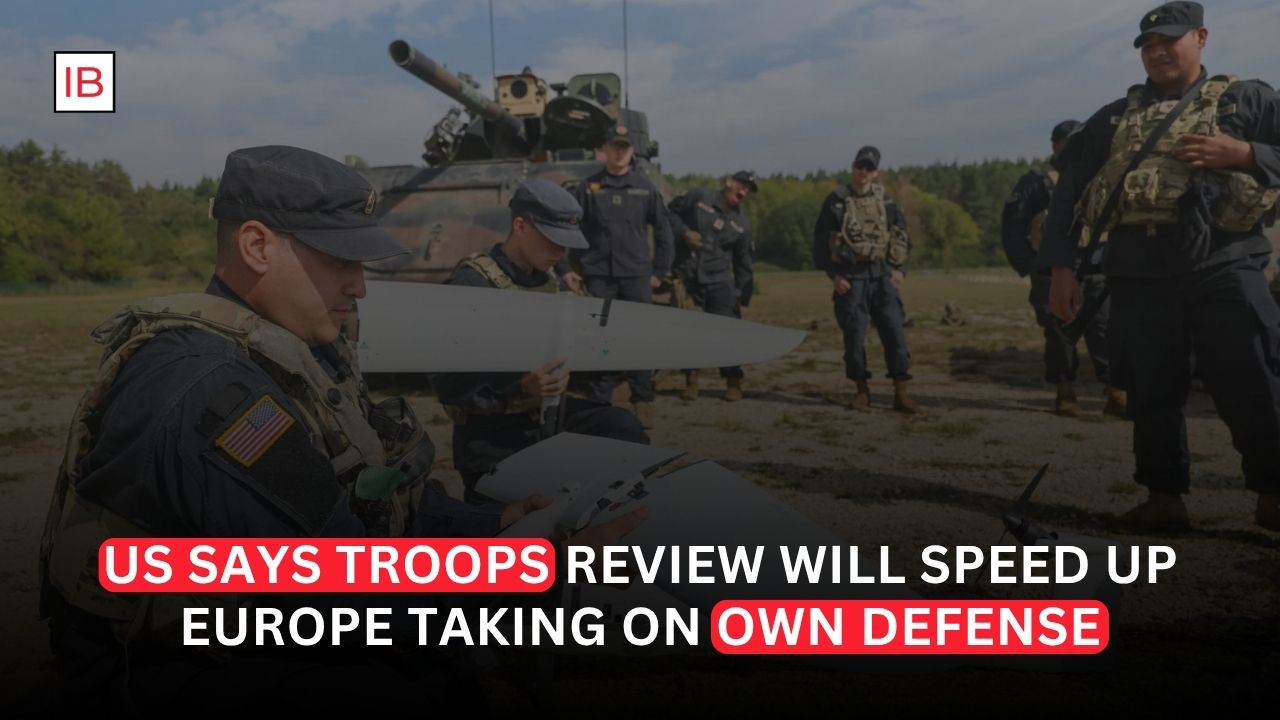
The United States is reviewing the deployment of its military forces in Europe, a move that could accelerate a long-running European effort to assume greater responsibility for the continent’s defense.
The review matters because the US military presence has been one of the central pillars of European security for decades. Thousands of American troops, along with advanced aircraft, intelligence capabilities, logistics networks and other military assets, remain closely integrated into NATO’s defense structure.
A reduction or restructuring of the US presence would not necessarily mean Washington is abandoning Europe. But it could force European governments to move faster on defense spending, military readiness and cooperation.
That pressure is already building.
Europe Is Being Asked to Do More
For years, American administrations have urged European allies to spend more on defense.
The argument is straightforward: European countries are wealthy enough to contribute more, while the US has carried a disproportionate share of NATO’s military burden.
Russia’s war in Ukraine has made the issue more urgent.
European governments have increased military budgets, expanded weapons procurement and discussed new ways to coordinate defense production.
A US troop review could strengthen the argument that Europe cannot assume American forces will always provide the same level of protection.
A Review Is Not the Same as a Withdrawal
One important distinction should not be lost.
A review of US troops does not automatically mean a large-scale withdrawal.
Washington could move forces between European countries, change their missions, reduce certain deployments or increase reliance on European allies without abandoning NATO.
The significance lies partly in the uncertainty.
European governments have to plan for a range of possibilities rather than assuming that today’s American military footprint will remain unchanged.
NATO Depends Heavily on US Capabilities
Europe has substantial military forces of its own.
But the continent still relies on American capabilities in several areas, including intelligence, surveillance, strategic airlift, missile defense and certain advanced weapons systems.
That means replacing US troops is not simply a matter of recruiting more European soldiers.
European countries would need to develop expensive capabilities that take years to build.
The Ukraine War Changed the Debate
Russia’s invasion of Ukraine fundamentally changed European defense policy.
Before the war, many European governments were comfortable maintaining relatively modest military budgets while relying heavily on the US security umbrella.
The invasion demonstrated that major conventional conflict was not simply a historical possibility.
European militaries suddenly had to think about ammunition stocks, armored vehicles, air defenses, drones, logistics and the ability to sustain prolonged warfare.
Defense Spending Is Rising
European governments have responded by increasing defense spending.
The challenge is converting larger budgets into usable military capabilities.
Buying weapons is not enough.
Countries also need trained personnel, ammunition, maintenance facilities, command systems and logistical infrastructure.
A US troop review could add urgency to those efforts.
Germany Faces a Particularly Important Role
Germany is central to Europe’s defense because of its economic size and geographic position.
It also hosts major US military facilities and forces.
If Washington changes its European posture, Berlin would face pressure to strengthen its own military capabilities and assume more responsibility for NATO’s eastern flank.
That would require political decisions as well as money.
Poland Has Already Increased Spending
Poland has become one of Europe’s most aggressive defense spenders.
Its proximity to Russia and Belarus makes the security threat particularly immediate.
Warsaw has invested heavily in tanks, artillery, aircraft and missile-defense systems.
A shift in the US military presence could strengthen Poland’s argument that European allies need to build even greater independent capabilities.
The Eastern Flank Is the Biggest Concern
The countries closest to Russia are particularly sensitive to changes in American military deployments.
Baltic states, Poland, Romania and other eastern members of NATO view the US military presence as an important deterrent.
For these countries, the question is not simply how much Europe spends.
It is whether European forces can respond quickly enough during a crisis.
Europe Has a Readiness Problem
European defense spending has increased, but readiness remains uneven.
Some countries have relatively modern militaries.
Others have aging equipment or limited ammunition stocks.
There are also differences in military planning, procurement systems and national priorities.
Greater spending will help, but creating a coherent European defense capability is much harder.
Fragmentation Is a Major Obstacle
Europe has dozens of different defense programs and national procurement systems.
Countries frequently purchase similar equipment from different manufacturers.
This can create duplication and make military cooperation more difficult.
A stronger push toward joint procurement could allow European governments to get more capability from each euro spent.
Defense Industry Capacity Matters
Europe’s ability to increase military spending also depends on its defense industry.
Weapons manufacturers need factories, skilled workers and long-term orders.
The war in Ukraine has exposed shortages in artillery ammunition and other military equipment.
European governments are therefore increasingly focused on expanding production capacity.
The US Still Has an Important Role
Even if Europe becomes more capable, replacing the US entirely would be difficult.
American military spending remains vastly larger than that of any individual European country.
The US also operates global military infrastructure and possesses capabilities that Europe cannot easily replicate.
The likely future is therefore not necessarily “Europe without America.”
It could instead be a NATO alliance in which Europe carries a significantly larger share of the burden.
Washington Wants Greater Burden Sharing
The troop review fits into a broader American argument about burden sharing.
From Washington’s perspective, European allies should be capable of defending their own territory while the US concentrates more resources on global priorities.
China is increasingly central to American strategic planning.
That makes European burden sharing even more important from the US perspective.
The China Factor
The United States faces strategic competition with China in the Indo-Pacific.
American military resources are limited.
If European countries can assume more responsibility for their own security, Washington has greater flexibility to deploy resources elsewhere.
This does not necessarily mean Europe becomes less important to the US.
It means Washington wants Europe to require fewer American resources.
European Autonomy Is Gaining Momentum
The concept of European strategic autonomy has existed for years.
But it has often struggled to translate into concrete military capabilities.
A US troop review could give the idea new momentum.
European governments may increasingly conclude that maintaining military independence is not simply a political preference but a strategic necessity.
France Has Long Supported the Idea
France has historically argued for greater European strategic independence.
Paris has maintained an independent nuclear deterrent and has pushed for stronger European defense capabilities.
A reduction in US involvement could strengthen France’s argument that Europe needs to develop its own strategic capacity.
Britain Has a Complicated Position
The UK is no longer a member of the European Union, but it remains one of Europe’s strongest military powers and a key NATO member.
London has traditionally maintained a close defense relationship with Washington.
At the same time, Britain has a strong interest in European security.
A major shift in American deployments could therefore require closer UK-European military cooperation.
The Nuclear Question Is Different
Conventional military capabilities are only one part of the equation.
The US also provides an extended nuclear deterrent to NATO allies.
Britain and France possess their own nuclear weapons, but European nuclear policy is not integrated in the same way as America’s broader NATO commitment.
Any significant US strategic shift would therefore raise difficult questions about deterrence.
Money Is Not the Only Problem
Europe could increase defense spending substantially and still struggle to replace American capabilities quickly.
Military equipment requires years to design, manufacture and deploy.
Training personnel also takes time.
Infrastructure must be built.
Supply chains must be secured.
The transition therefore cannot happen overnight.
Europe May Need to Buy More Quickly
A US troop review could encourage European governments to accelerate procurement.
That may benefit defense companies across the continent.
Manufacturers could receive larger and longer-term orders.
But rapid procurement also carries risks.
Governments may pay more for equipment when they are under pressure to buy quickly.
Standardization Could Become More Important
One of Europe’s biggest opportunities is standardization.
If multiple countries use compatible equipment and communication systems, their militaries can operate more effectively together.
Joint procurement can also reduce costs.
The difficulty is persuading governments to give up some national control over defense purchasing.
The Political Challenge
Defense spending is politically difficult.
Governments have competing demands for healthcare, pensions, infrastructure and education.
Increasing military budgets means making trade-offs.
Politicians therefore need to convince voters that higher defense spending is necessary.
Russia’s actions have made that argument easier, particularly in eastern Europe.
Voters May Demand Results
Higher defense budgets will eventually need to produce visible improvements.
If governments spend more without increasing readiness, public support could weaken.
Citizens may ask why military spending is rising while equipment shortages persist.
That puts pressure on defense ministries to demonstrate measurable progress.
The Economic Impact
Higher defense spending can stimulate industrial production.
It can create demand for manufacturing, engineering and technology.
But sustained military spending also consumes government resources.
The economic benefit therefore depends on how efficiently the money is spent and whether new defense investment generates broader industrial capabilities.
Europe Could Build a Stronger Defense Industry
A sustained increase in military spending could help Europe develop a more competitive defense-industrial base.
Companies producing missiles, drones, radar systems, armored vehicles and other equipment could expand.
That could reduce Europe’s reliance on foreign suppliers.
But building a self-sufficient industry would be expensive and politically complicated.
Drones Are Changing Warfare
The Ukraine conflict has demonstrated the growing importance of drones.
European militaries are investing heavily in unmanned systems, electronic warfare and counter-drone technologies.
These systems can sometimes be developed and deployed more quickly than traditional major weapons platforms.
That could give Europe an opportunity to modernize its military capabilities relatively quickly in certain areas.
Air Defense Is a Major Gap
European countries also need stronger air and missile defenses.
Modern warfare increasingly involves drones, cruise missiles and ballistic missiles.
Protecting cities, military bases and critical infrastructure requires layered defense systems.
The US has traditionally provided important capabilities in this area.
Europe will need to expand its own capacity if Washington reduces its role.
Logistics Could Become the Key Issue
Moving troops and equipment across Europe requires roads, railways, ports, aircraft and coordination.
NATO has repeatedly identified military mobility as an important challenge.
A stronger European defense posture will require more than weapons.
It will require the infrastructure needed to move forces rapidly.
The Defense Burden Could Shift South and East
If the US reduces certain deployments, European countries may need to determine where their own forces should be concentrated.
Eastern Europe is likely to demand greater resources because of its proximity to Russia.
That could create disagreements between countries with different threat perceptions.
Smaller Countries Need Protection
Smaller European states cannot independently build every military capability.
They depend on alliances and regional cooperation.
A stronger European defense structure would therefore need to ensure that smaller countries are not left exposed.
NATO Remains the Framework
Despite debates about European autonomy, NATO remains the central defense organization for most European countries.
The US troop review could therefore lead to stronger European contributions within NATO rather than the creation of an entirely separate European military alliance.
That distinction matters.
European defense autonomy does not necessarily mean leaving NATO.
A Stronger Europe Could Strengthen NATO
If European countries develop more capable militaries, NATO could become stronger overall.
The US would still provide major capabilities while Europe takes greater responsibility for conventional defense on the continent.
That could create a more balanced alliance.
But Transition Risks Are Real
A poorly managed reduction in US forces could create a temporary security gap.
European capabilities cannot be built instantly.
If American deployments decline faster than European replacements arrive, deterrence could weaken during the transition.
That is why the details of the troop review matter.
Russia Will Be Watching
Moscow will closely monitor changes in American and European deployments.
If Russia believes NATO is becoming weaker, it could become more aggressive.
Conversely, if Europe responds to a US review by rapidly strengthening its military capabilities, the long-term deterrence effect could increase.
The transition therefore carries strategic risks.
The Message Matters
Even before troops move, political signals can affect deterrence.
If European allies believe Washington remains firmly committed to NATO, the troop review may be viewed as a rebalancing exercise.
If allies interpret it as a sign of declining American commitment, uncertainty could increase.
Communication will therefore be almost as important as the troop numbers themselves.
Europe’s Defense Future
The most likely long-term outcome is not a simple American withdrawal.
Instead, Europe may move toward a model in which European countries provide a much larger share of conventional military power while the US retains major strategic and technological capabilities.
That would represent a significant change from the post-Cold War period.
The End of the Old Security Model?
For decades, European governments could assume that the US would provide the ultimate military backstop.
That assumption is becoming less secure.
The Ukraine war, rising tensions with Russia and American strategic competition with China are forcing Europe to reconsider the model.
The result could be a more militarily capable Europe.
What Comes Next
The critical question is how quickly European governments can turn political commitments into actual military capabilities.
That means:
- More defense spending
- Faster weapons procurement
- Larger ammunition stocks
- Stronger air defenses
- Better military mobility
- More joint procurement
- Greater defense-industrial capacity
- Improved coordination between European militaries
The US troop review could accelerate all of these trends.
Conclusion
The US review of its military posture in Europe could become a catalyst for a major shift in the continent’s security architecture.
It does not automatically mean Washington is abandoning Europe. Nor does it mean European countries can immediately replace American forces.
But the review reinforces a reality that European governments have increasingly acknowledged since Russia’s invasion of Ukraine: Europe needs to be capable of carrying much more of its own defense burden.
The biggest challenge is speed.
Europe can increase defense spending, but new weapons, trained personnel, logistics networks and industrial capacity take years to develop. A rapid reduction in American capabilities before European replacements are ready could create vulnerabilities.
At the same time, the pressure could produce a stronger European defense system over the longer term.
If European countries coordinate procurement, expand military production and improve readiness, they could become significantly more capable within NATO.
The US may ultimately remain indispensable to European security, but the balance of responsibility could change.
For Washington, that would free resources for priorities elsewhere, particularly the Indo-Pacific.
For Europe, it would mean accepting greater responsibility for its own security.
And for NATO, the result could be an alliance in which Europe is no longer primarily the protected partner, but a much more capable military pillar alongside the United States.