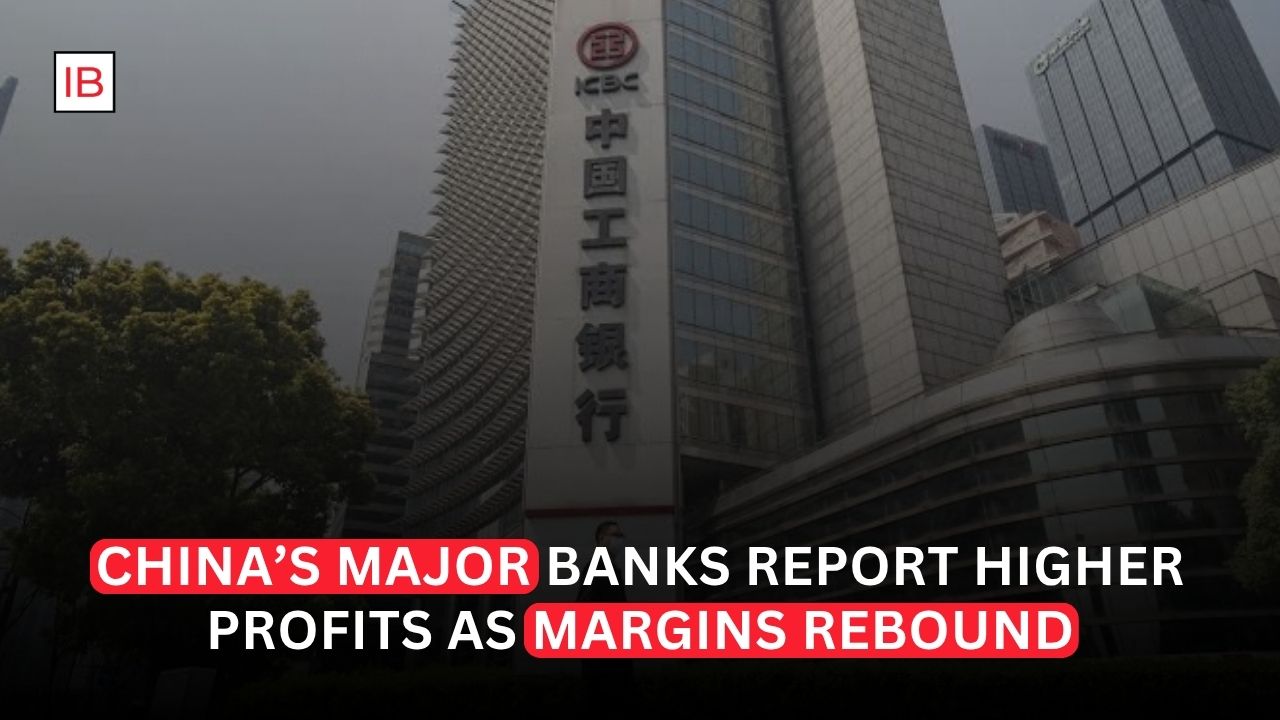
China’s biggest banks are showing signs of relief after years of pressure on profitability, with several major lenders reporting higher first-half earnings as the squeeze on net interest margins begins to stabilize.
The results provide a rare positive signal for the country’s financial sector, which has been dealing with weak credit demand, falling lending rates and persistent pressure from a slowing economy. Industrial and Commercial Bank of China, the world’s largest lender by assets, reported a 3.3% increase in first-half net profit to 173.68 billion yuan ($25.85 billion).
Profit Growth Returns
The improvement at China’s largest banks is significant because profitability has been under pressure for an extended period.
Banks have been encouraged to reduce borrowing costs for businesses and households, while competition for deposits has kept funding expenses elevated. That combination has compressed the difference between what banks earn on loans and what they pay for funding.
The latest results suggest that pressure may be starting to ease.
Bank of China, the country’s fourth-largest commercial lender, reported a 5.1% increase in first-half net profit to 123.59 billion yuan, compared with 117.59 billion yuan a year earlier.
Margin Pressure Stabilizes
Net interest margin is one of the most important measures of profitability for traditional banks.
It shows how much a bank earns from lending and investments after accounting for the cost of its funding.
For ICBC, the net interest margin remained at 1.29% at the end of June, unchanged from the end of March.
That stability matters because margins had been under sustained pressure as China’s banks lowered lending rates to support economic activity.
A stable margin does not mean the problem has disappeared, but it suggests the sharp deterioration may have reached a temporary floor.
Weak Loan Demand Remains a Problem
The biggest threat to Chinese banks is not simply the level of interest rates.
It is demand for credit.
Businesses and households have remained cautious about taking on new debt, reflecting uncertainty surrounding the property market, consumer spending and the broader economy.
China’s recent credit data has also shown weak demand for new yuan loans, reinforcing concerns that banks may struggle to expand lending profitably.
That creates a difficult environment: banks can have large balance sheets but still find it difficult to generate strong returns.
China’s Economy Is Still Slowing
The banking results should not be interpreted as evidence that China’s broader economic problems have disappeared.
The economy expanded by only 4.3% in the second quarter, below the government’s annual growth target range of 4.5% to 5%.
Weak domestic demand remains a major concern.
China’s manufacturing sector is also expected to remain under pressure, with economists forecasting that the official manufacturing Purchasing Managers’ Index will stay below the 50 level that separates expansion from contraction.
Banks therefore continue to operate against a difficult macroeconomic backdrop.
Property Sector Remains a Risk
China’s prolonged property downturn is another major challenge.
Real estate developers have struggled with debt, falling sales and weak consumer confidence, while banks remain exposed to property companies, mortgages and local-government-related borrowers.
Any further deterioration in property values could increase credit losses.
So far, however, the major banks appear to be maintaining relatively controlled levels of bad loans.
ICBC’s non-performing loan ratio improved to 1.29% at the end of June from 1.31% three months earlier.
Credit Quality Holds Up
Stable or improving non-performing loan ratios provide another reason for investors to pay attention to the results.
If banks can maintain asset quality while margins stabilize, profitability could become more predictable.
But the current figures should not be treated as proof that credit risks have disappeared.
Weak economic growth can affect borrowers with a delay, particularly in property, construction and small-business sectors.
The health of Chinese banks will therefore depend heavily on whether economic activity strengthens during the remainder of the year.
State Banks Have a Strategic Role
China’s largest banks are not purely commercial institutions.
State-owned lenders play an important role in implementing government economic policy, including financing infrastructure, strategic industries and smaller businesses.
That creates a tension between profitability and policy objectives.
Banks may be expected to provide cheaper credit to support economic growth even when those loans generate lower returns.
The recent profit increases suggest the major lenders are managing that tension relatively effectively, at least for now.
Technology and AI Offer New Opportunities
China’s technology sector could provide another source of stronger banking demand.
Investment linked to artificial intelligence, semiconductors, advanced manufacturing and other high-tech industries has remained relatively strong.
China’s industrial profit data shows that high-tech and export-oriented sectors have been outperforming many traditional industries, helped by global demand for AI-related products.
Banks could benefit if this investment translates into greater corporate borrowing and stronger cash flows.
The Consumer Sector Is Still Weak
The bigger problem is that consumer-facing industries remain under pressure.
Industrial sectors connected to domestic consumption and property have struggled, reflecting cautious spending by households and businesses.
That weakness limits opportunities for banks to grow profitable retail lending.
Mortgage demand, consumer credit and small-business borrowing are all closely tied to confidence.
Until households become more willing to spend and borrow, China’s banking sector may struggle to return to the stronger growth rates seen in previous decades.
Investors Need to Look Beyond Profit
Higher profits are encouraging, but headline earnings alone do not tell the full story.
Investors also need to monitor return on equity, net interest margins, capital levels, loan growth and provisions for bad debts.
A bank can report higher profits while its underlying profitability remains weak if earnings are supported by temporary factors.
The sustainability of the improvement will therefore be more important than the single reporting period.
Pressure on Banks Has Not Disappeared
The fundamental challenges remain.
China’s banking system is enormous, highly interconnected with the government and deeply exposed to the domestic economy.
Slower credit growth means banks have fewer opportunities to expand through traditional lending.
At the same time, policy pressure to support borrowers can keep loan yields low.
The recent stabilization in margins is therefore welcome, but it does not eliminate the structural challenges.
What Comes Next
The next major test will be whether China’s economy generates stronger credit demand without requiring banks to cut lending rates further.
If domestic demand improves, property conditions stabilize and corporate investment remains strong, banks could see further improvement in earnings.
If growth weakens again, however, the pressure could quickly return.
The direction of monetary policy will also matter because changes in interest rates can affect both lending income and funding costs.
Conclusion
China’s major banks are delivering a stronger set of earnings results at a time when the country’s economy remains under significant pressure.
ICBC’s 3.3% rise in first-half net profit and Bank of China’s 5.1% increase suggest that the banking sector is beginning to absorb the impact of years of declining lending rates and margin compression.
The stabilization of ICBC’s net interest margin at 1.29% is particularly important because it indicates that profitability pressure may no longer be intensifying at the same pace.
But investors should not mistake better bank earnings for a broad economic recovery.
China continues to face weak domestic demand, a troubled property sector and subdued credit appetite. The country’s economy grew 4.3% in the second quarter, while manufacturing activity is expected to remain below the expansion threshold in August.
The banking sector’s resilience therefore remains closely linked to government policy and economic conditions.
If authorities can revive consumer demand, stabilize property markets and encourage productive investment, major lenders could sustain their recent improvement.
If those efforts fail, banks may again face falling margins, weak loan growth and rising credit risks.
For now, the latest results offer a measure of relief. They show that China’s biggest banks can still produce higher profits despite a difficult economic environment—but whether that improvement marks a lasting turnaround remains uncertain.