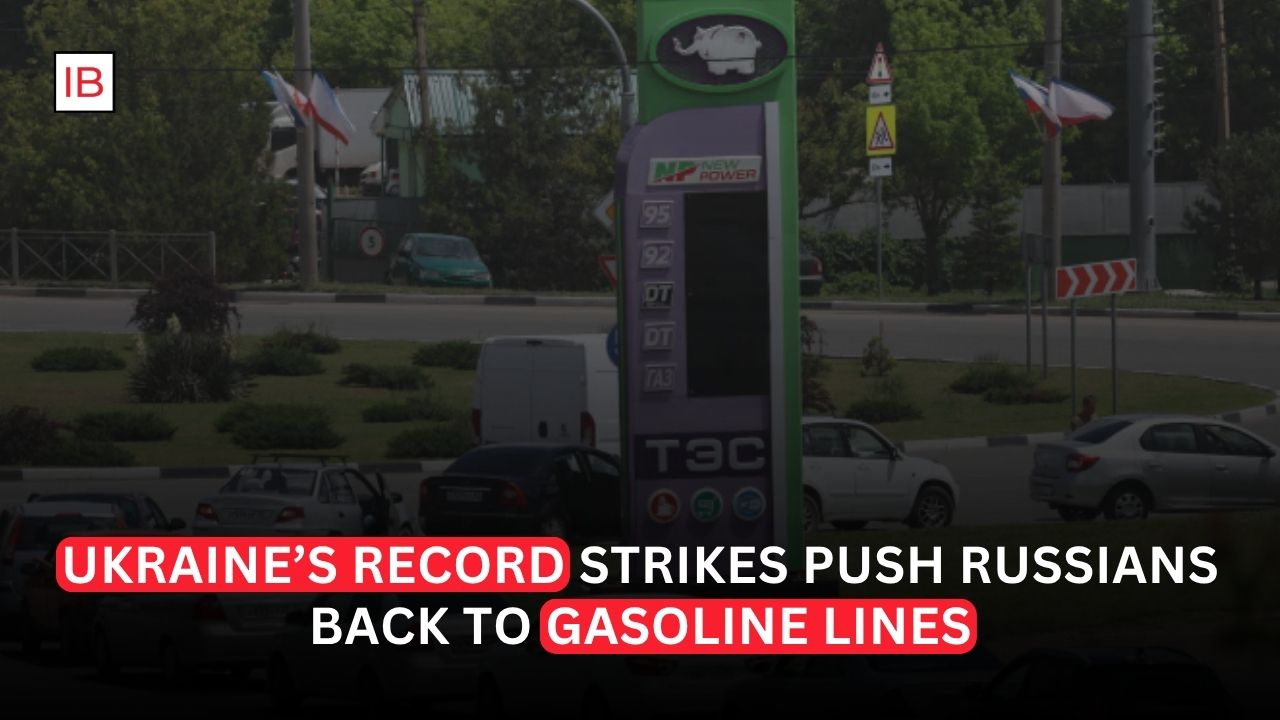
Ukraine’s intensifying attacks on Russia’s oil infrastructure are creating an increasingly visible problem for ordinary Russians: gasoline shortages. A wave of Ukrainian drone strikes has damaged refineries and disrupted fuel production, forcing Moscow to search for supplies abroad as queues return at some Russian filling stations.
The pressure comes at a sensitive moment for the Kremlin. Russia remains one of the world’s largest oil producers, but its ability to turn crude into usable fuel has been repeatedly disrupted by Ukrainian long-range attacks. Recent reporting indicates that Russian gasoline imports have surged as domestic refining capacity struggles to keep pace with demand.
Ukraine Targets Russia’s Fuel System
Ukraine’s strategy has increasingly focused on Russia’s energy infrastructure rather than limiting attacks to military positions near the battlefield.
Refineries, fuel depots and other oil facilities are particularly important because they connect Russia’s enormous crude-oil production industry with its domestic transportation system and military logistics.
Recent attacks have repeatedly forced facilities to reduce or temporarily halt operations. According to reporting, Ukraine carried out 18 attacks on Russian refineries in August, matching the record number recorded in July. Russian refining output had already fallen substantially before the latest strikes.
Gasoline Lines Return
The consequences are now becoming visible beyond the oil industry.
Some Russian regions have experienced shortages, rationing and restrictions on gasoline sales. Drivers have faced longer queues and difficulties finding particular grades of fuel.
That is politically significant.
For years, Russia’s energy wealth has been a symbol of economic strength. A country capable of producing millions of barrels of crude oil every day should theoretically have little difficulty keeping domestic filling stations supplied.
The fact that Russia is increasingly importing gasoline demonstrates how effectively attacks on refining capacity can create problems even when crude production remains relatively strong.
Russia Turns to Foreign Suppliers
Moscow has responded by searching for alternative sources.
Russia has increased fuel purchases from countries including Turkey, India and Belarus, while also exploring arrangements involving Kazakhstan. The logistics are complicated because transporting finished gasoline across borders is considerably more difficult than simply purchasing crude oil.
The increased imports are also expensive.
Russia is effectively replacing some domestic refining capacity with fuel purchased from external suppliers, adding transportation and trading costs at a time when sanctions are already complicating its energy business.
A Different Kind of Pressure
Ukraine’s objective appears broader than simply creating inconvenience for Russian drivers.
The attacks are designed to increase the economic cost of the war by interfering with the infrastructure that supports Russia’s military and civilian economy.
Fuel is particularly important because it powers trucks, agricultural machinery, military vehicles and industrial equipment.
If shortages become widespread, the impact could extend beyond private motorists to businesses and government operations.
Ukraine is therefore attempting to turn its growing drone capability into economic pressure deep inside Russian territory.
Moscow Faces a Difficult Calculation
The Kremlin has several options, but none is particularly easy.
Russia can increase imports, reduce exports of refined products, impose restrictions on domestic consumption or accelerate repairs at damaged refineries.
It can also deploy additional air defenses around important energy facilities.
But protecting the entire Russian energy system is extremely difficult.
Russia has a vast territory and a large number of strategically important installations. Ukraine does not need to destroy every refinery to create disruption; repeated strikes against a smaller number of key facilities can be enough to reduce spare capacity.
The Wider Energy Impact
The disruption is also being watched by global energy markets.
Russia remains a major exporter of crude oil and petroleum products, so changes in its refining operations can affect international supply flows.
When Russian refineries are damaged, Moscow may have to export more crude while importing more finished gasoline. That changes the balance between crude and refined-product markets.
The effect is not necessarily straightforward for global oil prices, but it adds another source of uncertainty to an already volatile energy market.
Russia’s Fuel Problem Is Not the Same as Economic Collapse
The gasoline shortages should not be interpreted as evidence that Russia’s economy is collapsing.
The country retains substantial oil resources, industrial capacity and financial mechanisms for responding to disruptions.
Russia has also demonstrated an ability to redirect energy trade toward Asian and Middle Eastern markets despite Western sanctions.
The more realistic conclusion is that Ukraine is increasing the cost and complexity of maintaining Russia’s war economy.
That distinction matters. Fuel shortages can create pressure without immediately changing Moscow’s strategic decisions.
The War Moves Deeper Into Russia
The attacks also demonstrate how the geographic boundaries of the war continue to expand.
Ukraine has developed long-range drones capable of reaching targets far inside Russian territory. Earlier in the war, Ukraine’s ability to strike distant Russian infrastructure was much more limited.
Today, oil refineries and industrial facilities hundreds of miles from the front can become targets.
Russia has responded with its own increasingly intense attacks against Ukrainian infrastructure. On August 27 and 28, Russian forces launched major waves of drones and missiles against Kyiv and other Ukrainian regions, damaging warehouses, businesses, energy infrastructure and residential areas.
A Battle of Infrastructure
The conflict is increasingly becoming a contest over infrastructure as much as territory.
Russia is attacking Ukraine’s power, transportation and industrial networks to weaken the country’s ability to sustain the war.
Ukraine is striking Russian oil facilities, logistics networks and industrial assets to impose costs on Moscow.
Neither side appears close to abandoning its strategy.
For Ukraine, however, fuel infrastructure offers an especially attractive target because damage can have economic consequences even without destroying large numbers of military assets.
Conclusion
Ukraine’s record attacks on Russian oil infrastructure are creating a growing fuel problem that Moscow cannot easily ignore.
The return of gasoline queues is particularly significant because it shows how battlefield technology can translate into everyday economic disruption. Ukrainian drones are reaching deep into Russia and repeatedly damaging refineries, forcing the country to increase gasoline imports from foreign suppliers.
The strategy does not mean Russia is running out of oil or approaching economic collapse. Its crude production remains enormous, and the government has substantial resources with which to respond.
But refining capacity is a different vulnerability.
Russia can produce crude without automatically being able to turn it into enough gasoline and diesel for domestic consumers. Every damaged refinery therefore increases the pressure on imports, logistics and prices.
For Ukraine, that makes energy infrastructure an important part of its broader campaign to weaken Russia’s ability to sustain the war.
For Moscow, the challenge is to protect an enormous network of refineries and fuel facilities while continuing its military operations and maintaining supplies for the civilian economy.
The gasoline lines are therefore more than a temporary inconvenience. They are a visible sign that Ukraine’s long-range strike campaign is beginning to impose costs far from the battlefield—and that Russia’s energy system, despite its enormous size, has vulnerabilities that Kyiv can exploit.