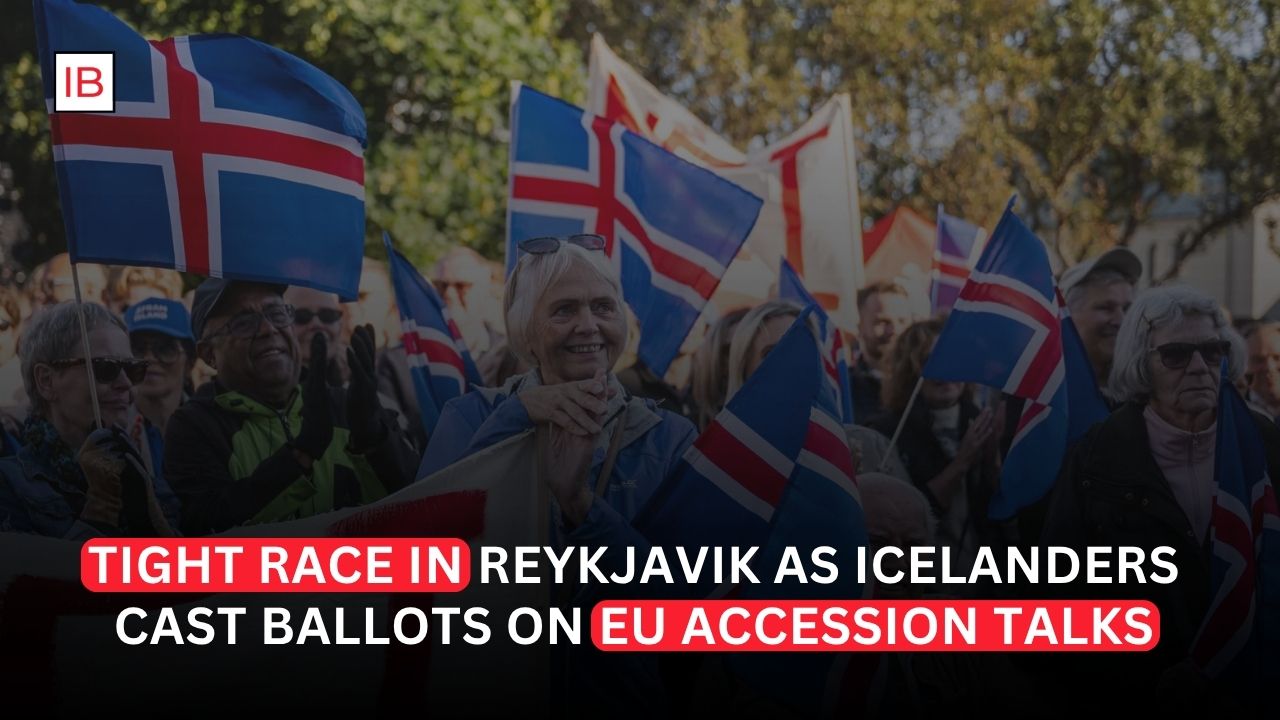
Iceland is heading to the polls in a closely contested referendum that could reopen the country’s long-suspended negotiations to join the European Union. The vote is not a decision on EU membership itself. Instead, voters are being asked whether Iceland should resume accession talks, with any eventual membership agreement requiring another referendum.
The outcome could nevertheless mark a major change in Iceland’s relationship with Europe and comes at a time when economic uncertainty, security concerns and tensions in the North Atlantic are reshaping the debate.
A Vote That Is Not About Membership
The referendum question is deliberately narrower than a direct vote on joining the EU.
A “yes” would allow Iceland to restart negotiations with Brussels. A final decision on membership would come later, after the terms of any agreement had been negotiated and presented to voters.
That distinction is important because voters who support reopening negotiations are not necessarily committing themselves to joining the bloc.
Iceland previously applied for EU membership in 2009 during the aftermath of a devastating financial crisis. Negotiations began the following year but were suspended after a Euroskeptic government came to power, eventually ending the process in 2013.
The Vote Is Extremely Close
The referendum has become increasingly difficult to predict.
A Gallup poll published shortly before voting showed 51.6% opposed to reopening negotiations and 48.4% in favor, indicating that the result could be decided by a relatively small number of voters.
That narrow gap reflects how divided Iceland remains.
Supporters see negotiations as an opportunity to examine the advantages of membership under today’s economic and geopolitical conditions. Opponents argue that Iceland already has extensive access to European markets without surrendering control over key national interests.
Fishing Is the Biggest Obstacle
The most politically sensitive issue is fishing.
Iceland’s fishing industry is central to its economy and national identity, and many voters fear that EU membership could weaken the country’s control over its fishing waters.
EU membership would normally involve participation in the bloc’s Common Fisheries Policy, creating concerns that decisions over quotas and access could increasingly be influenced by European institutions.
For opponents, this is not simply an economic question. Fishing has historically been linked to Iceland’s sovereignty and independence, including its famous disputes with Britain during the Cod Wars.
Farmers Have Concerns Too
Agriculture is another source of opposition.
Iceland’s agricultural sector operates under unusual geographic and climatic conditions. Farmers fear that EU membership could increase competition from imported European products and put pressure on domestic producers.
Some argue that Iceland needs the freedom to maintain policies specifically designed for its small population and challenging agricultural environment.
These concerns have made rural communities generally more skeptical of European integration than many urban voters.
Supporters See Economic Benefits
The pro-EU argument focuses heavily on economic stability.
Iceland already participates in the European Economic Area, giving it access to the EU single market. It is also part of the Schengen area.
But supporters argue that the current arrangement leaves Iceland in an awkward position: the country adopts many European rules while having no formal vote when those rules are made.
EU membership, they say, would give Iceland a seat at the table rather than leaving it as a rule-taker.
Currency Is Part of the Debate
The Icelandic króna is another factor.
Iceland has a small economy and its currency can experience substantial swings. Supporters of EU membership argue that deeper European integration could improve economic stability and potentially open a path toward eventual euro adoption.
They also point to the high cost of living and borrowing costs as reasons to reconsider whether remaining outside the EU is still the best economic strategy.
Opponents counter that adopting European institutions and potentially the euro would mean giving up another important element of national economic control.
Security Has Changed the Conversation
The geopolitical environment is also very different from when Iceland suspended its EU negotiations.
Russia’s war against Ukraine has increased security concerns across Europe, while tensions in the Arctic and North Atlantic have become more prominent.
Iceland does not maintain a conventional standing army and has historically relied heavily on its NATO relationship and security cooperation with the United States.
Recent uncertainty surrounding US policy toward Greenland has added another layer to the debate. President Donald Trump’s repeated interest in controlling Greenland has caused concern in Iceland and other Nordic countries about the future security environment in the North Atlantic.
For some Icelanders, closer European integration now looks more attractive as a way to strengthen political and strategic ties with Europe.
Sovereignty Remains the Core Argument
Despite the economic and security arguments, sovereignty remains central to the opposition campaign.
Icelanders have a strong tradition of political independence, shaped by the country’s history and its experience controlling its own natural resources.
Opponents argue that joining a larger political union would inevitably transfer some decision-making power from Reykjavík to Brussels.
That concern extends beyond fishing to agriculture, trade, regulation and broader economic policy.
Iceland Already Has Close EU Ties
The debate is unusual because Iceland is already deeply connected to the European economy.
Through the European Economic Area, Iceland participates in the EU single market despite not being a member.
It is also part of the Schengen zone and maintains extensive economic and regulatory cooperation with European countries.
This creates the central argument from the pro-EU camp: Iceland already accepts many European rules, so formal membership could provide political influence in return.
Opponents see the same arrangement differently. They argue that Iceland receives many of the benefits of European cooperation while retaining the freedom to make its own decisions.
Brussels Is Watching
The result is also important for the EU.
Iceland would be a relatively small addition to the bloc, with a population of fewer than 400,000 people.
But its accession would have symbolic importance.
Iceland is already closely aligned with European institutions, and successful negotiations could demonstrate that EU enlargement remains attractive even among countries that previously rejected membership.
For Brussels, Iceland’s potential return would also reinforce the EU’s position in the strategically important North Atlantic and Arctic region.
What Happens After a Yes Vote?
A “yes” result would not guarantee EU membership.
Negotiations would have to be reopened, and Iceland would need to reach agreement with EU member states across a wide range of policy areas.
Fishing would almost certainly become one of the most difficult subjects.
Agriculture, financial policy and other areas could also generate difficult negotiations.
If a final agreement were reached, Icelanders would then have another opportunity to accept or reject membership.
That makes Saturday’s referendum a first step rather than an irreversible decision.
What a No Vote Would Mean
A rejection would leave Iceland’s current relationship with the EU largely intact.
The country would continue participating in the European Economic Area and Schengen while remaining outside the EU’s political institutions.
It would also signal that sovereignty concerns remain stronger than arguments about deeper integration, at least under current conditions.
A narrow rejection, however, would not necessarily end the debate permanently.
Economic conditions and geopolitical pressures could bring the issue back again.
A Decision Shaped by a Changing World
The most important difference between today’s vote and Iceland’s earlier EU debate is the environment surrounding it.
The 2009 application was driven largely by financial crisis and economic instability.
The current debate includes those concerns but also reflects a more uncertain international security environment.
Russia’s war in Ukraine, tensions around Greenland and uncertainty over US commitments have made European strategic cooperation more important for Iceland.
At the same time, voters remain deeply protective of fishing rights and national sovereignty.
Conclusion
Iceland’s referendum is a test of whether the country’s relationship with Europe should move into a new phase.
The immediate question is not whether Iceland should join the European Union. It is whether the country should reopen negotiations and examine what membership would actually mean under current conditions.
That distinction gives voters room to support negotiations without committing themselves to the final outcome.
The decision is nevertheless politically significant.
Supporters believe deeper integration could provide greater economic stability, political influence and security at a time of growing uncertainty. They argue that Iceland already follows many European rules through the European Economic Area but lacks a voice in shaping them.
Opponents fear that membership would compromise national sovereignty, particularly over fishing and agriculture. For them, Iceland’s ability to control its natural resources is more important than the potential benefits of joining the bloc.
The extremely narrow polling gap shows that neither side has secured a decisive advantage.
A “yes” vote would reopen a complicated negotiation, followed by another referendum on any final membership deal. A “no” vote would preserve Iceland’s current model of close economic cooperation without formal EU membership.
Either result would reflect a country reconsidering its place in Europe at a moment when economic and geopolitical realities are changing rapidly.
For Iceland, the question is no longer simply whether EU membership is desirable.
It is whether remaining outside the bloc still offers the best combination of sovereignty, prosperity and security in a far less predictable world.