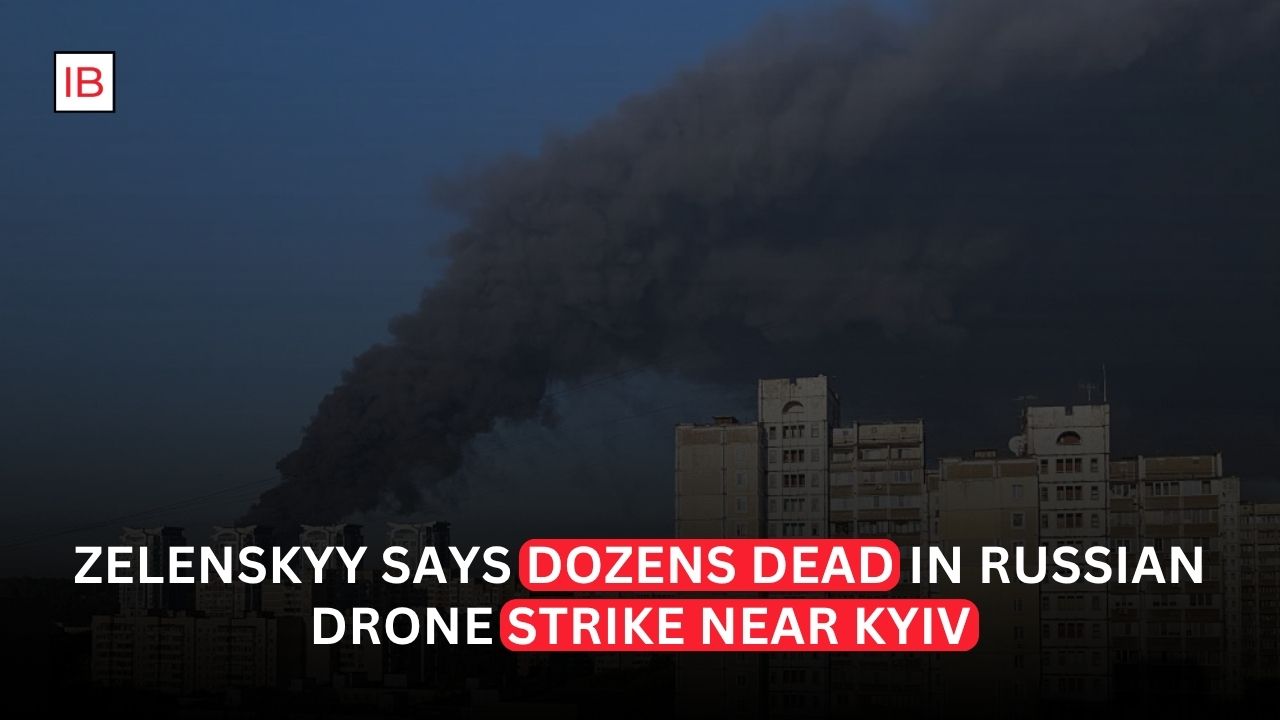
A Russian drone strike near Kyiv killed at least 27 people and injured dozens more after an explosion at a warehouse in the Bucha district, Ukrainian officials said Saturday. The attack adds to a growing wave of Russian aerial assaults around the Ukrainian capital and highlights the continuing danger faced by civilians even far from the front line.
The strike occurred in the village of Myla, west of Kyiv, where a warehouse was hit and subsequently detonated. The explosion triggered a major fire that spread to nearby homes and other buildings, while emergency crews worked through the aftermath.
Death Toll Rises After Explosion
Ukrainian officials initially reported a lower number of casualties, but the death toll increased as emergency workers searched the damaged site.
By Saturday, at least 27 people had been confirmed dead and 42 injured, according to Reuters. Officials warned that the number could still rise as rescue and recovery operations continued.
The attack also damaged around 50 residential buildings, according to local authorities. A care facility housing elderly people and people with disabilities was among the structures affected.
More than 370 residents were evacuated from the area as authorities attempted to secure the site and protect people from additional dangers.
Ammunition Storage Under Investigation
President Volodymyr Zelenskyy said the warehouse contained ammunition or other explosive materials and questioned why such material had been stored close to residential areas.
He said Ukrainian authorities had opened criminal proceedings over possible official negligence.
The issue has created a complicated dimension to the tragedy. While Ukrainian officials blamed Russia for the initial strike, they are also examining whether the consequences were worsened by the location and handling of explosive materials.
Zelenskyy said regulations prohibit ammunition from being stored near homes and other residential buildings.
A Devastating Secondary Explosion
The warehouse explosion appears to have substantially increased the scale of destruction.
A drone strike can cause serious damage by itself, but a secondary detonation involving stored explosives can send fire and debris across a much larger area.
The resulting blast damaged residential structures and created additional risks for emergency responders.
Authorities therefore had to deal not only with casualties and fires but also with potentially dangerous unexploded material.
That complicated rescue operations and contributed to the large evacuation.
Kyiv Region Under Repeated Attack
The deadly incident came after several days of intense Russian aerial attacks around Kyiv.
The capital and surrounding areas have faced repeated drone strikes, including attacks on warehouses, apartment buildings, vehicles and infrastructure.
The latest wave represents a broader pattern in which Russia has increased the frequency of drone attacks against Ukrainian cities.
Unlike traditional missile attacks, drones can be produced and launched in large numbers, allowing Russia to place sustained pressure on Ukraine’s air defenses.
The sheer volume of attacks can force Ukrainian forces to use valuable interceptors even when relatively inexpensive drones are being targeted.
Ukraine’s Air Defense Challenge
Air defense has become one of the most important factors in Ukraine’s ability to protect its cities.
Kyiv has repeatedly asked Western allies for additional systems and interceptors, particularly for the defense of major population centers.
The problem is not simply the number of air-defense systems.
Ukraine must also manage limited stocks of ammunition while facing increasingly sophisticated Russian attack patterns.
Recent reporting has indicated that Ukraine has become more cautious about publicly releasing detailed information about Russian missile launches and interception rates because of security concerns.
That makes it more difficult for outsiders to assess the exact effectiveness of Ukraine’s defenses.
Russia Expands Drone Warfare
Russia has increasingly relied on drones as a central component of its long-range strike campaign.
The systems are generally cheaper to produce than sophisticated cruise or ballistic missiles, allowing Moscow to launch large numbers simultaneously.
Some newer drones are also faster and more difficult to intercept, increasing pressure on Ukrainian air-defense networks.
The strategy can serve several purposes at once: damaging infrastructure, disrupting economic activity, exhausting air-defense supplies and creating psychological pressure on civilians.
The repeated attacks around Kyiv demonstrate that the capital remains a major target despite its distance from the main battlefield.
Civilian Life Is Being Disrupted
The consequences extend well beyond the immediate casualties.
Repeated air raids can shut businesses, disrupt transportation and force residents into shelters.
Factories and warehouses may be damaged, while workers are unable to reach their jobs.
Schools and other public institutions can also be affected.
The Washington Post reported that near-constant air raids around Kyiv had severely disrupted civilian life and economic activity.
For residents, the cumulative effect can be as important as any single strike.
Living under repeated alerts creates uncertainty and psychological pressure even when a particular attack does not directly hit a residential building.
Ukraine Is Also Increasing Drone Attacks
The escalation is not occurring in only one direction.
Ukraine has expanded its own long-range drone campaign against targets inside Russia, particularly energy infrastructure, refineries and logistics facilities.
President Zelenskyy recently ordered Ukrainian forces to significantly increase their daily long-range drone strikes, according to reporting on the conflict.
Kyiv argues that attacks on Russia’s military and economic infrastructure can reduce Moscow’s ability to sustain the war.
The result is an increasingly reciprocal drone war in which both sides are using unmanned systems to reach targets hundreds of kilometers from the front.
A New Phase of the Air War
The latest attack is part of a broader transformation in the conflict.
Russia’s aerial campaign has increasingly combined drones with ballistic and cruise missiles, while Ukraine has expanded its own domestic drone production and long-range strike capabilities.
The objective on both sides is increasingly economic as well as military.
Russia seeks to damage Ukrainian infrastructure and maintain pressure on the population.
Ukraine is attempting to disrupt the industrial systems and energy revenues that help finance Russia’s war effort.
That creates a cycle in which attacks increasingly reach civilian and economic areas far from the battlefield.
The Human Cost Is Rising
The death toll near Kyiv demonstrates the human cost of that strategy.
At least 27 people were killed in a single incident, while dozens more were injured. Homes and a care facility were damaged, and hundreds of people were evacuated.
The casualties also illustrate why the distinction between military and civilian areas is becoming increasingly difficult to maintain in the aerial war.
Even when a strike targets an industrial or logistical site, nearby communities can suffer devastating consequences.
Kyiv Faces a Difficult Winter
The attacks also raise concerns about the months ahead.
Ukraine has repeatedly faced Russian efforts to damage electricity, heating and other critical infrastructure before winter.
This year’s situation is particularly challenging because air-defense resources remain under pressure.
If Russia can combine attacks on energy infrastructure with continued strikes against warehouses and transportation networks, the economic and humanitarian consequences could become more serious.
Ukraine therefore needs not only additional interceptors but also resilient infrastructure capable of continuing to function after attacks.
Russia’s Strategy Has Limits
Despite the intensity of the bombing campaign, there is no clear evidence that aerial attacks alone are forcing Ukraine toward capitulation.
The conflict has already demonstrated that Ukrainian society can absorb substantial damage while continuing to operate.
In fact, sustained attacks can strengthen public determination rather than weaken it.
The strategic question for Moscow is therefore whether increased pressure can produce meaningful military or political gains.
So far, the answer remains uncertain.
Conclusion
The Russian drone strike near Kyiv that killed at least 27 people is another indication of how destructive the aerial war in Ukraine has become.
The immediate tragedy unfolded in Myla, where a warehouse was struck and a subsequent detonation caused extensive destruction. At least 42 people were injured, around 50 residential buildings were damaged and more than 370 residents were evacuated.
The incident is particularly complicated because Ukrainian authorities are investigating the storage of explosive materials near residential areas. Zelenskyy said criminal proceedings had been opened over possible official negligence, while continuing to hold Russia responsible for the initial attack.
The wider context is even more concerning.
Kyiv and surrounding areas have experienced repeated drone attacks, while Ukraine continues to face shortages and pressure on its air-defense capabilities. Russia’s growing use of drones allows it to sustain large-scale attacks while forcing Ukraine to consume valuable defensive resources.
At the same time, Ukraine is expanding its own long-range drone campaign against Russian infrastructure, creating an increasingly intense cycle of attacks on both sides.
For civilians, however, the strategic calculations offer little comfort.
Homes can be destroyed, businesses disrupted and lives lost even when the intended target is a warehouse, industrial facility or military-related site.
The latest attack therefore illustrates a central reality of the war: as drone technology becomes cheaper, more capable and more widely available, the battlefield continues to expand beyond the front lines.
Kyiv’s residents are once again being forced to live with the consequences.
And with both Russia and Ukraine increasing their use of long-range drones, the danger of further civilian casualties is likely to remain a major feature of the conflict.