The American Southwest is approaching a water decision that can no longer be postponed. The Colorado River is under severe pressure from decades of overuse, declining snowpack and a warming climate, and new federal restrictions are forcing states to decide where increasingly scarce water should go.
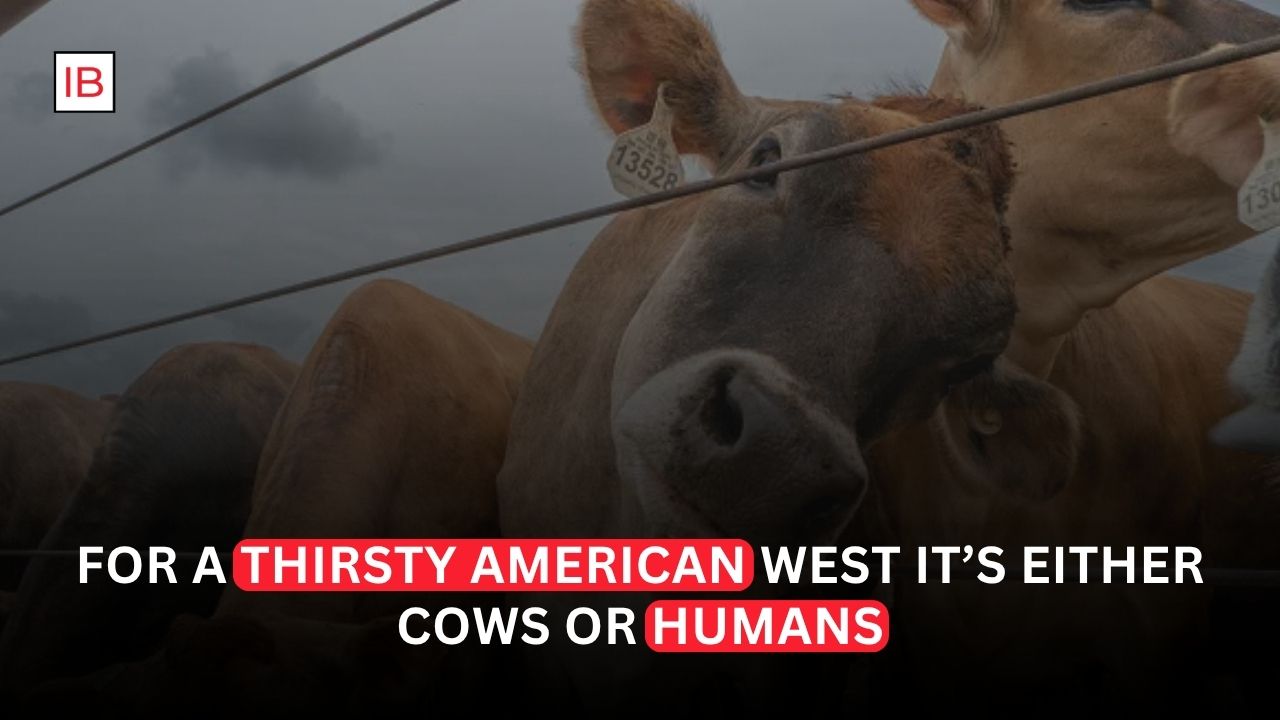
The argument is often framed as a choice between farmers and cities. But the real conflict is more complicated: the Southwest must decide how much water should continue supporting water-intensive agriculture, particularly cattle-feed crops, while millions of residents depend on the same river for drinking water and economic activity.
A River Supporting Millions
The Colorado River supplies water to roughly 40 million people across seven US states, as well as tribal nations and Mexico. It supports major metropolitan areas including Phoenix, Las Vegas and Los Angeles while also sustaining one of the most productive agricultural regions in the country.
That combination was manageable when the river system provided more water than it does today.
It is becoming increasingly difficult now.
Major reservoirs including Lake Mead and Lake Powell have fallen to historically low levels, forcing policymakers to confront a fundamental problem: the Southwest has legally promised more water than nature can reliably provide.
Federal Cuts Change the Equation
The Trump administration has now imposed significant reductions on water use in the lower basin.
Under the federal plan, Arizona, California and Nevada must collectively reduce their use by about 1.25 million acre-feet annually for two years beginning in 2027. Nevada has challenged the plan in federal court, arguing that the cuts are unfair and violate established water laws.
The immediate goal is to stabilize the river system.
But conservation on this scale cannot happen without somebody giving something up.
That is where the fight over agriculture becomes unavoidable.
Agriculture Uses the Most Water
Irrigated agriculture is by far the largest consumer of Colorado River water.
Research cited by High Country News found that agriculture accounts for roughly 52% of overall Colorado River consumption and about 74% of direct human consumption. Cattle-feed crops such as alfalfa and other hay account for an especially large share.
That creates an uncomfortable question.
Should scarce river water continue to grow crops that are ultimately used to feed cattle, or should more of that water be reserved for households, cities and industries?
There is no painless answer.
Why Alfalfa Matters
Alfalfa is not simply another crop.
It is a water-intensive perennial crop that can be harvested repeatedly during the growing season.
The crop is also valuable because it supports the enormous livestock and dairy industries of the Southwest.
But the water economics are increasingly difficult to justify.
More than half of the water consumed in the Colorado River Basin has been associated with growing alfalfa and hay for cattle feed, according to research cited by Time. Some of that production is ultimately exported overseas.
In a water-abundant environment, that might not matter.
In a shrinking river system, it becomes a central political issue.
Farmers Have Powerful Water Rights
The problem is that cities cannot simply take agricultural water away.
Western water law is built around a complicated system of senior and junior rights, historical agreements and interstate compacts.
Some farmers possess water rights that are older and legally stronger than those held by newer urban users.
That means the question is not merely how much water agriculture consumes.
It is also about who legally owns the right to use it.
Changing those arrangements could trigger years of lawsuits.
Farmers Face Their Own Crisis
It would also be misleading to portray farmers as simply wasting water.
Agriculture is an economic industry supporting families, workers, food processors and rural communities.
A sudden reduction in irrigation could destroy farms and businesses.
Some farmers have already reduced planting or changed crops because of uncertain water supplies.
Colorado farmers, for example, have been searching for additional water following an exceptionally difficult winter and worsening drought conditions.
For rural communities, water cuts are therefore not an abstract environmental policy.
They can determine whether a farm remains economically viable.
Cities Are Growing
At the same time, the Southwest continues to attract residents and businesses.
Phoenix, Las Vegas and other desert cities have grown dramatically despite being located in one of the driest regions of the United States.
That growth has increased demand for municipal water.
Cities have generally become more efficient through conservation programs, wastewater recycling, leak reduction and restrictions on outdoor watering.
But efficiency has limits.
At some point, continued population growth means more water is required even if each resident uses less.
The “Cows or People” Framing Is Incomplete
The phrase “cows versus people” is politically powerful but technically misleading.
People consume agricultural products.
Farmers employ people.
Cities depend on food produced by farms.
And agricultural businesses contribute to regional economies.
The actual choice is about how society values different economic uses of a scarce resource.
Water used for alfalfa may eventually become milk, beef or other food products.
Water supplied to cities supports households, factories, hospitals, restaurants and technology companies.
Both have economic value.
The question is which uses generate enough value to justify consuming increasingly scarce water.
The Export Problem
One of the most controversial aspects is that some crops grown using Colorado River water are ultimately sold outside the region.
That means water from an increasingly stressed river can effectively be embedded in products consumed elsewhere.
Critics argue that this makes little sense when Southwestern communities are being asked to conserve.
Farmers counter that restricting production could damage domestic food supplies and eliminate valuable agricultural businesses.
The disagreement reflects a broader issue: water markets were designed for a very different climate and population than the Southwest has today.
Climate Change Makes the Problem Worse
The Colorado River’s decline cannot be explained only by population growth.
Climate change has reduced snowpack and increased evaporation, while prolonged drought has reduced inflows into reservoirs.
The result is a river system that is becoming less reliable.
That matters because the existing legal framework was developed during a period when policymakers assumed the river would provide more water than recent conditions suggest is realistic.
The Southwest is now confronting the gap between historical expectations and current hydrology.
Reservoirs Are the Warning Signal
Lake Mead and Lake Powell are particularly important indicators.
They function as enormous storage systems, allowing states to survive dry years.
But when reservoir levels fall too far, the system loses its ability to absorb future drought.
That is why federal officials have moved toward deeper cuts.
The objective is not simply to save water today.
It is to prevent reservoirs from reaching levels that threaten water deliveries, hydropower generation and the basic functioning of the river system.
Nevada Is Fighting Back
Nevada’s lawsuit demonstrates how politically difficult the adjustment will be.
The state argues that the federal government has imposed disproportionate burdens on lower-basin states while allowing Colorado, Utah, New Mexico and Wyoming to avoid comparable mandatory cuts.
Nevada’s position reflects a broader concern.
If one group gives up water while another retains its historical allocation, the economic and political consequences will not be evenly distributed.
That makes compromise extremely difficult.
The Upper Basin Is Part of the Debate
The Colorado River system includes seven states divided broadly into upper- and lower-basin regions.
Colorado, Utah, New Mexico and Wyoming are in the Upper Basin, while Arizona, California and Nevada make up the Lower Basin.
The states have different climates, economies and legal claims.
That means a reduction imposed on one state can generate demands for reductions elsewhere.
The long-running conflict is therefore not simply between farmers and cities.
It is also between states and regions.
Conservation Can Buy Time
The Southwest has made real progress in reducing water consumption.
Urban conservation programs have demonstrated that cities can support large populations with less water than they once required.
Wastewater recycling, drought-tolerant landscaping and agricultural efficiency can all help.
But conservation cannot create water that does not exist.
Efficiency measures can buy time.
They cannot permanently solve a structural deficit between supply and demand.
Water Markets Could Become More Important
One possible solution is to allow water rights to move more freely toward higher-value uses.
Farmers could be compensated for temporarily or permanently transferring water to cities.
That approach already exists in limited forms.
But expanding it raises concerns about rural communities, farmland preservation and whether wealthy cities could simply outbid agricultural regions.
A functioning market could improve efficiency.
It could also fundamentally reshape the economic geography of the Southwest.
The Food Question
Reducing agricultural water use could have consequences beyond the Colorado River Basin.
The Southwest produces substantial quantities of vegetables, fruits, dairy products and livestock feed.
If production declines, consumers could face higher food prices or increased reliance on imports from other regions.
That does not mean every existing agricultural use should be protected.
It does mean policymakers must consider the food system when deciding which water uses to eliminate.
The Hard Choices Are Beginning
For years, policymakers have relied on temporary agreements, conservation payments and emergency measures to prevent the river system from collapsing.
Those approaches have helped.
But the underlying imbalance remains.
The latest federal plan is effectively an admission that voluntary conservation alone is no longer enough.
Mandatory reductions mean some users will receive less water.
The political fight is now about determining who those users will be.
Conclusion
The Colorado River crisis is moving into a more consequential phase.
The river supplies water to around 40 million people while supporting major agricultural industries and ecosystems across the American Southwest. Yet reservoirs are at historically low levels, and federal officials have concluded that deeper reductions in water use are necessary.
Agriculture will inevitably be part of that discussion because it consumes more Colorado River water than cities and other sectors combined.
Cattle-feed crops such as alfalfa and hay are particularly important. They account for a substantial share of agricultural water consumption, making them an obvious target for policymakers searching for large savings.
But simply declaring that farms should give their water to cities ignores the legal and economic realities.
Farmers hold valuable water rights, employ workers and produce food. Rural communities depend on agriculture. Eliminating irrigation too quickly could cause serious economic damage.
Cities, meanwhile, cannot simply stop growing, and residents need reliable drinking water.
That is why the coming fight will be less about “cows versus people” than about deciding what the Southwest’s shrinking water supply is worth and who should have the authority to allocate it.
The hardest issue is that there may not be enough water to preserve every existing use.
Climate change has made the river less reliable, while decades of population growth and development have increased demand.
Conservation can reduce waste, but it cannot completely close the gap.
The Southwest will therefore have to confront choices that previous generations could postpone.
Some farms may need to switch crops. Others may reduce production or sell water rights. Cities may impose stricter conservation measures. States may have to renegotiate longstanding agreements, while federal officials could face continued lawsuits over how reductions are distributed.
The most important question is whether those changes happen through an organized transition or through a crisis.
If states wait until reservoirs reach dangerous levels, the choices will become more expensive and more disruptive.
If they act earlier, farmers, cities and businesses may have more time to adapt.
The Colorado River is not simply an environmental problem.
It is a legal, economic and political system built around a resource that is becoming increasingly scarce.
The Southwest now has to decide what kind of economy can survive with less water—and who will be asked to give up the most to make that future possible.