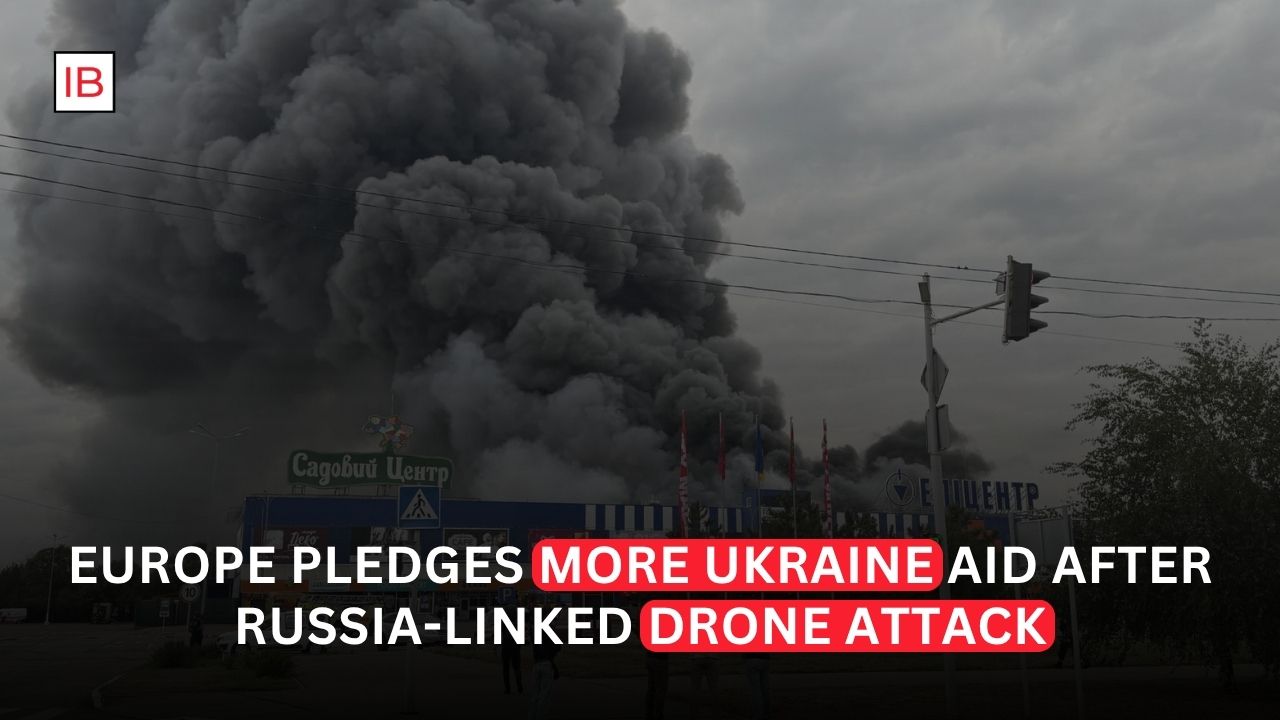
Europe is moving to strengthen its support for Ukraine after Germany accused Russia of orchestrating an attempted drone attack near Leipzig/Halle Airport, turning what could have been a single security incident into a wider test of Europe’s willingness to confront Moscow’s growing hybrid-war campaign.
German authorities said the attack involved explosives-laden drones discovered near Ukrainian cargo aircraft at Leipzig/Halle Airport on Aug. 4. Berlin concluded that Russian state agencies were behind the operation, while Moscow has denied involvement. The airport is strategically important because it handles military and humanitarian logistics connected with European support for Ukraine.
The accusation prompted an unusually strong response from European officials. EU foreign-policy chief Kaja Kallas described the incident as bearing the hallmarks of state-sponsored terrorism and argued that Russia was attempting to intimidate European governments into reducing their assistance to Kyiv. European leaders have increasingly warned that Moscow’s activities extend beyond the battlefield, including suspected sabotage, cyberattacks, disinformation and drone incursions.
Germany has taken its own diplomatic measures, including closing Russia’s consulate in Bonn and ending cooperation with a Russian cultural organization. Several other European countries have summoned Russian diplomats as governments coordinate their response. The European Union is also preparing additional sanctions targeting Russian individuals and entities.
The security concerns come as Russia continues its large-scale campaign against Ukraine. Russian strikes have recently targeted Kyiv and other Ukrainian regions, while Ukrainian forces have expanded their own long-range drone operations against Russian military and energy infrastructure. The continuing exchange has increased pressure on European governments to provide Ukraine with more air-defense equipment, ammunition and financial assistance.
Air defense has become particularly urgent. Kallas said some European countries possess interceptor missiles approaching the end of their usable life and suggested that sending those systems to Ukraine could provide immediate assistance. She also acknowledged that several countries with relevant stocks, including Greece and Spain, had not yet made new commitments. The comments highlight one of Europe’s central problems: governments have increased spending on Ukraine but still face shortages of critical missile systems.
Europe’s financial commitment has nevertheless expanded sharply. The Kiel Institute for the World Economy reported in August that European institutions allocated almost €11 billion in aid to Ukraine during May and June 2026, driven largely by the new €90 billion Ukraine Support Loan. About €4.3 billion of those allocations was military assistance, while €6.7 billion was directed toward financial and humanitarian support. Germany separately allocated €700 million in military assistance during the period, with Denmark and the Netherlands also making substantial contributions.
The European Union has also approved a broader framework intended to cover Ukraine’s budgetary and military needs through 2027. The €90 billion support package is designed to strengthen Kyiv’s defenses while keeping essential government services operating. Brussels has indicated that immobilized Russian assets could eventually play a role in repaying the loan, although using those assets directly remains politically and legally contentious.
The debate over frozen Russian assets is returning to the center of European policy. EU countries have immobilized roughly €210 billion of Russian central-bank assets, with most held in Belgium. Several governments, including the Netherlands, Poland, Spain and Sweden, are again calling for discussions about using the money to support Ukraine. Belgium remains concerned about potential legal and financial liabilities.
Another challenge is Europe’s dependence on American military technology. The Kiel Institute estimates European donors procured at least €3 billion of military equipment from US defense companies during the first half of 2026, representing about 30% of Europe’s military aid delivered through defense-industry procurement. Advanced systems such as Patriot remain particularly difficult for Europe to replace quickly.
The Leipzig incident therefore arrives at a sensitive moment. European governments are trying to increase support for Ukraine while simultaneously strengthening their own defenses against possible Russian interference. For Moscow, the response demonstrates that hybrid operations can produce the opposite of their intended effect: rather than weakening European backing for Kyiv, they may encourage governments to increase military aid, tighten sanctions and accelerate defense cooperation.
For Ukraine, that could translate into additional air-defense systems, weapons and financing at a time when Russian attacks remain intense. For Europe, however, the episode underlines a larger strategic question: whether the continent can sustain long-term support for Ukraine while developing enough independent military capacity to confront a broader security threat.