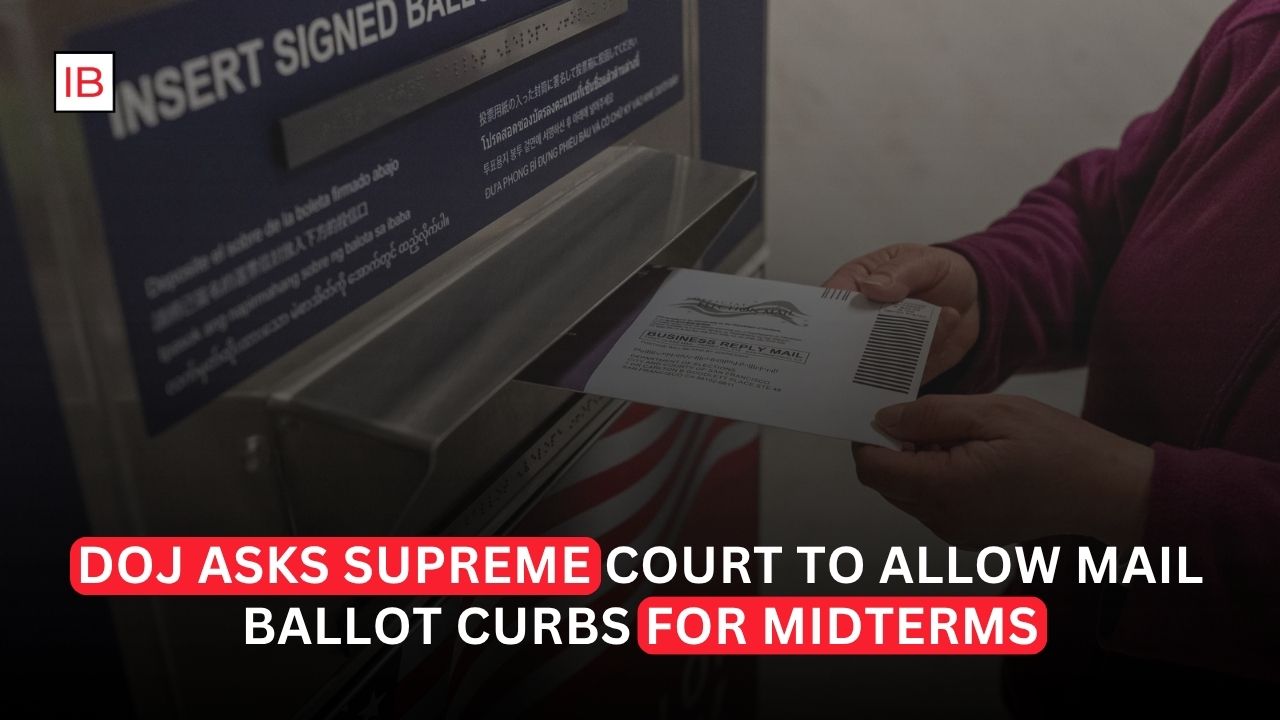
Administration Seeks Emergency Ruling as Legal Fight Over Federal Voting Rules Intensifies. The US Justice Department has asked the Supreme Court to allow new restrictions on mail-in voting to take effect ahead of November’s midterm elections, escalating a fast-moving legal battle over the Trump administration’s role in election procedures.
The emergency request came after a federal judge in Boston temporarily blocked the US Postal Service from enforcing key parts of the new rules, which were introduced as part of President Donald Trump’s broader push to tighten mail-ballot procedures.
Federal Judge Blocks New Rules
US District Judge Indira Talwani temporarily halted parts of the Postal Service’s new mail-ballot rules in late August, finding that the states and voting rights groups challenging the policy had raised serious legal concerns.
The disputed rules would give the Postal Service greater authority over how election mail is handled. States could be required to comply with revised ballot-design standards and provide voter information through a federal online system. Non-compliant election mail could potentially be returned to state officials.
Talwani’s initial order was temporary, but the legal battle intensified as the midterm election timetable moved closer.
DOJ Seeks Supreme Court Intervention
The Justice Department has argued that the lower court should not prevent the administration from enforcing the new regulations while the broader legal challenge continues.
The Trump administration maintains that the measures are intended to improve election security and standardize procedures involving mail-in ballots. Justice Department lawyers have asked the Supreme Court to intervene quickly because states are already approaching important deadlines for printing and sending election materials.
The administration’s appeal puts the issue back before the Supreme Court after earlier legal battles over Trump’s mail-voting policies.
States Warn of Election Disruption
Democratic-led states and voting rights organizations have strongly opposed the new restrictions, arguing that the federal government is attempting to interfere with powers traditionally held by state election officials.
The challengers say the changes could create major logistical problems only weeks before the November elections. They have also warned that new technical requirements could result in ballots being delayed or rejected, potentially affecting voters who depend on mail voting.
A coalition of state officials has argued that complying with the new rules so close to the election would be difficult and costly.
Questions Raised Over USPS Voting Portal
The dispute has also focused on a new federal online portal intended to support the Postal Service’s ballot requirements.
During a court hearing, Justice Department lawyers faced questions about whether the system was fully ready for use. Concerns over the portal’s readiness have added to uncertainty about whether states could realistically comply with the new requirements before Election Day.
Election officials and voting-rights advocates argue that major changes to mail-ballot systems should not be introduced at the last minute, particularly when states are already preparing election materials.
Midterm Deadline Adds Pressure
The timing of the legal battle has increased pressure on both the courts and election officials.
Some states are already approaching or reaching deadlines for sending mail-in ballots to voters, meaning a late Supreme Court decision could force election administrators to make rapid changes to systems that are already in operation.
The case has therefore become one of the most important election-related disputes ahead of the 2026 midterms, when control of Congress will be at stake.
Supreme Court Decision Could Shape Voting Rules
The Supreme Court’s response could determine whether the Trump administration’s new mail-ballot restrictions can be enforced before the November election.
A ruling in favor of the Justice Department would allow the administration to move ahead with key parts of its plan, while a decision to leave the lower court’s block in place would provide states with more certainty as they continue preparing for the vote.
For now, the battle remains unresolved, with the Justice Department pressing for an urgent decision and election officials warning that continued legal uncertainty could disrupt preparations for one of the most closely watched US midterm elections in years.