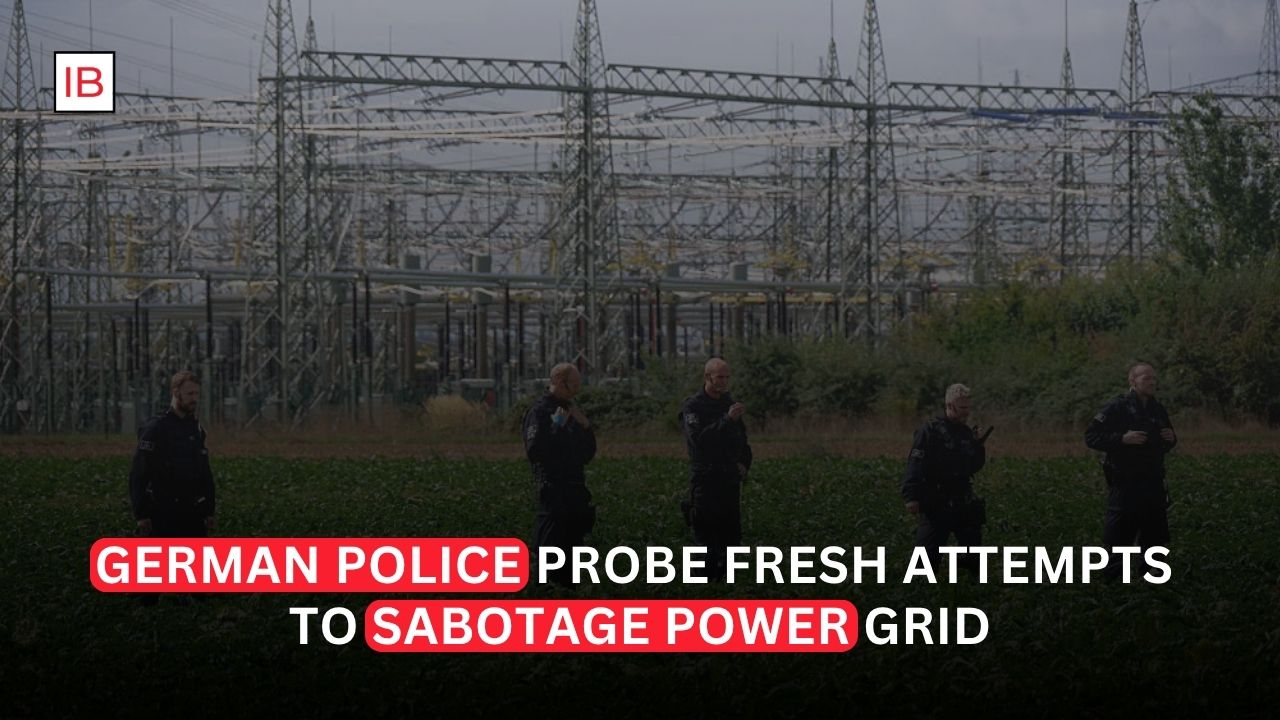
German authorities are investigating fresh attempts to disrupt the country’s electricity infrastructure, raising concerns about a widening threat to critical infrastructure at a time of heightened tensions across Europe.
The latest incidents come only days after suspected sabotage targeted power substations in Brandenburg and North Rhine Westphalia. Authorities are now examining whether the cases are connected and whether they could form part of a broader campaign against Germany’s energy system.
New Incidents Put German Grid on Alert
Police are responding to reports of suspicious activity at power installations in several parts of Germany.
In Dormagen, North Rhine Westphalia, investigators are examining an apparent attempt to trigger a short circuit at a power facility. A letter claiming responsibility has also reportedly been found and is being assessed as part of the investigation.
Another incident occurred at a transformer station in Ganderkesee in northern Germany, where police secured the area after suspicious circumstances were reported. Authorities said there was no immediate danger to the public, while details surrounding the discovery remained under investigation.
The incidents have heightened concern because they follow two confirmed attempts to interfere with electricity infrastructure earlier in the week.
Two Earlier Attacks Caused Major Disruptions
On September 1, authorities recorded separate incidents involving substations in Brandenburg and near Bergheim in western Germany.
At a substation near the Jänschwalde power plant in Brandenburg, improvised explosive devices were used to damage power infrastructure. The incident caused a brief disruption but did not result in a widespread blackout.
Police launched a terrorism investigation and are examining whether the attack could have been directed by a foreign state or carried out by extremist groups.
Hours later, another incident occurred near Bergheim in North Rhine Westphalia. Investigators believe unidentified perpetrators deliberately caused a short circuit at a substation by placing conductive material on overhead power lines.
The disruption temporarily knocked five power generating units offline, representing about 4.2 gigawatts of capacity. Electricity supplies to consumers remained stable, but the incident demonstrated how relatively targeted interference can affect large parts of the energy system.
Authorities Examine Possible Links
German officials are now trying to determine whether the separate incidents are connected.
North Rhine Westphalia Interior Minister Herbert Reul said investigators were considering both foreign state directed sabotage and left wing extremism. Officials have emphasized that neither possibility can currently be ruled out.
That uncertainty is particularly significant because Germany has become increasingly concerned about hybrid threats involving sabotage, cyberattacks, espionage and other forms of interference.
The government has previously warned that hostile actors could seek to exploit vulnerabilities in critical infrastructure without launching a conventional military attack.
Russia Allegations Add to the Security Concerns
The investigations are unfolding against a wider backdrop of tensions between Germany and Russia.
German authorities recently attributed an attempted drone attack at Leipzig/Halle Airport to Russian intelligence. Moscow has rejected the accusation, but the incident has contributed to growing fears across Europe about covert attacks and interference.
The suspected power grid sabotage is therefore being examined within a much broader national security environment. Officials have cautioned against drawing premature conclusions about who is responsible, but the timing has increased pressure on German authorities to strengthen protection around critical infrastructure.
Germany Faces a Growing Critical Infrastructure Challenge
The electricity network is particularly sensitive because even limited damage can create cascading problems.
Germany’s modern power system depends on a large network of substations, transmission lines and generation facilities. Many installations are spread across rural and industrial areas, making comprehensive physical protection difficult.
Recent events have demonstrated that attackers do not necessarily need to destroy major generating facilities to create disruption. Targeting a strategically important substation can temporarily remove substantial generation capacity or interfere with the movement of electricity across the grid.
That vulnerability is becoming more important as European electricity systems become increasingly interconnected and digital.
Calls for Stronger Protection Are Growing
The latest incidents are already prompting calls for greater investment in security.
German police organizations and security officials have argued that critical infrastructure operators need stronger physical protection, surveillance and detection systems. Potential measures include improved monitoring, sensors, cameras and faster coordination between infrastructure companies and law enforcement.
Brandenburg is also preparing broader changes designed to improve protection of critical infrastructure, including closer cooperation among security agencies and emergency services.
The objective is to protect not only electricity facilities but also other essential systems such as telecommunications, transport, information technology and healthcare.
Europe Is Facing a Wider Hybrid Threat
Germany’s experience reflects a broader European concern.
Governments across the continent are increasingly treating sabotage of energy networks and other critical infrastructure as a national security issue. The risks have become more complicated as infrastructure becomes more connected, automated and dependent on digital systems.
A successful attack on a single component can potentially create consequences far beyond the immediate location.
European governments are therefore under pressure to improve physical security while also strengthening cyber defenses and intelligence cooperation.
The Investigation Could Have Wider Consequences
For Germany, the immediate priority is identifying those responsible and determining whether the recent incidents represent isolated criminal acts or a coordinated campaign.
No definitive connection has yet been established between all of the reported incidents, and authorities have not publicly identified a perpetrator.
Nevertheless, the repeated targeting of electricity infrastructure has exposed a vulnerability that Germany can no longer treat as theoretical.
The latest investigations could ultimately lead to stronger security requirements, greater spending on critical infrastructure protection and closer cooperation between energy companies and government agencies.
For Europe, the incidents also serve as another warning that modern conflicts can extend well beyond traditional battlefields. Power networks, transport systems and industrial facilities can become targets in a form of confrontation designed to create disruption without crossing the threshold of open warfare.
Germany’s challenge now is to determine who is behind the attacks, prevent further incidents and ensure that attempts to interfere with the country’s power system do not develop into a much larger threat.