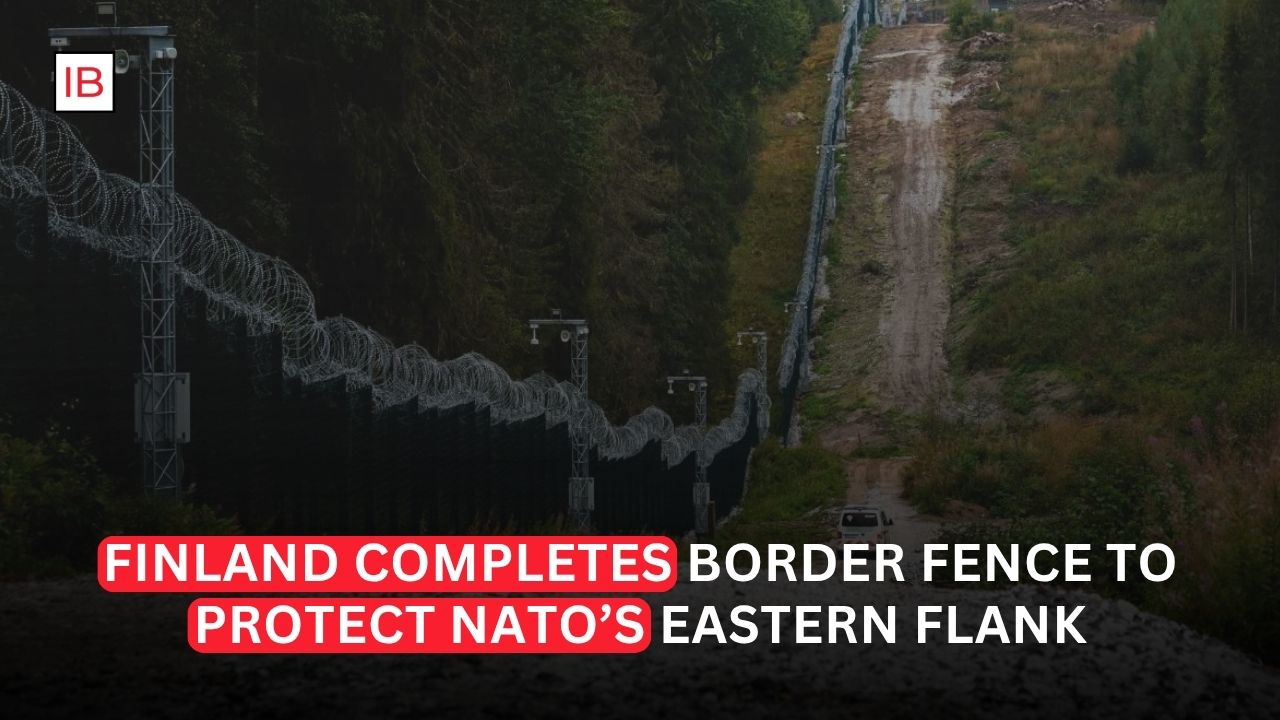
Finland is nearing completion of a major border-fence project along its frontier with Russia, reinforcing one of NATO’s most exposed northern positions as security concerns across Europe remain elevated. Finishing work is still being carried out on sections between North Karelia and the eastern end of the Gulf of Finland, according to Finnish reporting on Monday, meaning the project is at the final stage rather than simply a completed line across the border.
The barrier is part of Finland’s broader effort to strengthen surveillance and prevent what Helsinki describes as “instrumentalised migration” — the use of migrants to create pressure on the country’s security and social stability. Finland has kept its land crossings with Russia closed since December 2023, and the government renewed that decision in June, saying the risk of a renewed migration operation remained significant if the crossings were reopened.
The fence does not cover Finland’s entire 1,340-kilometre border with Russia. Instead, authorities have concentrated physical barriers in locations where the operational need is considered greatest. The broader project is expected to cover roughly 200 kilometres, with the barrier combining a substantial physical fence with roads and advanced technical surveillance systems.
By February, approximately 110 kilometres of the planned barrier had been completed in southeastern Finland. The Finnish Border Guard said the completed sections significantly improve border control, situational awareness and the mobility of patrols. The project also incorporates electricity and telecommunications infrastructure that can support newer surveillance technologies, including preparations for radio-based monitoring and anti-drone systems.
The physical barrier is therefore only one element of Finland’s changing border-security architecture. Rather than attempting to seal the entire frontier, Finnish authorities are combining fencing with sensors, patrol roads, artificial-intelligence-supported surveillance and other technologies. The approach reflects the country’s assessment that modern border threats can involve organized migration, drones, criminal activity and other forms of hybrid pressure rather than conventional military crossings alone.
The project has taken on greater strategic significance since Finland joined NATO in April 2023. Finland now provides the alliance with one of its longest borders with Russia, while its geographic position gives NATO a direct security connection to the Arctic and High North. NATO has responded by expanding its military presence in the region: a multinational Forward Land Forces formation began operations in Finland and Sweden in June 2026, with the Finnish component intended to strengthen deterrence and defense on NATO’s northeastern flank.
Finland’s border preparations also fit into a wider European response to Russia’s increasingly broad approach to security competition. European officials have warned about sabotage, cyberattacks, espionage, disinformation and other forms of hybrid activity that can remain below the threshold of conventional warfare. The heightened concern has encouraged NATO members on the alliance’s eastern and northern flanks to strengthen both military defenses and civilian resilience.
The Finnish government has explicitly linked its border policy to national security rather than treating the fence as a conventional immigration-control project. Officials say the closure of the eastern crossings has so far stopped the form of instrumentalised migration that emerged in 2023, but they continue to regard a renewed campaign as a credible possibility. The government has therefore decided to maintain the border restrictions until further notice while continuing to monitor conditions.
The cost of the fence also illustrates the scale of Finland’s post-NATO security adjustment. Earlier estimates put the roughly 200-kilometre project at around €362 million, with construction costing about €1.8 million per kilometre on average. Authorities have deliberately avoided fencing areas where lakes, rivers, difficult terrain or sparse populations make a physical barrier less necessary.
For Finland, the project represents a shift from relying primarily on border patrols toward a layered security system designed for a more uncertain relationship with Russia. For NATO, it adds another physical and technological layer to the alliance’s northeastern defenses at a time when the Arctic and Baltic regions are becoming increasingly important to European security planning. As construction reaches its final stages, Finland’s eastern border is becoming not merely a national frontier but an increasingly important component of NATO’s wider eastern-flank defense.