The rise of Chinese artificial intelligence is creating an uncomfortable choice for businesses and governments around the world: accept that Chinese models are becoming increasingly capable without necessarily trusting the companies and political systems behind them. That distinction matters because the debate over Chinese AI has increasingly become trapped between two weak positions — dismissing the technology because it comes from China or assuming that technical performance automatically makes it safe to use.
Neither conclusion holds up.
The evidence increasingly shows that Chinese AI developers are narrowing the performance gap with leading American laboratories. DeepSeek’s breakthroughs were followed by a wider group of Chinese models capable of competing strongly on coding, reasoning and agent tasks. The Center for Strategic and International Studies has described the recent progress as evidence that DeepSeek was not an isolated success but part of a continuing pattern of Chinese laboratories catching up with American frontier models.
Cost is another reason the challenge cannot simply be ignored. Recent research indicates that some Chinese models can be operated at dramatically lower prices than leading American alternatives, in some cases by as much as 90%. That advantage could matter enormously in applications where millions of inference requests are made every day. Cheap, capable models can spread quickly even when users have reservations about the companies that developed them.
But capability is not the same thing as trust.
For Western companies, one of the biggest questions concerns what happens to information submitted to an AI service. Data residency, corporate ownership, government access and regulatory obligations can matter as much as model accuracy. These concerns have already prompted governments to restrict or discourage the use of Chinese AI services. Taiwan, for example, instructed government departments not to use DeepSeek, citing information-security risks and concerns over cross-border data transmission.
Privacy concerns are only part of the equation. Chinese AI systems also operate within a political environment fundamentally different from that of most Western technology companies. Models may be subject to restrictions surrounding politically sensitive subjects, meaning users cannot necessarily assume that the system will approach controversial questions according to the same principles as an American or European model.
That does not make every Chinese model inherently dangerous. It does mean that organizations should evaluate the jurisdiction, ownership structure, data practices and deployment architecture of an AI system rather than treating the model itself as the only relevant product.
There is another reason for caution: the competitive relationship between Chinese and American AI companies is becoming increasingly adversarial. U.S. officials are concerned about China’s ability to develop advanced AI despite restrictions on access to cutting-edge chips, while American companies are increasingly concerned about Chinese competitors reproducing capabilities through techniques such as model distillation. Anthropic has accused several Chinese AI companies of conducting large-scale distillation efforts against its Claude models, allegations that have intensified debate over intellectual property and AI security.
At the same time, the United States has its own trust problem. American AI companies have faced security incidents, privacy controversies and growing criticism over the concentration of powerful technology in a handful of private firms. Recent AI-related breaches and autonomous-agent incidents demonstrate that the risks associated with advanced AI are not uniquely Chinese.
That is why the sensible question is not whether Chinese AI should be trusted in the abstract. The question is what type of trust is required for a particular use case.
A consumer asking a general question through an AI model faces a different risk from a bank sending confidential customer information to an external model. A programmer running an open-weight model locally has a different security profile from a government department uploading sensitive documents to a cloud service based in another jurisdiction. The distinction between local deployment and foreign-hosted services can be more important than the nationality of the underlying model.
Open-weight Chinese models may eventually make this distinction even more important. If powerful models can be downloaded, inspected and operated locally, users can avoid sending sensitive information to the model developer altogether. That could reduce some privacy risks while creating others, including challenges involving malicious modifications, insecure deployments and insufficient safeguards.
The broader geopolitical implications are difficult to ignore. China is developing not only AI models but also domestic chips and software ecosystems intended to reduce reliance on American technology. Chinese AI chipmakers are already challenging Nvidia’s position in the country’s market, suggesting that the competition is evolving into a broader race for technological independence.
That competition could ultimately produce a fragmented global AI ecosystem, with American, Chinese and other regional standards developing along separate paths. Such fragmentation would make interoperability, safety standards and international oversight more difficult.
Ironically, distrust may therefore become one of the forces accelerating AI development. Washington wants to limit China’s access to sensitive technology because of national-security concerns. Beijing wants to reduce its dependence on American hardware and software for the same reason. Companies on both sides consequently have stronger incentives to build independent supply chains.
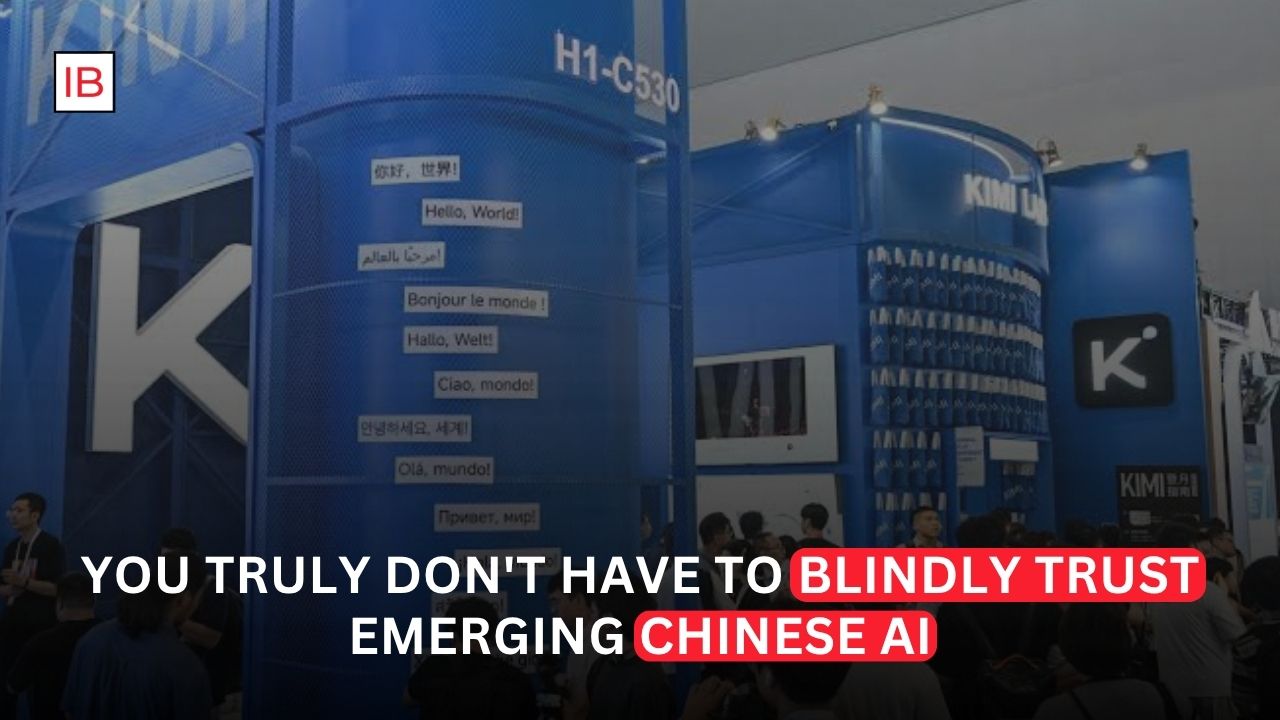
The result is a world in which users do not have to trust Chinese AI blindly — but neither can they afford to dismiss it. Chinese models are becoming too capable, too inexpensive and too widely available for that strategy to work. The appropriate response is rigorous evaluation: protect sensitive data, demand transparency, test models independently and match the deployment environment to the level of risk.
Trust should be earned by evidence, not granted because a model is Chinese or American. That principle may be the most useful way to navigate the next stage of the global AI race.