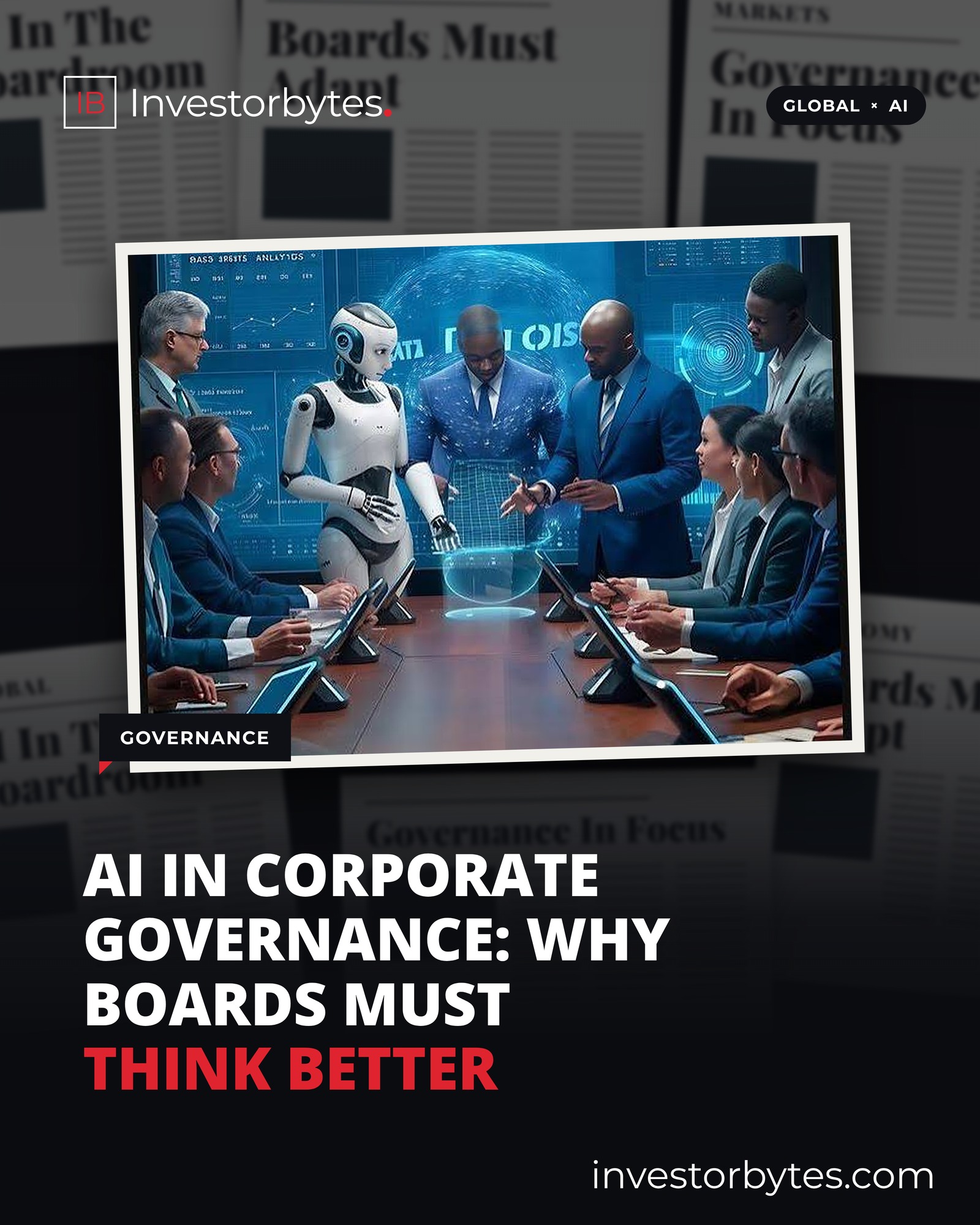
Boardrooms around the world are experimenting with artificial intelligence, and most of the early enthusiasm centres on speed: summarising lengthy reports, searching past minutes and helping directors digest information before meetings. Yet the real significance of AI in corporate governance may lie elsewhere. The technology is prompting boards to ask a more uncomfortable question about whether their structures and habits are fit for a faster, more uncertain business environment.
That is the central argument of a recent World Finance analysis of boardroom AI, which draws on a year of conversations with directors and senior executives. The conclusion is that the boards likely to gain most from AI are not those that use it to work faster, but those that use it to think better.
Boards Under Mounting Pressure
The modern board carries a heavier load than at any time in recent memory. Regulators expect more, investors and other stakeholders scrutinise more closely, and the list of risks that directors must oversee keeps lengthening. Cybersecurity, sustainability, workforce change and geopolitical instability now sit alongside traditional duties such as financial oversight, executive pay and succession planning.
The practical result is longer board packs and crowded agendas. Many non-executive directors spend evenings and weekends wading through hundreds of pages of material, only to leave meetings feeling that too little time went on the issues that will define their company’s future. The source describes this as cognitive overload: boards become very good at checking detail, but have less capacity for genuine strategic debate and constructive challenge.
This is not a new complaint. Governance codes in many markets have long urged boards to focus on strategy and culture rather than routine compliance. What has changed is the volume of information and the speed at which conditions shift, which together make the problem harder to ignore.
Why AI Is Different From Earlier Technology
Previous waves of enterprise technology, from accounting software to customer relationship systems, generally belonged to a single function. AI does not. It touches hiring, customer service, compliance, product design and competitive strategy simultaneously, and it changes how organisations gather information and make decisions at every level.
For directors, that creates a dual challenge. They must oversee how management deploys AI across the business, including the risks around data, bias, security and regulation, while also deciding how the board itself should use these tools. Getting the second part wrong can undermine the first, because a board that relies on AI uncritically will struggle to hold management to account for doing the same.
Regulators in several jurisdictions are also paying closer attention to how companies govern AI, which raises the stakes for directors. Boards that cannot explain how material AI-driven decisions are overseen, or who is accountable when automated systems go wrong, may find themselves exposed to legal, reputational and investor pressure. Building that understanding at board level is quickly becoming part of basic fiduciary diligence.
AI in Corporate Governance: The Limits of Speed
Most early products marketed as AI for boards focus on automation and summarisation. These tools save time, and that has value for overstretched directors. But the article makes a pointed observation: a weak board paper remains weak when it is summarised, and processing information faster does not automatically produce better decisions.
There is also a risk of amplification. If a board already suffers from overconfidence, groupthink or a reluctance to question a dominant chief executive, AI tools that simply accelerate existing processes may make those weaknesses worse. Governance would become faster without becoming more effective. This echoes lessons from past corporate failures, where boards often had the relevant information but failed to interrogate it.
AI as a Strategic Sparring Partner
A more promising approach treats AI as a challenger rather than a secretary. The article highlights a recent partnership between Board Intelligence, a governance technology firm, and Lloyds Banking Group, which explored how AI could help executives and directors test assumptions, identify gaps in reasoning and surface perspectives that might otherwise be overlooked ahead of high-stakes discussions.
One participating director reportedly described the experience as having an extra perspective in the room rather than using a chatbot. The explicit aim was to strengthen human judgement, not to replace it. In practice, that could mean asking an AI system to argue against a proposed acquisition, stress-test a capital allocation plan under different scenarios, or flag where a management paper relies on optimistic assumptions.
This augmentation model offers a more meaningful role for AI in corporate governance than administrative efficiency alone. It addresses the core weakness identified in overloaded boards: not a shortage of information, but a shortage of time and space for rigorous debate.
Human Judgement Remains the Differentiator
None of this diminishes the importance of the people around the table. Curiosity, scepticism, integrity and the confidence to challenge consensus are qualities that technology cannot replicate. The best boards, the article argues, are not necessarily the fastest. They are those that maintain high-quality discussion under pressure, bring alternative views to the surface early and keep questioning both the information in front of them and the reasoning behind it.
As growth prospects soften and disruption accelerates across industries, the quality of board judgement is likely to become a more significant competitive advantage than it has been historically. Investors already pay close attention to board composition and independence; how a board uses AI may become another lens through which governance quality is assessed.
Practical steps for boards include agreeing clear principles on which tasks AI may support, ensuring directors understand the limitations of the tools they use, protecting confidential board materials, and periodically reviewing whether AI is improving the quality of debate rather than merely shortening preparation time.
Conclusion
The arrival of AI in the boardroom is less a technology story than a governance one. Used purely to accelerate existing routines, it risks entrenching the very weaknesses that overloaded boards already face. Used deliberately to sharpen questions, test assumptions and widen perspectives, AI in corporate governance can help directors do what they are ultimately there for: exercising sound, independent judgement on behalf of the company and its shareholders.