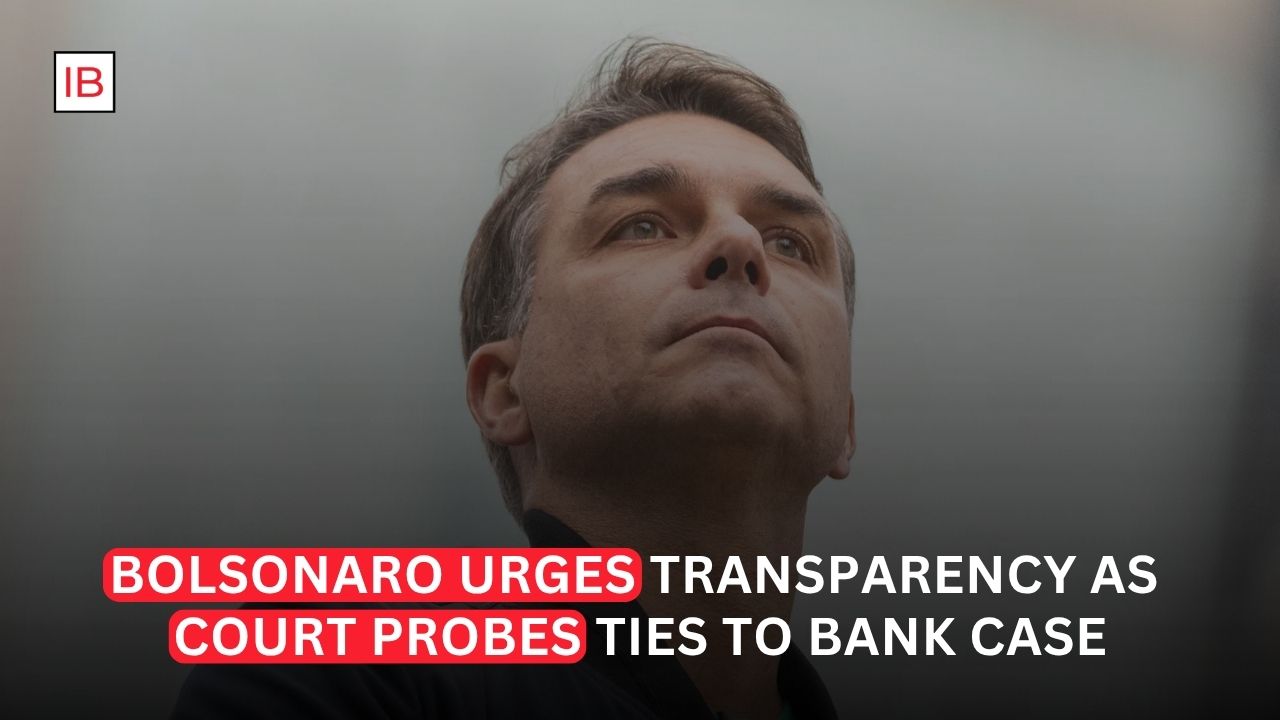
Brazilian presidential candidate Flávio Bolsonaro is calling for greater transparency in an investigation linked to the collapse of Banco Master, seeking to turn a growing political and judicial controversy into an argument for openness as the country approaches its October election.
Flávio, the son of former President Jair Bolsonaro, said the investigation into financing for a film about his father should be made public. He has denied wrongdoing and argued that transparency would demonstrate that the transactions were legitimate. The probe, opened by Supreme Court Justice André Mendonça in July, examines possible corruption, money laundering and foreign-exchange violations connected to the project.
The investigation centers on Daniel Vorcaro, the former owner of Banco Master, who is facing allegations of large-scale financial fraud. Brazilian authorities say the failed bank’s activities may have involved billions of reais, making the scandal one of the country’s most significant financial investigations in recent years.
According to documents released as part of the case, more than $12 million was transferred to finance the movie project, titled “Dark Horse,” which portrays the life of Jair Bolsonaro. Investigators are examining the source of the money and the relationships between Vorcaro, Flávio Bolsonaro and other people connected to the film. Flávio has said he was seeking private investment for the production and has rejected allegations of illegal activity.
The controversy has expanded beyond the Bolsonaro family and into Brazil’s Supreme Court. Justice Alexandre de Moraes has come under scrutiny over alleged ties to Vorcaro, while Mendonça’s handling of the investigation has itself become controversial. Mendonça was appointed to the Supreme Court by Jair Bolsonaro, creating additional political sensitivity around the case.
The dispute intensified this week after Supreme Court Chief Justice Edson Fachin asked Mendonça to remove secrecy from investigations connected to Banco Master, except where confidentiality remained essential to protect ongoing investigative measures. Mendonça subsequently made public the main Banco Master proceeding and 14 related investigations. However, documents involving the “Dark Horse” film and some political figures remained confidential.
That partial disclosure has triggered another dispute inside the court. Moraes accused Mendonça of selectively releasing information and said about 180 documents remained under seal. He asked Fachin to make all relevant material public and argued that the court should examine both sides of the dispute together to prevent contradictory decisions.
The controversy comes at an especially sensitive moment for Brazilian politics. Flávio Bolsonaro has emerged as the leading right-wing challenger to President Luiz Inácio Lula da Silva in the presidential race. Any investigation involving Flávio therefore has the potential to affect not only his campaign but also the broader struggle between Bolsonaro’s political movement and Lula’s Workers’ Party.
For Flávio, demanding transparency carries both political risks and potential advantages. If the complete evidence supports his claim that the film financing was a legitimate private transaction, disclosure could help neutralize the allegations. But if additional documents reveal undisclosed financial relationships or other irregularities, greater transparency could intensify pressure on his campaign.
Lula has also called for greater transparency in the Banco Master investigations, while criticizing what he described as selective leaks intended to influence the election. The president’s position reflects the broader concern that the scandal could become another battleground in Brazil’s increasingly polarized political environment.
The Banco Master case has already produced a wider institutional crisis. Questions surrounding Vorcaro’s relationships with senior figures in Brazil’s judiciary have placed the Supreme Court under unusual scrutiny, while disagreements between Moraes and Mendonça have become increasingly public.
The court is scheduled to address the controversy in a plenary session on Sept. 15. That hearing could determine how the competing investigations are handled and whether further scrutiny is opened into alleged links between officials and the former banker.
With the presidential election less than a month away, the case has become more than a banking scandal. It now sits at the intersection of finance, the judiciary and Brazil’s political succession. Flávio Bolsonaro’s call for transparency could help him argue that the allegations should be judged on evidence rather than political narratives. But the more information that becomes public, the greater the potential consequences for every politician and institution connected to the Banco Master affair.