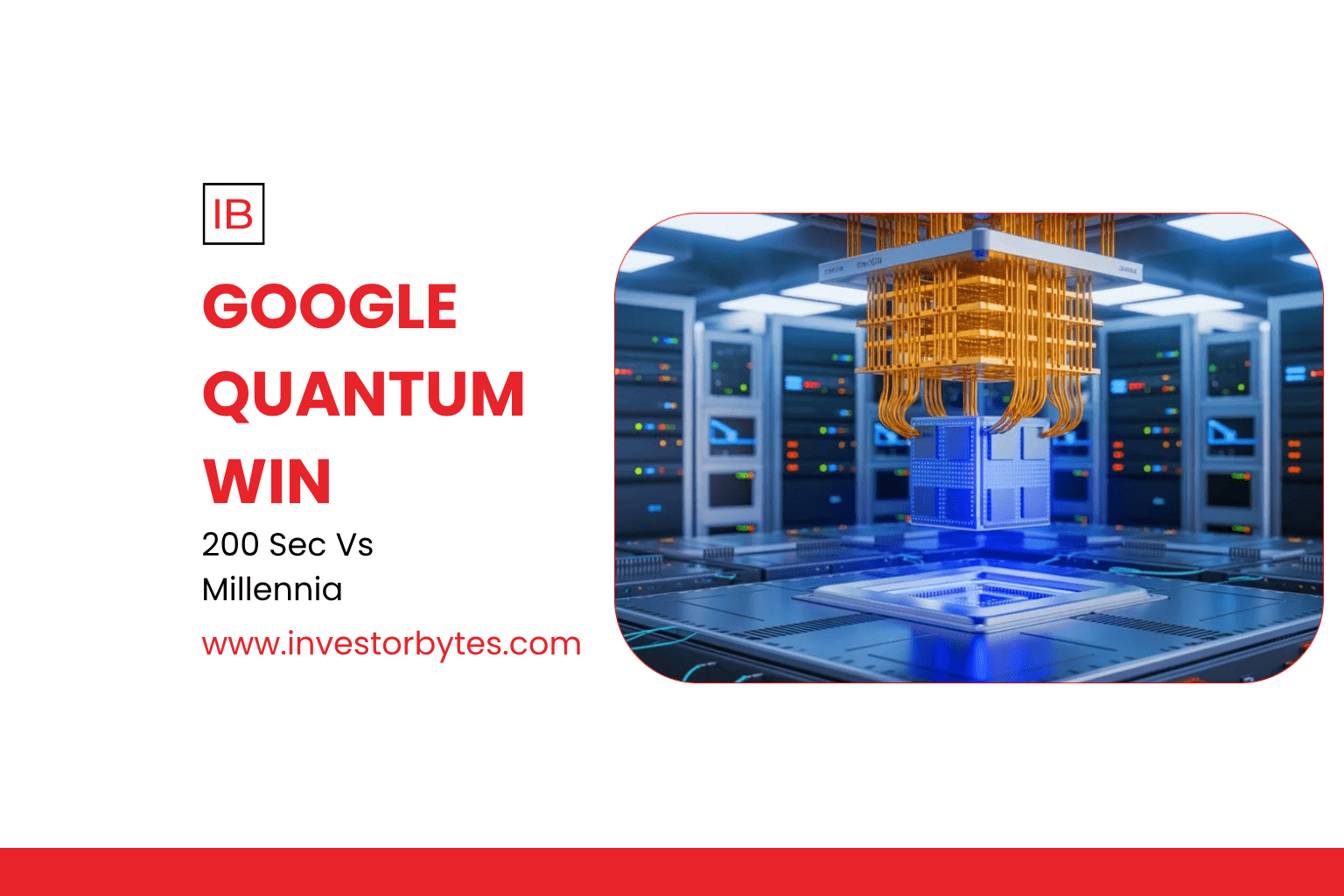
Google Quantum AI‘s Willow chip has reignited the quantum supremacy race, achieving verifiable quantum advantage on November 12, 2025, by solving a random circuit sampling (RCS) benchmark in under 5 minutes—a task estimated to consume 10 septillion (10^25) years on the world’s fastest classical supercomputers like Frontier, as detailed in a landmark Nature paper titled “Observation of constructive interference at the edge of quantum ergodicity.” Fabricated in Google’s state-of-the-art Santa Barbara facility, Willow’s 105 superconducting transmon qubits execute 10^25 operations with unprecedented fidelity, outpacing 2019’s Sycamore by demonstrating not just speed, but scalable error suppression—reducing logical error rates exponentially as qubit grids expand from 3×3 to 7×7, achieving below-threshold quantum error correction (QEC) for the first time. “This isn’t supremacy for supremacy’s sake; Willow peels away at classical limits with double-exponential scaling, paving verifiable paths to utility,” proclaimed Hartmut Neven, Google Quantum AI founder, in the announcement blog, echoing his January 2026 Medium post on Sycamore’s renewal but amplified by Willow’s real-world echoes.
The architecture’s genius lies in its surface-code QEC: encoding 50 logical qubits across 100 physical ones via a 2D grid with 3.47 average connectivity, yielding 100x error reduction over Sycamore’s noisy intermediate-scale quantum (NISQ) era—coherence times stretched to ~100 microseconds (5x prior), enabling fault-tolerant thresholds below 0.1% per gate. Willow’s Quantum Echoes algorithm—leveraging out-of-time-order correlators (OTOCs) to probe information scrambling—delivers 13,000x speedup on verifiable tasks like molecular geometry simulations, matching NMR experiments on 28-atom organics while revealing hidden interatomic distances inaccessible classically. Neven forecasts practical applications within 5 years: drug discovery via variational quantum eigensolvers (VQEs) compressing protein folding timelines from years to hours, materials science for fusion reactors optimizing plasma confinement 20% beyond classical DFT, and battery design simulating lithium-ion intercalation at quantum fidelity—potentially unlocking 50% energy density gains. “Willow’s echoes reverse chaos, echoing nature’s code for breakthroughs in AI training data and climate modeling,” Neven added, teasing Cirq v3.0 updates for developer access by Q1 2026.
Funding ecosystems propel this ascent: amid $1 trillion compute pacts, OpenAI and Meta’s $65 billion 2025 AI capex—Meta’s $60-65 billion for 1.3 million Nvidia GPUs—fuels quantum hybrids, with Google’s $500 million Quantum AI allocation integrating Willow into TensorFlow Quantum for co-processing. Tenstorrent’s $320 million Fidelity-led RISC-V raise (val $2.6B) embeds quantum simulators, while Cerebras’ $400 million Series F ($2.2B val) accelerates graph-based QEC benchmarks 50x over A100s. Mythic ($190M analog edge), Untether ($140M low-power), and Esperanto ($115M 7nm) target on-device quantum-inspired annealing, driving Gartner’s 26% edge chip surge for LLM fine-tuning—compressing NP-hard optimizations 70% via heuristics Willow validates. OwlTing pegs $11.4 billion 2025 inference at 45% YoY growth, with D-Wave in 30% Fortune 500 pipelines yielding 100x Gurobi speeds (Deloitte).
Skeptics temper hype: RCS remains a contrived benchmark, with classical GPUs narrowing gaps via tensor networks, and fault-tolerance demands millions of qubits—Willow’s 10^-3 logical errors lag 10^-6 targets. Yet, verified reproducibility and open datasets counter claims, with McKinsey eyeing $1 trillion annual value by 2030 in simulation alone. Regulatory boosts like the $500 million U.S. Quantum Cybersecurity Act de-risk, while Xanadu’s photonic v5.0 democratizes boson sampling.
This renewal’s quiet supremacy unveils a new era: qubits’ vast speed bridges classical voids, transforming science with enduring harmony. From ergodic edges to fault-tolerant frontiers, Willow heralds symbiotic computation—watch 2026 for 1,000-qubit scales; if thresholds halve errors again, 10,000x utility dawns, rendering supercomputers echoes of a bygone idyll.