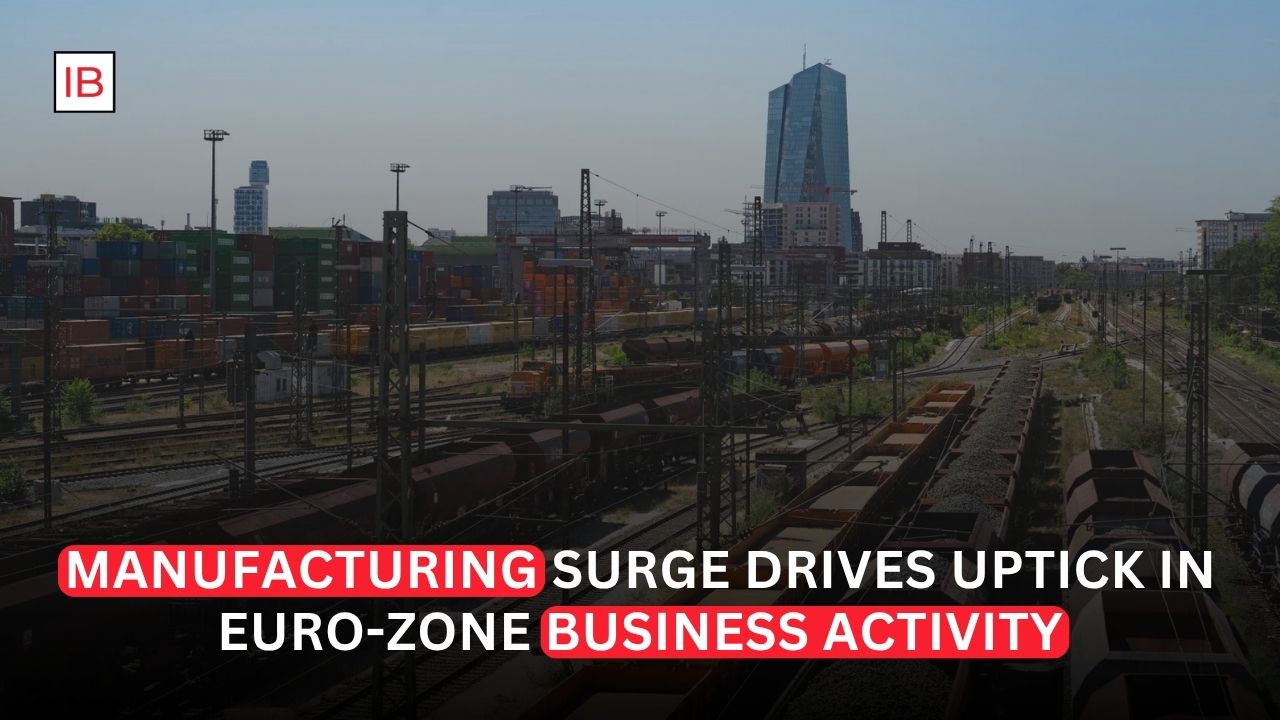
Manufacturing Gives the Euro-Area Economy a Fresh Boost
Business activity across the euro area strengthened in August as a sharp improvement in manufacturing helped offset weaker momentum in other parts of the economy. The latest figures suggest that the region’s recovery is gaining support from factories after a long period in which manufacturing had been one of Europe’s weakest sectors.
The Composite PMI, which measures activity across manufacturing and services, rose to 52.1 in August from 52.0 in July, beating expectations of 51.7. A reading above 50 indicates economic expansion, making this the euro area’s strongest pace of business growth since November.
Manufacturing Leads the Recovery
The strongest development in the latest survey came from manufacturing.
The euro-area manufacturing PMI climbed to 52.8 from 51.9, reaching its highest level in more than four years. Factory output also recorded its strongest growth in 54 months.
This represents a significant change for the European economy.
For several years, manufacturing had been one of the region’s biggest weaknesses. High energy costs, weaker global demand and geopolitical uncertainty placed significant pressure on factories.
The latest figures suggest that the situation may be improving.
Several factors are helping manufacturing activity, including:
- Stronger new orders
- A recovery in export demand
- Increased demand for AI-related technology
- Higher defense spending
- Inventory rebuilding by companies
- Improved production activity
The survey showed that overall new orders increased at their fastest pace in 40 months, while export orders expanded for the first time since Russia’s invasion of Ukraine in February 2022.
AI and Defense Spending Support Factory Demand
The rise in manufacturing is being supported by structural changes in the global economy.
Demand for AI-related technology is creating new opportunities for European manufacturers involved in producing equipment, industrial components and advanced technology.
At the same time, increased defense spending across Europe is supporting demand for machinery and other industrial products.
S&P Global’s Chris Williamson said manufacturing had once again become the strongest-performing part of the economy, with demand for AI technology and defense-related equipment contributing to stronger production, particularly in Germany.
This suggests that Europe’s manufacturing recovery is not being driven only by traditional consumer demand.
Instead, investment in technology, infrastructure and defense is increasingly becoming an important source of economic activity.
Services Maintain Their Expansion
While manufacturing accelerated sharply, the services sector remained relatively stable.
The euro-area services PMI held steady at 51.7, showing that service-sector activity continued to expand even though it did not match the strong momentum seen in manufacturing.
The services sector remains extremely important because it represents a large share of economic activity across the euro area.
Its continued expansion provides additional support to the broader economy.
However, the contrast between manufacturing and services is becoming increasingly noticeable.
Factories are experiencing a strong recovery, while some service businesses continue to face pressure from higher costs, weaker consumer confidence and geopolitical uncertainty.
The result is an economy where growth is improving, but the recovery remains uneven across different sectors and countries.
Germany Benefits From Manufacturing Strength
Germany, Europe’s largest economy, continued to show modest business expansion in August.
Its composite PMI registered 51.0, slightly lower than July’s 51.3 but still above the level that separates economic growth from contraction.
The country’s manufacturing sector was the main source of strength.
Germany’s manufacturing PMI jumped to 54.1 from 52.2, reaching its highest level in 51 months.
That improvement helped offset a continued decline in the country’s service sector, where activity fell to 48.5, marking the fifth consecutive monthly contraction.
Germany’s performance demonstrates how important manufacturing has become to the euro area’s latest recovery.
The country’s industrial sector had struggled for an extended period, but the latest data suggests that factory activity is gaining momentum again.
France Remains a Weak Point
France provided a sharp contrast to Germany.
Business activity in France contracted more than expected, with the country’s services sector particularly affected.
Recent heatwaves contributed to weaker activity in France’s dominant services industry, adding another challenge to an already fragile economic environment.
The difference between Germany and France highlights the uneven nature of the euro-area recovery.
Germany is benefiting from a manufacturing rebound, while France is experiencing greater pressure in services.
Despite this, the overall euro-area PMI improved because stronger activity in manufacturing and other parts of the region offset weakness in France.
Employment Shows Signs of Improvement
Another encouraging development was the labor market.
Companies across the euro area increased employment for the first time this year.
Manufacturers returned to hiring after more than three years of job reductions, while service-sector employment increased at its fastest pace in eight months.
This could be an important signal for the wider economy.
When companies begin hiring, it usually indicates greater confidence in future demand.
Higher employment can also support consumer spending, which in turn benefits retailers, service providers and other businesses.
However, stronger hiring could eventually contribute to wage pressures.
The European Central Bank will therefore continue monitoring employment and salary growth as it assesses the outlook for inflation.
Price Pressures Show Signs of Easing
The latest PMI survey also provided some encouraging news on inflation.
Both input costs and prices charged by businesses showed signs of easing.
The slowdown in price pressures was visible across manufacturing and services, suggesting that inflationary pressures within the private sector may be becoming less intense.
This could be important for the European Central Bank.
If businesses face slower cost increases, they may have less need to raise prices for consumers.
However, inflation remains above the ECB’s 2% target, with euro-area inflation rising to 2.9% in July.
That means policymakers still face a difficult balance.
The economy is strengthening, but inflation remains elevated.
Energy Prices Remain a Major Threat
The biggest risk to the euro area’s recovery could come from energy markets.
The region has so far shown resilience despite disruptions caused by the conflict involving the US, Israel and Iran.
The euro-area economy expanded by 0.4% in the second quarter, demonstrating stronger-than-expected resilience.
However, higher oil prices and geopolitical uncertainty could eventually affect both economic growth and inflation.
Bert Colijn of ING warned that oil prices above $90 per barrel and higher interest-rate expectations could become major obstacles in the coming months.
Higher energy costs can affect:
- Transportation
- Manufacturing
- Household spending
- Consumer prices
- Business profits
- Investment decisions
If energy prices remain elevated, the positive momentum seen in August could come under pressure.
Stronger Growth Creates a Challenge for the ECB
The European Central Bank now faces a more complicated economic environment.
On one hand, business activity is improving, employment is strengthening and manufacturing is experiencing its strongest growth in years.
On the other hand, inflation remains above target and energy prices continue to create uncertainty.
The stronger PMI figures may make policymakers cautious about declaring victory over inflation.
S&P Global’s survey suggests that the euro-area economy could achieve solid GDP growth in the third quarter, while improving business activity and employment could increase pressure on the ECB to maintain a hawkish policy stance.
At the same time, easing price pressures could provide some reassurance that inflation is not accelerating across the entire economy.
The ECB will therefore need to determine whether the current recovery is strong enough to create new inflation risks or whether external pressures, particularly energy costs, represent the greater threat.
Business Confidence Remains Cautious
Despite stronger current activity, businesses remain cautious about the future.
The survey showed that confidence weakened and remained relatively subdued, reflecting concerns about geopolitical developments, energy prices and inflation.
This is an important distinction.
Companies may currently be experiencing stronger orders and production, but they are not necessarily confident that the improvement will continue indefinitely.
Businesses are still operating in an environment shaped by:
- Geopolitical tensions
- Higher energy prices
- Inflation uncertainty
- Rising borrowing costs
- Changes in global trade
- Weak consumer confidence in some countries
These factors could limit investment and hiring if conditions deteriorate.
Export Growth Provides Another Positive Signal
One of the most encouraging parts of the survey was the return of export growth.
Export orders increased for the first time since early 2022, providing evidence that demand for euro-area goods may be improving outside domestic markets.
For an export-dependent region, this development is particularly important.
European manufacturers depend heavily on demand from international markets.
A sustained recovery in exports could support industrial production, employment and business investment.
However, global trade remains vulnerable to geopolitical tensions and changes in economic policy.
The improvement in exports will therefore need to continue over the coming months before economists can conclude that a lasting recovery is underway.
The Recovery Appears Broader Than Expected
The August data surprised economists because the composite PMI came in above expectations.
Analysts had predicted a slight slowdown to 51.7, but the index instead increased to 52.1.
This suggests that the euro-area economy is showing greater resilience than many expected.
The recovery is being supported by manufacturing, stronger orders and renewed export activity.
The latest figures also indicate that Europe has so far managed to avoid a major economic slowdown despite rising energy prices and geopolitical uncertainty.
Still, the recovery remains fragile.
France continues to struggle, Germany’s service sector remains weak and business confidence is subdued.
The euro area is therefore improving, but it has not yet reached a stage of strong and consistent growth across all sectors.
Looking Ahead
The latest PMI figures provide one of the strongest signs yet that the euro-area economy is gaining momentum.
Business activity rose to its fastest pace since November, with the Composite PMI increasing to 52.1. The strongest contribution came from manufacturing, where activity reached a more than four-year high of 52.8 and factory output recorded its fastest growth in 54 months.
The recovery is being supported by stronger new orders, renewed export growth, demand for AI-related technology and increased defense spending.
Employment is also improving, while price pressures appear to be easing.
However, major risks remain.
Higher energy prices, geopolitical tensions and elevated inflation could still slow the recovery. France remains weak, Germany’s services sector is contracting and business confidence remains cautious.
For the European Central Bank, the stronger economic data creates an increasingly difficult policy decision.
A more resilient economy could support further monetary tightening, but easing price pressures may reduce the urgency for aggressive action.
The coming months will show whether August’s manufacturing surge represents the beginning of a sustained industrial recovery or a temporary improvement driven by inventory rebuilding and increased technology and defense spending.
For now, the message from Europe’s businesses is cautiously positive: the euro-area economy is expanding, manufacturing is leading a powerful recovery, and new orders are increasing — but rising energy costs and geopolitical uncertainty could still determine whether this momentum can last.