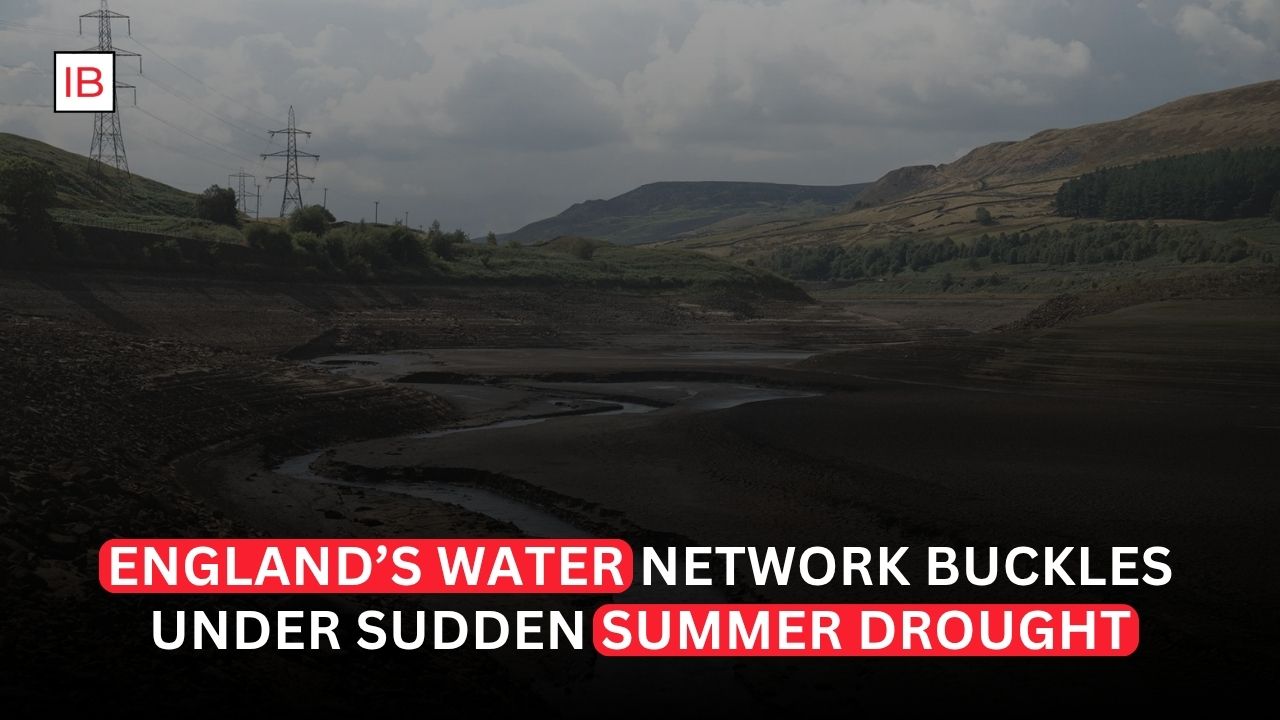
England is facing a severe water shortage after an exceptionally dry summer pushed reservoirs, rivers and groundwater supplies to unusually low levels, exposing weaknesses in a water network already struggling with aging infrastructure and rising demand.
The crisis has forced water companies to impose restrictions on millions of households while raising difficult questions about whether England has invested enough in the infrastructure needed to cope with a changing climate.
An Unusually Dry Summer
The scale of the drought is striking.
Government data showed that England received only 17% of its long-term average rainfall during August through August 20, while reservoir storage fell to 62.6% on August 18. Seven major reservoirs were classified as having exceptionally low storage.
The problem is not limited to reservoirs. River flows across much of England remain below normal, while groundwater levels continue to decline.
That creates a more serious problem than a temporary shortage of rainfall because groundwater and reservoirs are crucial buffers between wet and dry periods.
Water Companies Under Pressure
The drought is exposing weaknesses in the country’s water distribution network.
Many pipes are old and vulnerable to leaks, meaning water can be lost before it reaches customers. At the same time, extreme heat increases demand as households use more water for gardens, showers and other everyday purposes.
That combination creates a difficult equation: supplies are falling while demand rises.
The result has been restrictions across large parts of England, including hosepipe bans affecting millions of consumers.
Infrastructure Was Not Built for This
England’s water system was developed around historical patterns of rainfall and population.
Climate change is making those assumptions increasingly unreliable.
Longer dry periods can reduce the amount of water entering reservoirs and underground aquifers, while sudden heavy storms may deliver large amounts of rain too quickly for the system to capture efficiently.
Recent storms illustrate the contradiction. England can experience flooding and drought within the same period because rainfall does not necessarily arrive when or where the water system needs it.
Reservoirs Need Time to Recover
One of the biggest misconceptions about drought is that a few days of rain can solve the problem.
It cannot.
Heavy rainfall may temporarily increase river levels, but restoring groundwater and reservoir storage can require sustained rainfall over months.
Recent government data showed that reservoir storage was still falling despite periods of rain.
That means England could receive substantial rainfall in late summer without immediately ending the drought.
The Southeast Is Especially Vulnerable
Southern and eastern England are among the areas facing the greatest pressure.
These regions combine high population density with relatively limited natural water resources.
London and the wider Southeast also face long-term population growth, increasing demand even as climate change threatens supply reliability.
Five reservoirs across England and Wales were recently described as exceptionally low, prompting warnings that conditions could become much more difficult if autumn remains dry.
Aging Pipes Make Things Worse
The drought is also turning attention toward leakage.
A water system can have adequate theoretical supply while still struggling to deliver enough water if large quantities disappear through damaged infrastructure.
Replacing old pipes is expensive and disruptive, however.
Water companies must balance infrastructure investment against customer bills, while regulators face pressure to make sure utilities actually spend money on improving networks rather than prioritizing other financial objectives.
That debate has become particularly sensitive after years of criticism over leakage, pollution and underinvestment.
Thames Water Highlights the Problem
Thames Water provides an extreme example of the industry’s wider difficulties.
Britain’s largest water company is carrying around £20 billion of debt and is facing a major restructuring effort. Its creditors have proposed a new board and a long-term investment program focused partly on infrastructure and service reliability.
The company’s financial problems matter because the investments needed to make England’s water network more resilient will be enormous.
A financially weak utility has less flexibility to fund major projects.
More Storage Is Needed
One obvious solution is building additional reservoirs and storage capacity.
But new reservoirs take years to plan, finance and construct.
They also require land and can face environmental and political opposition.
That means policymakers cannot wait until the next drought to begin expanding capacity.
Long-term planning is necessary because major water infrastructure operates on timescales measured in decades rather than months.
Recycling Could Help
Water recycling is another potential solution.
Thames Water has been developing plans to recycle treated wastewater and return it to the River Thames system to increase available supplies.
But recent pilot testing raised environmental concerns after levels of the chemical PFOS increased significantly during the process.
That does not necessarily mean water recycling is impossible.
It does demonstrate that new supply technologies require rigorous environmental testing before being scaled up.
Agriculture Is Also Under Pressure
The drought is not only a household problem.
Farmers rely heavily on predictable water supplies for crops and livestock.
The government has been supporting projects involving aquifer recharge and smarter irrigation to help farmers adapt to increasingly hot and dry conditions.
But agricultural demand can compete with household and environmental needs.
During prolonged drought, governments face difficult decisions about how limited water should be allocated.
Sudden Rain Does Not End the Crisis
The arrival of thunderstorms may create another misleading impression.
Heavy rainfall can produce flooding while doing relatively little to solve the underlying water shortage.
After weeks of dry weather, hard and compacted ground can struggle to absorb intense rainfall.
That means water can run rapidly into rivers and drains instead of replenishing underground reserves.
England therefore faces a paradox: too little useful rain overall, but potentially too much rain at individual moments.
Climate Change Raises the Stakes
The bigger concern is whether this summer represents a new normal.
Climate change does not simply mean less rainfall.
It can produce greater volatility, including longer dry periods interrupted by intense rainfall.
That makes infrastructure designed around historical averages increasingly inadequate.
Water companies therefore need to plan not only for today’s drought but for a future in which extreme weather becomes more frequent.
Consumers Face Tougher Restrictions
For households, the immediate response is straightforward: reduce consumption.
But conservation campaigns cannot solve a structural supply problem indefinitely.
People can take shorter showers, avoid unnecessary watering and reduce outdoor use, but those measures have limits.
If population growth and climate change continue increasing pressure on supplies, England will eventually need additional infrastructure rather than relying solely on consumer behavior.
A Long-Term Investment Problem
The fundamental challenge is financial.
Building reservoirs, replacing pipes, reducing leakage, expanding treatment capacity and developing recycling systems all require billions of pounds.
Consumers will ultimately pay some of those costs through higher bills or taxpayers will finance them through public investment.
The alternative is accepting a system increasingly vulnerable to drought.
The current crisis suggests that option is becoming harder to defend.
Conclusion
England’s summer drought is exposing a water system that was not designed for today’s combination of climate volatility, population growth and aging infrastructure.
Government data shows reservoirs falling below seasonal averages, exceptionally low storage at several major sites and continued weakness in river and groundwater levels.
The problem cannot be solved simply by waiting for rain.
England needs more resilient infrastructure, including additional storage, better-maintained pipelines, lower leakage, improved water recycling and smarter management of agricultural demand.
The financial condition of major utilities makes that challenge harder. Thames Water’s enormous debt burden demonstrates how difficult it can be for private companies to finance the infrastructure required to protect future supplies.
At the same time, new solutions such as water recycling carry environmental risks that must be addressed before large-scale deployment.
The most important lesson from the drought is therefore not simply that England needs people to use less water.
It is that the country needs to redesign the system that supplies it.
Climate change is making weather less predictable, while England’s population and economic needs continue to grow. A network built for yesterday’s climate cannot reliably serve tomorrow’s demands.
The immediate drought may eventually end with a wet autumn and winter. But unless investment accelerates, the underlying vulnerability will remain.
England’s water crisis is becoming an infrastructure problem—and solving it will require decisions made years before the next drought arrives.