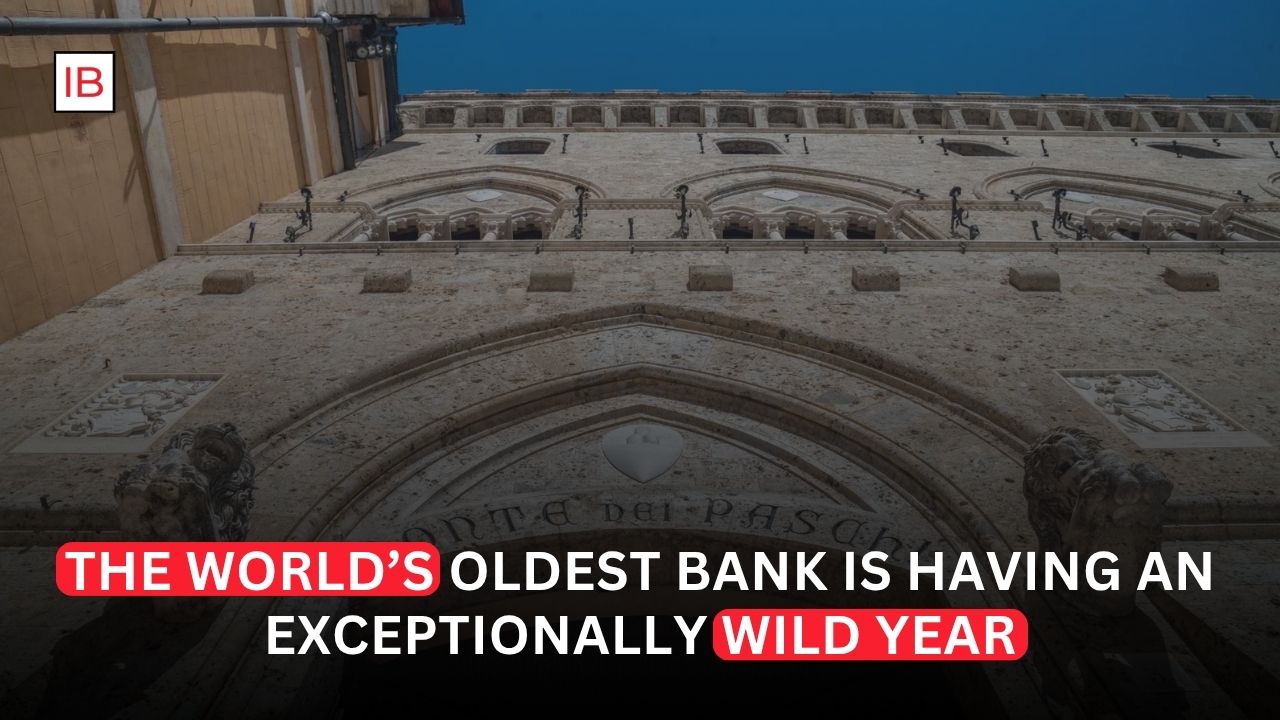
Monte dei Paschi Finds Itself at the Center of Italy’s Banking Battle
Few banks have experienced as much drama over centuries as Banca Monte dei Paschi di Siena, but 2026 is proving to be an extraordinary year even for the world’s oldest lender.
The Italian bank, founded in Siena in 1472, has moved from being a troubled institution rescued by the government to one of the central players in Italy’s latest banking consolidation battle. Its transformation has accelerated after the acquisition of Mediobanca and the return of Chief Executive Officer Luigi Lovaglio following an extraordinary shareholder dispute.
Now, MPS is attempting an even more ambitious expansion. On Aug. 21, the bank announced all-share offers for Banco BPM and Banca Generali, with proposed values of €25.3 billion and €8.7 billion respectively. The combined transactions would create a financial group worth roughly €70 billion and position MPS as a much larger competitor to Italy’s dominant banking institutions.
From Bailout Candidate to Banking Consolidator
The scale of MPS’s transformation is remarkable.
For years, the Siena-based bank was better known for its financial problems than its expansion ambitions. It accumulated huge losses and bad loans and eventually required a government bailout.
That history made the bank’s recent strategy particularly surprising.
Instead of remaining focused on repairing its balance sheet, MPS has emerged as an aggressive participant in Italy’s banking consolidation. Its acquisition of Mediobanca in 2025 gave the lender a major position in investment banking and wealth management and significantly changed its strategic importance.
The Mediobanca deal also increased MPS’s influence over Generali, one of Italy’s most important insurers. The combination brought MPS closer to the center of Italy’s complicated network of banks, insurers and powerful shareholders.
Lovaglio’s Return Added Another Twist
The bank’s transformation has not been smooth.
Earlier this year, MPS’s board moved against Lovaglio following disagreements over the bank’s future strategy and the integration of Mediobanca. The board voted in March to exclude him from its proposed list of candidates for another term.
But shareholders later overturned that decision.
In April, investors reinstated Lovaglio as CEO, ending a bitter boardroom dispute and giving him another opportunity to pursue his strategy. His return demonstrated the influence of major shareholders, particularly Delfin, the investment holding company associated with the Del Vecchio family.
The episode showed that MPS is no longer simply a bank trying to repair its finances.
It has become an important battleground in the future structure of Italian finance.
The Banco BPM and Banca Generali Gamble
The latest move takes that transformation to another level.
MPS is proposing to acquire Banco BPM and Banca Generali through all-share transactions. Banco BPM would be valued at approximately €25.3 billion, while Banca Generali would be valued at around €8.7 billion.
The objective is clear.
MPS wants to create a much larger Italian financial institution with businesses spanning traditional banking, investment banking and wealth management.
If successful, the combined group could have roughly €450 billion in assets and a market value approaching €70 billion. That would put it among Italy’s largest financial institutions and create a stronger competitor to Intesa Sanpaolo and UniCredit.
However, the plan faces significant obstacles.
MPS Is Also Fighting Off Intesa
The timing of the announcement is especially important because MPS itself is facing a takeover threat.
Intesa Sanpaolo, Italy’s largest bank, has launched a hostile takeover bid for MPS worth around €30.6 billion to €36 billion, depending on market valuations and the structure of the offer.
That means MPS’s latest acquisitions are not simply about growth.
They are also a defensive strategy.
By expanding rapidly and creating a larger banking group, Lovaglio is attempting to make MPS a more difficult target for Intesa.
A successful combination with Banco BPM and Banca Generali would dramatically increase the size of the business and could make an Intesa takeover more complicated.
The strategy effectively turns MPS from a potential acquisition target into an aspiring banking heavyweight.
Shareholders Will Determine the Outcome
The biggest challenge is securing shareholder support.
The proposed transactions require approval from investors, while the target companies have their own shareholders and strategic interests to consider.
Banco BPM presents a particularly difficult problem because its largest shareholder, Crédit Agricole, has substantial influence and previously opposed merger discussions involving MPS.
Banca Generali is also strategically sensitive because of its relationship with Assicurazioni Generali and the wider ownership structure surrounding Italian financial institutions.
This means that MPS’s strategy depends on much more than management’s ambitions.
It requires cooperation from powerful shareholders who may have very different objectives.
Italy’s Complicated Banking Power Structure
The situation illustrates why Italian banking consolidation can become so complicated.
Ownership stakes overlap between banks, insurers and investment groups.
Delfin, for example, holds a significant stake in MPS while also maintaining important interests elsewhere in Italian corporate life. Francesco Gaetano Caltagirone is another influential investor with positions across the country’s financial sector.
These relationships can make corporate decisions highly strategic.
A takeover of one bank can affect the ownership structure of an insurer.
An acquisition involving an investment bank can influence control over other companies.
As a result, MPS’s latest moves are not occurring in isolation.
They are part of a much larger contest over who will control Italy’s financial system.
The Mediobanca Deal Changed MPS
The acquisition of Mediobanca was the turning point.
Mediobanca brought MPS exposure to businesses that were very different from its traditional retail and commercial banking operations.
The combination created opportunities for wealth management, investment banking and insurance-related activities.
But it also created integration challenges.
Mediobanca had its own corporate culture, management structure and strategic priorities. Analysts had warned that differences between the two institutions could make the merger difficult and potentially reduce the benefits expected by MPS.
Lovaglio’s determination to continue with the integration was one reason his leadership became such an important issue during the boardroom dispute.
His supporters argued that continuity was necessary to complete the strategy.
His opponents questioned whether the expansion had become too ambitious.
A Remarkable Financial Turnaround
The most surprising aspect of MPS’s current position is how far the bank has traveled.
The institution spent years struggling with bad loans and capital problems.
Its earlier difficulties became so severe that the Italian government had to intervene.
Today, however, MPS is using its improved financial position to pursue acquisitions worth tens of billions of euros.
The transformation demonstrates how quickly a bank’s strategic position can change when profitability improves and investors regain confidence.
The bank’s experience also illustrates the wider recovery of Italy’s banking industry after years of restructuring.
The Government Still Has an Important Role
The Italian government remains an important part of the story.
Rome has gradually reduced its ownership of MPS after the bank’s bailout, but Italian authorities continue to have a strong interest in preserving a competitive domestic banking sector.
The government has historically supported consolidation that creates stronger Italian institutions capable of competing with larger European banks.
MPS’s latest strategy fits into that broader objective.
A successful expansion could create a major Italian banking group rather than allowing MPS to disappear into a larger foreign-controlled institution.
That political dimension could influence how regulators and shareholders approach the proposed transactions.
MPS Wants to Become Italy’s Third Banking Power
The ultimate goal is to create a financial group capable of standing alongside Italy’s biggest banks.
Intesa Sanpaolo and UniCredit dominate the country’s banking landscape, while MPS has historically occupied a much weaker position.
The proposed combination with Banco BPM and Banca Generali would change that.
The resulting institution would combine:
- Retail banking
- Corporate banking
- Investment banking
- Wealth management
- Asset management
- Insurance exposure
- A large domestic customer base
That diversification could make the new group more resilient and provide multiple sources of revenue.
But Bigger Does Not Automatically Mean Better
MPS still faces substantial execution risks.
Integrating multiple institutions can be expensive and complicated.
Different technology systems need to be combined.
Employees may face overlapping roles.
Branches may need to be rationalized.
Management structures must be unified.
And regulators must approve the transactions.
There is also the risk that MPS could become too focused on expansion at a time when it still needs to complete the integration of Mediobanca.
The bank therefore needs to prove that its aggressive strategy can generate shareholder value rather than simply creating a larger organization.
The Battle Could Reshape Italian Finance
The outcome of the current struggle could determine the structure of Italy’s banking sector for years.
If MPS successfully acquires Banco BPM and Banca Generali, it could become a formidable third force in Italian finance.
If the deals fail, Intesa could have a clearer path toward acquiring MPS.
The outcome will also affect UniCredit, Crédit Agricole, Generali and several major Italian investors.
That is why MPS’s current year has become so extraordinary.
The bank is simultaneously defending itself against a takeover, integrating a major acquisition, managing internal political battles and launching new takeover bids.
Looking Ahead
The story of Monte dei Paschi in 2026 is almost impossible to separate from the wider transformation of Italian banking.
The world’s oldest bank has gone from being a government-backed rescue case to an aggressive consolidator seeking to build a financial group worth around €70 billion. Its latest strategy involves proposed acquisitions of Banco BPM and Banca Generali worth a combined €34 billion.
At the same time, MPS is trying to defend itself against Intesa Sanpaolo’s takeover attempt.
The return of Luigi Lovaglio has given the bank a leader committed to the expansion strategy, but success will depend on winning support from shareholders, regulators and the companies it wants to acquire.
The coming months could therefore be decisive.
MPS shareholders are expected to vote on the proposals later this year, with completion targeted for early 2027 if the transactions receive the necessary approvals.
For a bank founded more than five centuries ago, another period of upheaval may seem almost ordinary.
But even by Monte dei Paschi’s extraordinary standards, 2026 is shaping up to be one of the most consequential years in its history.