If you’re new to trading, the first real decision you’ll make isn’t which stock to buy or which currency pair to trade — it’s which kind of broker you actually need. The forex broker vs stock broker question trips up a lot of beginners because both types of brokers look similar on the surface: sign up, deposit money, place trades. But underneath, a forex broker and a stock broker operate in genuinely different worlds, with different hours, different risk profiles, and different regulatory rules. Understanding those differences before you open an account will save you a lot of confusion later.
What Each Broker Actually Connects You To
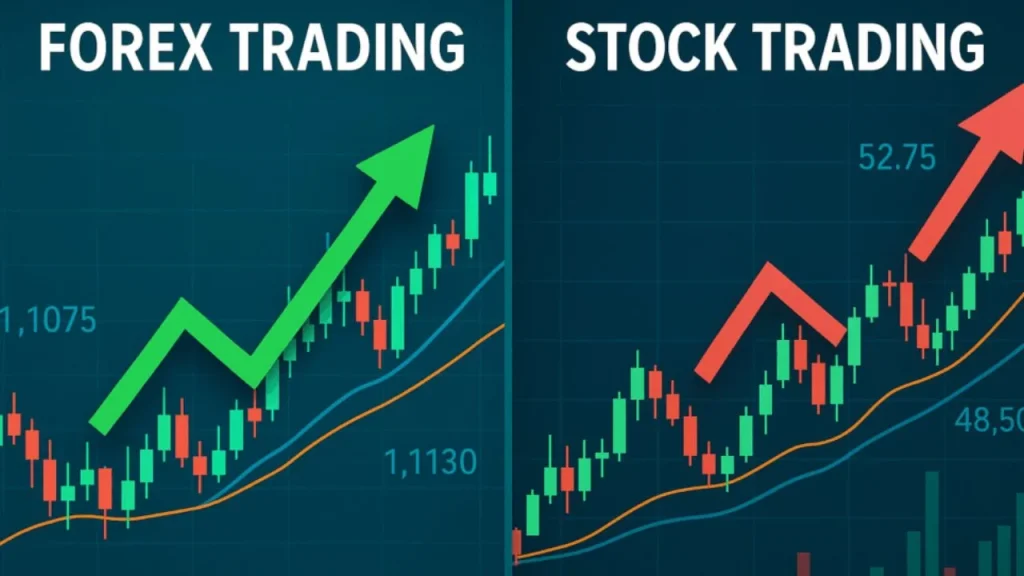
A forex broker gives you access to the foreign exchange market, where you’re always trading one currency against another — EUR/USD, GBP/JPY, USD/CAD, and so on. There’s no single “forex exchange” the way there’s a New York Stock Exchange; it’s a decentralized, global network of banks, institutions, and brokers all quoting prices electronically. A stock broker, by contrast, connects you to centralized exchanges like the NYSE or Nasdaq, where you’re buying actual shares — small pieces of ownership in a real company. This is the most fundamental difference in the forex broker vs stock broker comparison: one gets you exposure to currency values moving against each other, the other gets you partial ownership in businesses.
Trading Hours: Nonstop vs. Fixed Sessions
This is often the first thing that surprises new traders. A forex broker lets you trade 24 hours a day, five days a week, as the market rolls from the Sydney session to Tokyo, then London, then New York. A stock broker, on the other hand, ties you to the fixed hours of whichever exchange your stock is listed on — typically 9:30 a.m. to 4 p.m. Eastern Time for US markets, with limited and thinner pre-market or after-hours sessions available at some brokers. If your schedule doesn’t allow for trading during standard business hours, this alone might tilt your decision in the forex broker vs stock broker debate.
Liquidity and Market Size
The forex market is the largest financial market in the world, handling around $9.6 trillion in daily trading volume. That scale means major currency pairs are almost always highly liquid, so a forex broker can typically get you in and out of positions quickly with minimal slippage. Stock liquidity is far more uneven — a stock broker trading Apple or Microsoft shares will see plenty of liquidity, but move into small-cap or thinly traded stocks and that liquidity drops off fast, sometimes making it harder to exit a position at the price you expect.
Leverage: Where the Risk Really Diverges
This is arguably the sharpest contrast in the forex broker vs stock broker relationship. A forex broker commonly offers leverage of 30:1 in the UK and EU, and up to 50:1 in the US, meaning you can control a $50,000 position with just $1,000 of your own capital. Some offshore forex brokers push this even further, into the hundreds or thousands to one. A stock broker, meanwhile, typically limits margin accounts to around 2:1 leverage for retail clients under frameworks like US Regulation T — a cash account offers no leverage at all. That gap matters enormously: higher leverage through a forex broker can amplify gains, but it can just as easily wipe out an account far faster than stock trading typically would.
How Each Broker Makes Money From You
A forex broker usually earns its revenue through the spread — the small gap between the buy and sell price of a currency pair — rather than a flat commission, though commission-based “raw” accounts are common among more active traders. Overnight positions may also incur swap or financing charges. A stock broker’s revenue model has shifted a lot over the past decade too; commission-free stock trading is now standard at most platforms, with brokers instead making money through payment for order flow, interest on uninvested cash, and fees on specialized products like options. Neither type of broker is “free” — the cost is just structured differently depending on whether you’re working with a forex broker or a stock broker.
Regulation: A Decentralized Market vs. a Centralized One
Because currency trading happens over the counter with no single exchange, the protection you get from a forex broker depends heavily on which regulator actually oversees your specific account entity. Reputable forex brokers are supervised by authorities like the FCA, CFTC/NFA, or ASIC, but plenty of forex brokers operate under lighter offshore regulation, and the difference in protection between those two categories is substantial. A stock broker, by comparison, generally operates in a more standardized regulatory environment — publicly listed companies face strict disclosure and reporting requirements, and stock exchanges themselves enforce transparency rules under national regulators like the SEC. If regulatory certainty matters a lot to you, the forex broker vs stock broker landscape isn’t equally reassuring on both sides.
Which Type of Trader Each Broker Tends to Attract
A stock broker tends to appeal to people building longer-term, diversified portfolios — buying shares, ETFs, bonds, or mutual funds with the expectation of holding for months or years. A forex broker tends to attract traders looking for shorter time horizons: day trades, swing trades, and fast reactions to economic data, central bank announcements, or geopolitical events. Neither approach is inherently better; a forex broker suits an active, hands-on trading style, while a stock broker suits investors who prefer a steadier, longer-term approach to building wealth.
The Bottom Line
The forex broker vs stock broker decision really comes down to what kind of market participant you want to be. If you’re drawn to round-the-clock access, high liquidity, and the ability to use significant leverage on short-term trades, a forex broker fits that style. If you’d rather own a piece of real companies, trade within predictable hours, and build a portfolio gradually over time, a stock broker is the better fit. Many traders eventually use both — a stock broker for long-term investing and a forex broker for active, short-term trading — but understanding how differently these two types of brokers actually operate is the first step to choosing the right one for your goals.