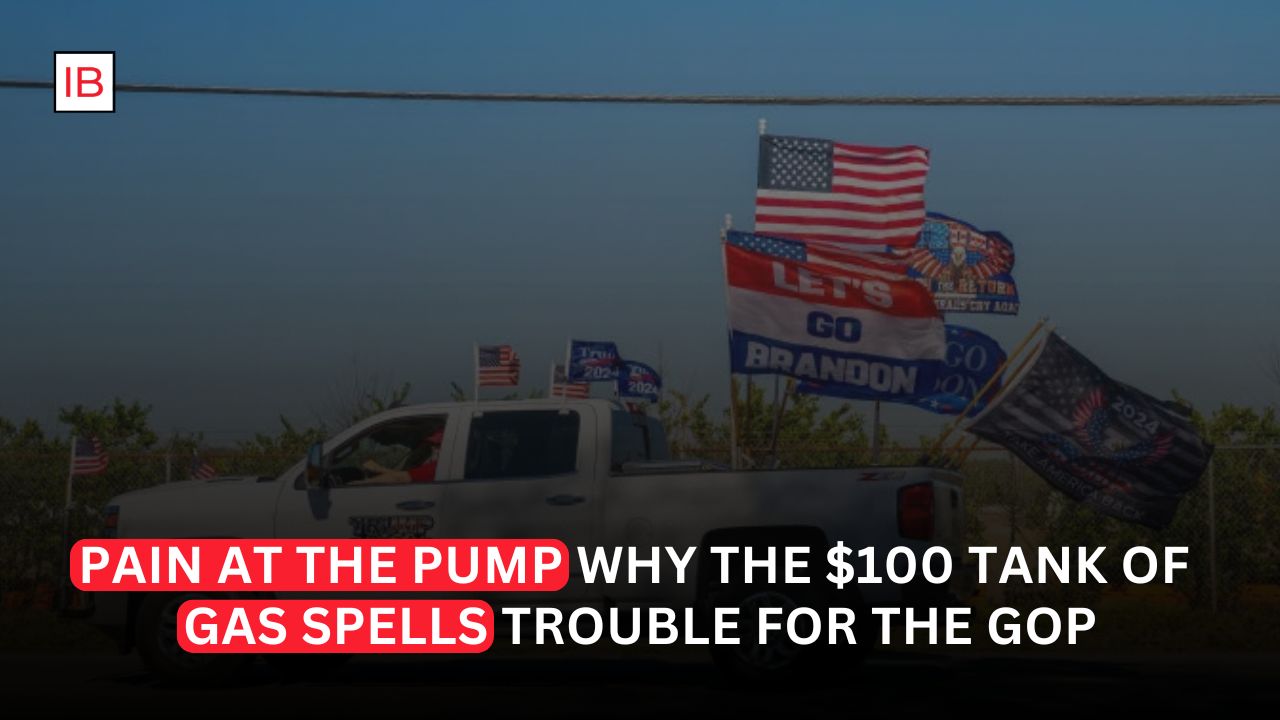
High gasoline prices are becoming more than an economic headache for American drivers. They are becoming a political liability for Republicans, particularly because some of the voters most exposed to fuel costs overlap with the party’s traditional base.
Pickup-truck owners are an obvious example.
Large trucks are deeply embedded in rural and suburban America, where drivers often travel longer distances and rely more heavily on gasoline-powered vehicles. When fuel prices rise sharply, the impact isn’t abstract: it shows up directly every time the tank is filled.
That makes gasoline unusually powerful as a political issue.
Pickup Drivers Feel the Shock Faster
The economics are straightforward.
A large pickup truck can have a fuel tank substantially bigger than that of a typical sedan. When gasoline prices rise, the cost of every fill-up increases accordingly.
A US Senate Joint Economic Committee analysis found that filling an F-150 cost about $147 in April 2026, roughly $39 more than at the start of the Iran-related oil shock.
That matters because pickup owners often drive more miles than the average commuter.
For contractors, farmers, tradespeople and small-business owners, fuel isn’t simply a household expense. It can be a business expense.
Higher gasoline prices can therefore squeeze both disposable income and operating margins.
This Creates a Political Problem for Republicans
The Republican Party has spent years building a political coalition around voters who tend to be more dependent on gasoline-powered vehicles.
That includes rural voters, suburban families, small-business owners, construction workers, farmers and pickup-truck owners.
These voters have also historically been more receptive to Republican arguments about energy production and lower fuel costs.
That creates a difficult political contradiction.
If gasoline prices rise substantially under a Republican administration, voters don’t necessarily care why the price increased.
They care about what they pay at the pump.
Recent polling already shows that gas affordability is politically sensitive. A Data for Progress survey found that 69% of Americans said gas had become harder to afford, including 58% of Republicans.
That doesn’t automatically mean those voters will switch parties.
But it does mean the issue can weaken Republican enthusiasm and create openings for Democrats.
The Iran War Makes the Problem Worse
The current fuel shock has been closely connected to the conflict involving Iran and disruptions in global oil markets.
That makes the politics particularly uncomfortable for President Donald Trump and Republicans.
Trump has historically emphasized American energy production and promised voters lower costs.
But oil is traded in a global market.
Even if US production increases, a major disruption in the Middle East can still push global crude prices higher.
Gasoline prices then respond.
This is one reason political promises to “bring down gas prices” are easier to make than to guarantee.
The Pickup Truck Is a Political Symbol
The problem goes beyond arithmetic.
The pickup truck has become closely associated with American working-class and conservative identity.
It represents work, independence, rural life and personal mobility.
That makes the cost of operating one politically meaningful.
A driver who pays an additional $30 or $40 every time they fill the tank doesn’t necessarily think about Brent crude, refinery margins or shipping disruptions.
They see a higher number on the gas pump.
That can translate into a broader perception that the economy is becoming more expensive.
Republicans Have an Awkward Energy Message
The GOP’s traditional energy position has been relatively simple: increase domestic oil and gas production, reduce regulation and make American energy more abundant.
There is a strong economic argument behind parts of that strategy.
More domestic production can improve energy security and reduce exposure to foreign supply disruptions.
But it cannot completely insulate the US from global oil prices.
The US is part of a global petroleum market.
If international crude prices rise sharply, domestic gasoline prices can rise as well.
That means politicians have limited control over the final price consumers see at the pump.
EVs Don’t Solve the Immediate Political Problem
One potential Republican response would be to accelerate the transition toward more fuel-efficient vehicles and electric vehicles.
But that creates another political complication.
Many Republican voters remain skeptical of government-led EV mandates and policies designed to discourage gasoline vehicles.
And replacing a large pickup truck isn’t cheap.
For a rural worker or contractor, an EV may not currently provide the same combination of towing capacity, range, charging availability and convenience.
So telling high-mileage pickup owners to simply buy a different vehicle isn’t a realistic short-term political solution.
Democrats Can Exploit the Pain — But Shouldn’t Overestimate It
Democrats have an obvious opportunity.
They can argue that Republicans promised cheaper energy but voters are still paying more.
That message is simple enough to work in campaign advertising.
But there is a major limitation.
Gas prices are volatile and voters understand, at least to some degree, that presidents don’t directly control crude oil prices.
If Republicans can convincingly blame the price spike on geopolitical disruptions, the political damage could be limited.
And if gasoline prices fall before the November elections, the issue could quickly lose importance.
The Bigger Problem Is Cost of Living
Gasoline is rarely just about gasoline.
Higher fuel costs affect transportation, trucking, agriculture and manufacturing.
Businesses eventually pass some of those costs through to consumers.
That means an oil shock can spread into food prices, shipping costs and household expenses.
US truckers, for example, have already faced sharply higher diesel costs during the Middle East conflict, putting pressure on freight operators and threatening to push transportation costs higher.
That is where the political risk becomes more serious.
Voters may tolerate one expensive fill-up.
They become much less tolerant if everything around them starts getting more expensive.
Rural Voters Are Not Automatically Locked In
Another weak assumption would be that pickup-truck owners will vote Republican regardless of economic conditions.
Political loyalty is strong, but it isn’t unlimited.
Historical research suggests gasoline prices can influence political attitudes, with Republican identifiers often reporting greater sensitivity to fuel costs.
That doesn’t mean high gas prices automatically produce Democratic votes.
More likely, they can influence turnout, enthusiasm and perceptions of economic competence.
A voter who normally votes Republican may still vote Republican while becoming less enthusiastic about the party.
In a close election, that distinction matters.
What Republicans Need to Watch
Gasoline prices: The most obvious indicator.
Diesel prices: Particularly important for trucking, agriculture and construction.
Oil prices: A renewed Middle East shock could quickly reverse any improvement.
Consumer confidence: Persistent inflation can amplify political frustration.
Rural sentiment: Pickup-heavy communities could become an important political pressure point.
Campaign messaging: Both parties will likely try to assign blame for fuel costs.
The Bottom Line
High gas prices are not automatically a Republican electoral disaster.
That claim would go too far.
But they create a particularly uncomfortable political problem because the voters who feel the pain most directly include many of the people Republicans depend on most heavily.
A pickup-truck driver doesn’t need to follow energy markets to understand the problem.
They just need to look at the receipt.
And if that receipt remains painfully high heading into the 2026 midterms, Republicans could discover that their strongest cultural and political base is also among the voters with the most immediate economic exposure to America’s gasoline problem.